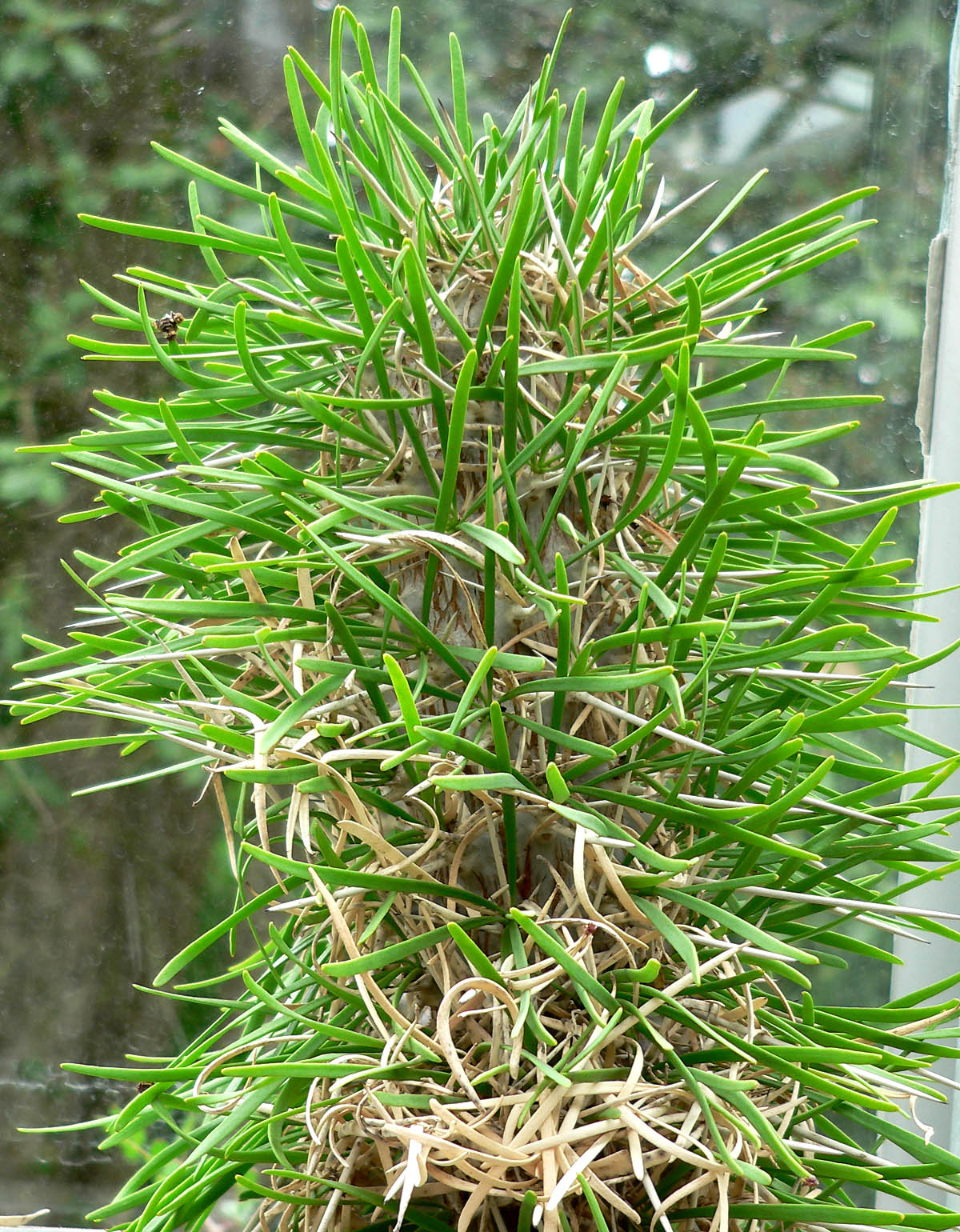
Didierea is a small genus of two species of spiny succulent plants in the family Didiereaceae, order Caryophyllales. Both species — Didierea madagascariensis and Didierea trollii — are endemic to the island of Madagascar, where they are confined to the distinctive spiny thicket (spiny forest) vegetation of the arid to semi-arid southwest.
The genus belongs to the subfamily Didiereoideae, a group of spiny succulent shrubs and trees reaching 2–20 metres in height. Like their relatives in the family, Didierea plants have thick, water-storing stems and carry two kinds of shoots: long-shoots whose leaves are quickly shed, and brachyblasts (short-shoots) in the leaf axils that bear small leaves in pairs alongside conical spines — a structure convergently similar to the areoles of cacti. All species are dioecious, meaning male and female flowers are borne on separate individual plants.
Didiereaceae is closely allied to the New World family Cactaceae; species of the two families can even be grafted onto one another, reflecting their shared evolutionary response to extreme aridity. Didierea was described by the French botanist Henri Baillon in 1880 and named in honour of the naturalist Alfred Grandidier (1836–1921), who documented much of Madagascar's flora and fauna.
Because of their restricted range and the continuing loss of spiny-thicket habitat, both species are listed in CITES Appendix II, which regulates international trade to protect wild populations.
Etymology
The genus Didierea was named by the French botanist Henri Baillon in 1880 in honour of Alfred Grandidier (1836–1921), a French naturalist and explorer who produced foundational studies of Madagascar's natural history.
Distribution
Both species of Didierea are endemic to Madagascar, restricted to the spiny thicket (spiny forest) biome of the dry southwestern region of the island. This habitat is characterised by extreme seasonal drought, and the plants are adapted to it with water-storing stems and drought-deciduous leaves.
Ecology
Didierea species grow in sub-arid to arid conditions in southwestern Madagascar's spiny thicket, an ecosystem dominated by drought-adapted succulent plants. Their brachyblast short-shoots bear conical spines and small deciduous leaves; water is stored in the thick stems. Plants start as small procumbent shrubs, eventually producing a dominant trunk that branches into a crown as lower branches die off. The genus is dioecious — individual plants are either male or female — and flowers develop in branched clusters from the brachyblasts.
Taxonomy Notes
Didierea was described by Henri Baillon in 1880 (published as Didierea Baill.). It belongs to the subfamily Didiereoideae within Didiereaceae — a subfamily endemic to Madagascar and comprising four genera: Alluaudia, Alluaudiopsis, Decarya, and Didierea. Didiereaceae is placed in the order Caryophyllales and is notably close to Cactaceae; the two families share convergent structural adaptations to aridity and are interfertile for grafting purposes. Some former members of Didierea have been moved to other genera in the family.
Conservation
Both Didierea madagascariensis and Didierea trollii are listed in CITES Appendix II. This designation restricts international commercial trade in these plants and their parts to levels that do not threaten wild populations, reflecting concern about habitat loss in Madagascar's spiny thicket.

