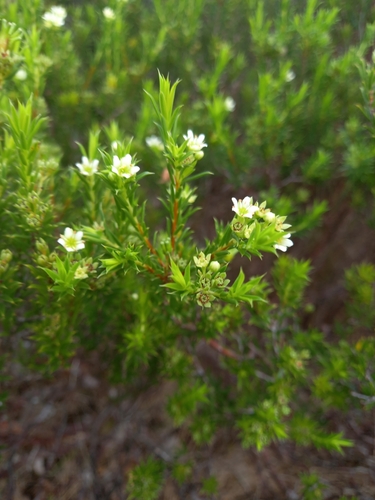
Diosma is a genus of small, aromatic shrubs in the family Rutaceae (subfamily Zanthoxyloideae), belonging to the order Sapindales. The genus was formally established by Carl Linnaeus in 1753 in his Species Plantarum, where he placed several fragrant Cape shrubs under the name Diosma. All accepted species are endemic to the Cape Provinces of South Africa, a region of exceptional plant diversity that forms part of the Cape Floristic Region.
Plants of the genus Diosma are characterised by small, needle-like or heath-like leaves that are strongly aromatic when crushed, a feature reflected in the genus name. The flowers are typically small, white or pale pink, and borne in clusters; the plants superficially resemble heathers (Erica) in habit and habitat. Diosma species grow in the fynbos biome — the fire-prone, nutrient-poor shrubland of the South African Cape — alongside other members of the Rutaceae.
The genus is sometimes confused with the closely related Coleonema, whose species are widely cultivated as garden ornamentals in Australia and elsewhere under the common name "diosma." True Diosma comprises around two dozen accepted species, the most frequently encountered being D. hirsuta and D. oppositifolia, both described by Linnaeus. Several additional species were described later by authors including Bartling, Wendland, Sprengel, and I. Williams.
Etymology
The name Diosma derives from the Greek words dios (divine, of Zeus) and osmē (scent, smell), alluding to the strongly fragrant foliage that characterises the genus. Linnaeus coined the name in 1753 in Species Plantarum.
Distribution
All species of Diosma are endemic to the Cape Provinces of South Africa, primarily within the Cape Floristic Region. iNaturalist observations confirm the highest species density and observation counts in the Western Cape, including the Overberg, Garden Route, and surrounding fynbos zones.
Ecology
Diosma species are components of the fynbos biome, the fire-prone, nutrient-poor shrubland endemic to the South African Cape. Like many fynbos plants, they are adapted to periodic fire and poor, acidic, well-drained soils. Their aromatic foliage is thought to play a role in deterring herbivory.

