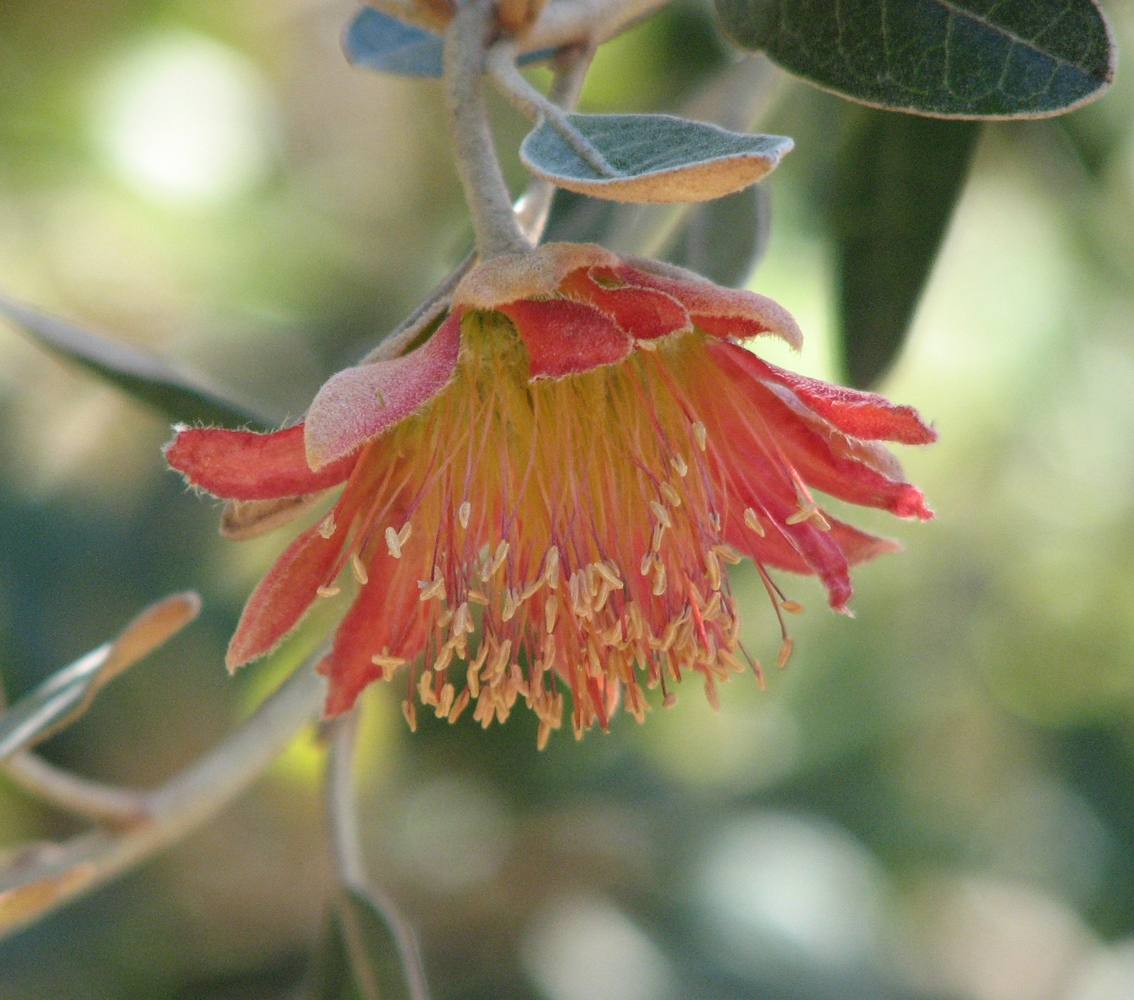
Diplolaena is a genus of evergreen shrubs in the family Rutaceae (the citrus and rue family), within the order Sapindales. The genus was described by the Scottish botanist Robert Brown (R.Br.) in 1814, published in Matthew Flinders' Voyage to Terra Australis. All species are endemic to Western Australia, making Diplolaena one of the many floristic elements that distinguish the Southwest Australian Floristic Region, one of the world's recognised biodiversity hotspots.
The genus comprises roughly a dozen species of small to medium-sized shrubs with ornamental flowerheads. The flowers are typically surrounded by colourful involucral bracts and are pollinated by birds and insects, a feature shared with other members of the family adapted to nutrient-poor Australian soils. Several species are known by common names reflecting their rose-like appearance in the field: Diplolaena angustifolia is called the Yanchep rose, and Diplolaena grandiflora is known as the wild rose of Western Australia.
Within the broader Rutaceae family, Diplolaena is notable as a purely Australian endemic genus, in contrast to many relatives with pantropical or Old World distributions. The genus name refers to a morphological character of the involucre or calyx, from the Greek diploos (double) and chlaena (cloak or mantle), alluding to the two-layered whorl of bracts enclosing the flowerheads. Species are distributed primarily across the southwest and midwest coastal regions of Western Australia, with individual species occupying specific soil and habitat types ranging from granite outcrops to sandy coastal scrublands.
Etymology
The name Diplolaena derives from the Greek diploos (double) and chlaena (cloak or mantle), referring to the distinctive double whorl of involucral bracts that surrounds the flowerheads. The genus was formally described by Robert Brown in 1814 in his account of plants collected during Matthew Flinders' circumnavigation of Australia.
Distribution
All known species of Diplolaena are endemic to Western Australia, with the majority occurring in the Southwest Botanical Province and the Geraldton Sandplains region. Individual species occupy narrow ecological ranges, including coastal heathlands, granite outcrops, and sandplain shrublands characteristic of the Southwest Australian Floristic Region.
Taxonomy Notes
The genus Diplolaena R.Br. was published in 1814 in Flinders' Voyage to Terra Australis (vol. ii, p. 546). It is placed in the family Rutaceae, order Sapindales. GBIF accepts the genus under Checklist Bank with authorship R.Br. and records between 6 and 19 species depending on the checklist source, reflecting ongoing taxonomic revisions primarily by Paul G. Wilson, who described most extant species.

