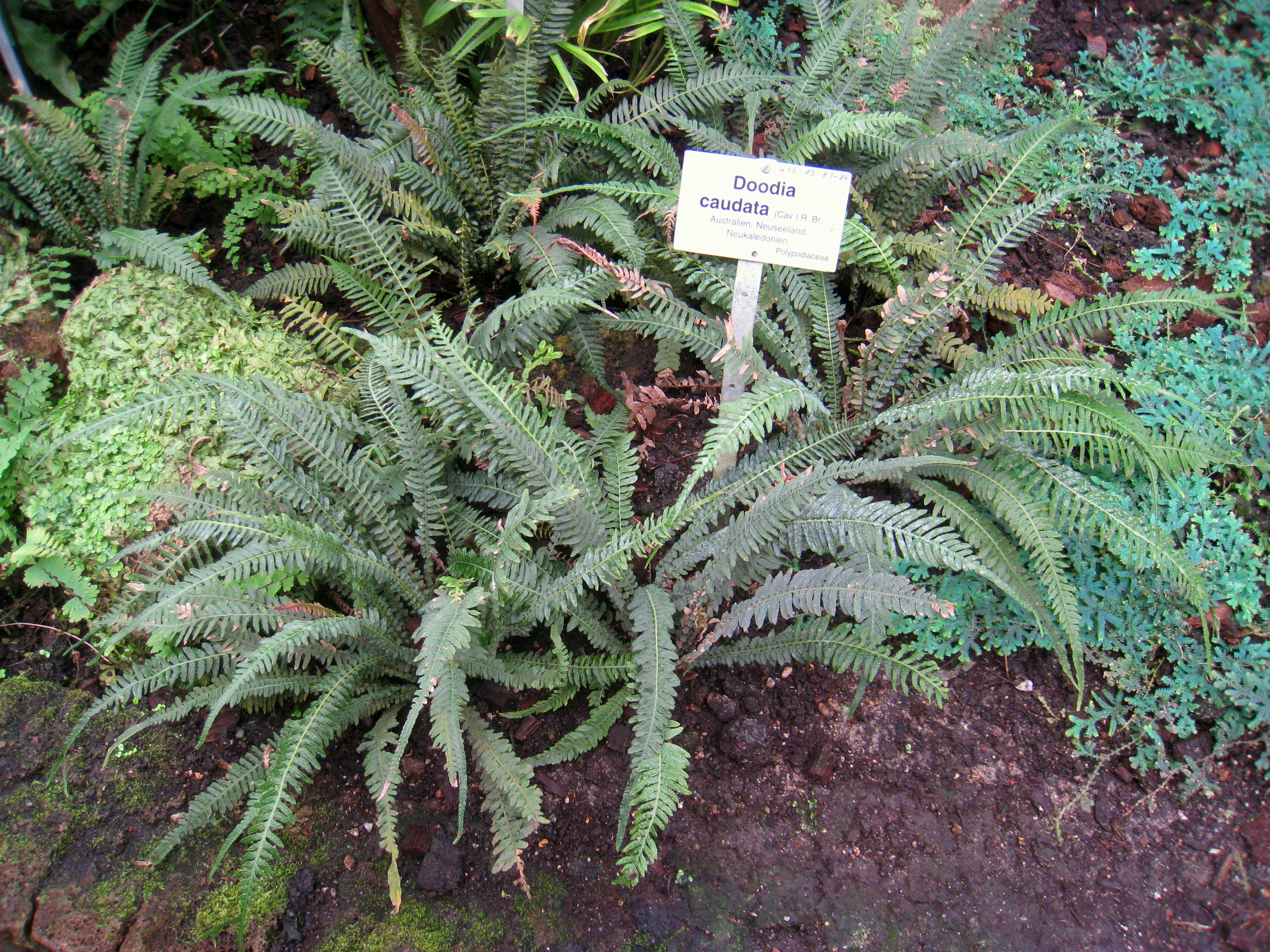
Doodia is a genus of terrestrial ferns in the family Blechnaceae (subfamily Blechnoideae), placed in the order Polypodiales. The genus ranges across Australia, New Zealand, and more broadly from Asia to Australasia and the Hawaiian Islands, encompassing more than 30 species, of which 8 occur in Australia (4 endemic).
Plants are terrestrial and reproduce vegetatively by stolons. The rhizome is black and short-creeping, with an erect tufted portion covered in small dark scales and numerous wiry roots. Fronds are 1-pinnatisect or 1-pinnate and may be all alike or dimorphic; fertile fronds tend to be erect with narrower, more widely spaced pinnae compared to the often prostrate sterile fronds. The lamina is scabrous and ranges from membranous to leathery, with segments that frequently bear a prickly, toothed margin. Veins are mostly anastomosing, at least in fertile fronds. Sori are discrete but often become confluent with age, arranged in 2–4 rows parallel with the main vein of each segment; an indusium is present and opens towards the vein.
The taxonomic circumscription of Doodia has been debated. Phylogenetic work showed the genus to be embedded within a paraphyletic Blechnum, leading Christenhusz et al. (2011) to synonymise Doodia into Blechnum. The Pteridophyte Phylogeny Group classification of 2016 (PPG I) instead opted to split Blechnum into several smaller genera, reinstating Doodia as a distinct genus — the treatment followed by many current authorities.
Etymology
The genus name Doodia honours Samuel Doody (1656–1706), an English apothecary and botanist who served as keeper of the Chelsea Physic Garden.
Distribution
Doodia occurs across Australia, New Zealand, and extends from Asia through Australasia to the Hawaiian Islands. In Australia, 8 species are recognised (4 endemic), distributed across Queensland, New South Wales, Victoria, Tasmania, and South Australia.
Taxonomy Notes
Doodia's placement has been contested: molecular phylogenies show it is embedded within Blechnum as traditionally circumscribed, making Blechnum paraphyletic. Christenhusz et al. (2011) responded by sinking all Doodia species into Blechnum. The alternative, adopted by PPG I (2016), is to break the broadly defined Blechnum into multiple smaller monophyletic genera and to retain Doodia as one of them. Both treatments remain in use.










