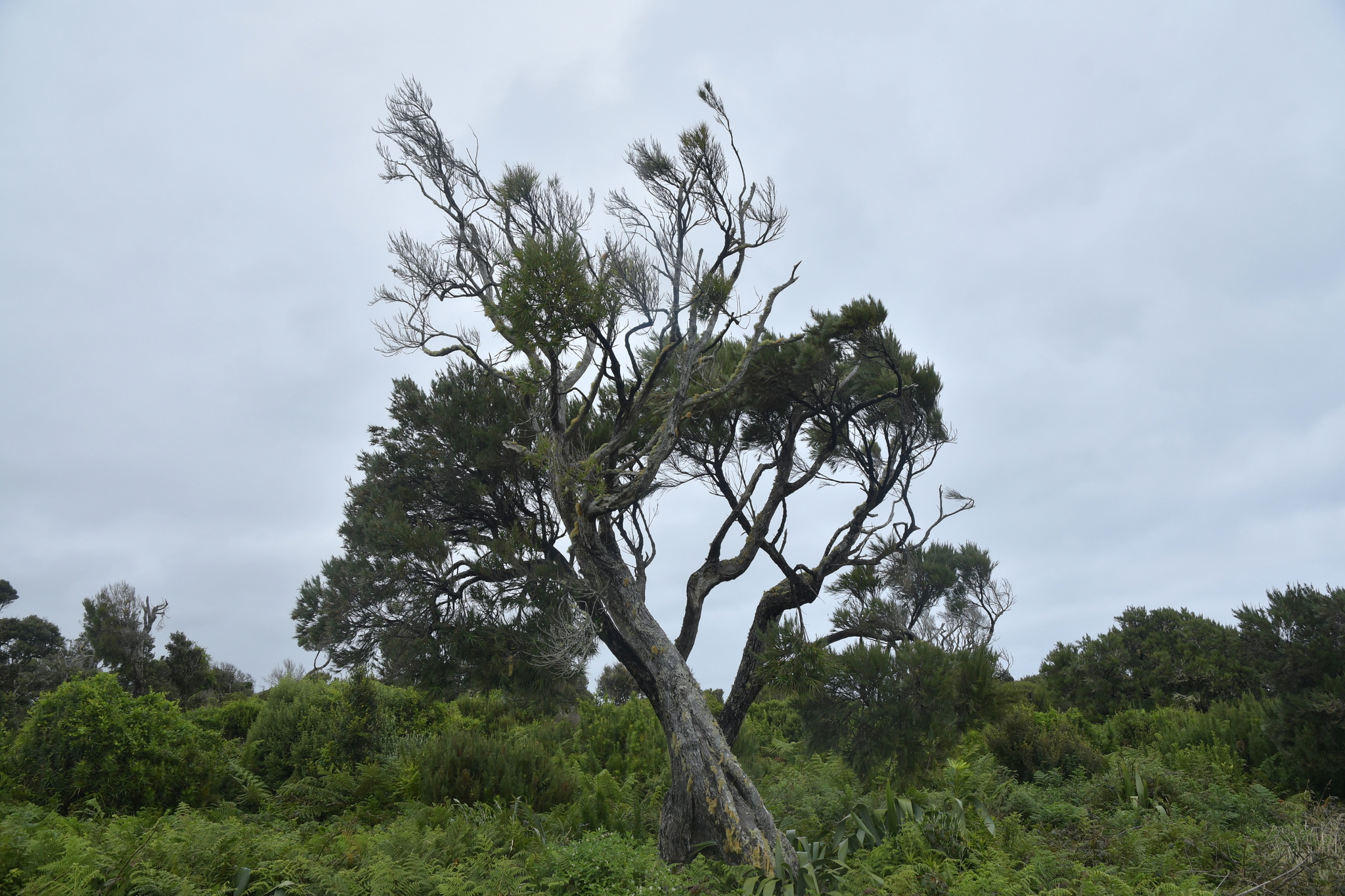
Dracophyllum is a genus of approximately 61 flowering plant species in the family Ericaceae, order Ericales. Ranging from low cushion plants barely 1 cm tall (D. minimum) to trees reaching 12 m (D. longifolium), the genus displays remarkable growth-form diversity. Although the plants are dicotyledonous, their slender, grass-like leaves clustered at branch tips lend them a superficial resemblance to primitive monocots, which has earned them the English common names "grass trees" and, for some species, "pineapple trees."
Leaves are simple, linear, and finely toothed along the margins; their bases form a tightly appressed sheath that leaves a characteristic linear scar when the leaf falls. Flowers are five-parted and may be arranged in panicles, racemes, spikes, or borne singly. The genus was formally described by the French botanist Labillardière in 1798 and belongs to subfamily Epacridoideae, tribe Richeeae. Taxonomists have traditionally recognised three subgenera: Dracophyllum (about 20 species), Cordophyllum (1 species), and Oreothamnus (about 29 species).
The genus is centred on New Zealand, which holds approximately 35 endemic species, but also extends to Australia (particularly Tasmania and Victoria), Lord Howe Island, and New Caledonia. In Australia, Dracophyllum is closely allied to the related endemic genera Richea and Sphenotoma, though Tasmanian Richea is sometimes treated as distinct. The Māori name neinei is widely used for New Zealand species and has cognates in Rarotongan.
Etymology
The genus name Dracophyllum is derived from Latin draco (dragon) and Greek phyllon (leaf), meaning "dragon leaf." This name alludes to the foliage's visual resemblance to that of the Canary Islands dragon tree (Dracaena draco). The Māori name neinei is the traditional New Zealand vernacular for the genus, with cognate forms occurring in Rarotongan. English common names reflect the plant's unusual appearance: "grass tree" (for the grass-like foliage), "pineapple tree" (for the rosette growth form of some species), "kerosene wood," "spiderwood," and colloquially the "Dr. Seuss tree" for its fantastical silhouette.
Distribution
Dracophyllum reaches its greatest species diversity in New Zealand, where approximately 35 species are endemic. The genus also occurs in eastern Australia (particularly Tasmania and Victoria), Lord Howe Island, and New Caledonia, giving it a broadly south-western Pacific and Australasian distribution. Australian species include D. fitzgeraldii, D. gunnii, D. milliganii, D. minimum, D. pandanifolium, D. procerum, D. sayeri, D. secundum, D. sprengelioides, D. tasmanicum, and D. victorianum. The genus is thought to have Australasian origins and is closely related to the Australian endemic genera Richea and Sphenotoma, which together form a coherent clade within tribe Richeeae.
Ecology
Dracophyllum species occupy a wide range of habitats across their Australasian range, from lowland shrublands to subalpine and alpine zones. The genus includes some of the most architecturally distinctive shrubs in New Zealand's high-country and montane landscapes. Growth forms range from minute cushion plants (e.g., D. minimum, D. muscoides) to large trees (e.g., D. longifolium, D. arboreum). Specific species show habitat specialisation: D. ophioliticum (asbestos inaka) is associated with ultramafic soils, while D. palustre (swamp neinei) grows in wetland habitats. The genus is an important component of New Zealand tussock grassland and sub-alpine shrubland communities.
Taxonomy
Dracophyllum was described by Jacques Labillardière and published in 1798 (per GBIF and most secondary sources; some authorities cite 1800, reflecting the later voyage account). The genus belongs to family Ericaceae, subfamily Epacridoideae, tribe Richeeae, order Ericales. Three subgenera are traditionally recognised: Dracophyllum (c. 20 spp.), Cordophyllum (1 sp.), and Oreothamnus (c. 29 spp.). The type species is Dracophyllum verticillatum Labill. Recorded synonyms include Cyrtanthe, Cystenthe, Dacryanthus, Pilitis, Richea, and Cystanthe; Tasmanian Richea is sometimes treated as a distinct genus. GBIF records 81 descendant taxa, of which the majority are accepted (GBIF usage key 7288478).
Cultural uses
In traditional Māori culture, the wood of Dracophyllum was valued for making walking sticks and staffs, crafted by tohunga (expert craftspeople). The Māori name neinei is in common use for New Zealand members of the genus and has related forms in Rarotongan, suggesting wider Polynesian familiarity with the plants. The colloquial English name "Dr. Seuss tree" reflects the visually striking, fantastical appearance of larger species.

