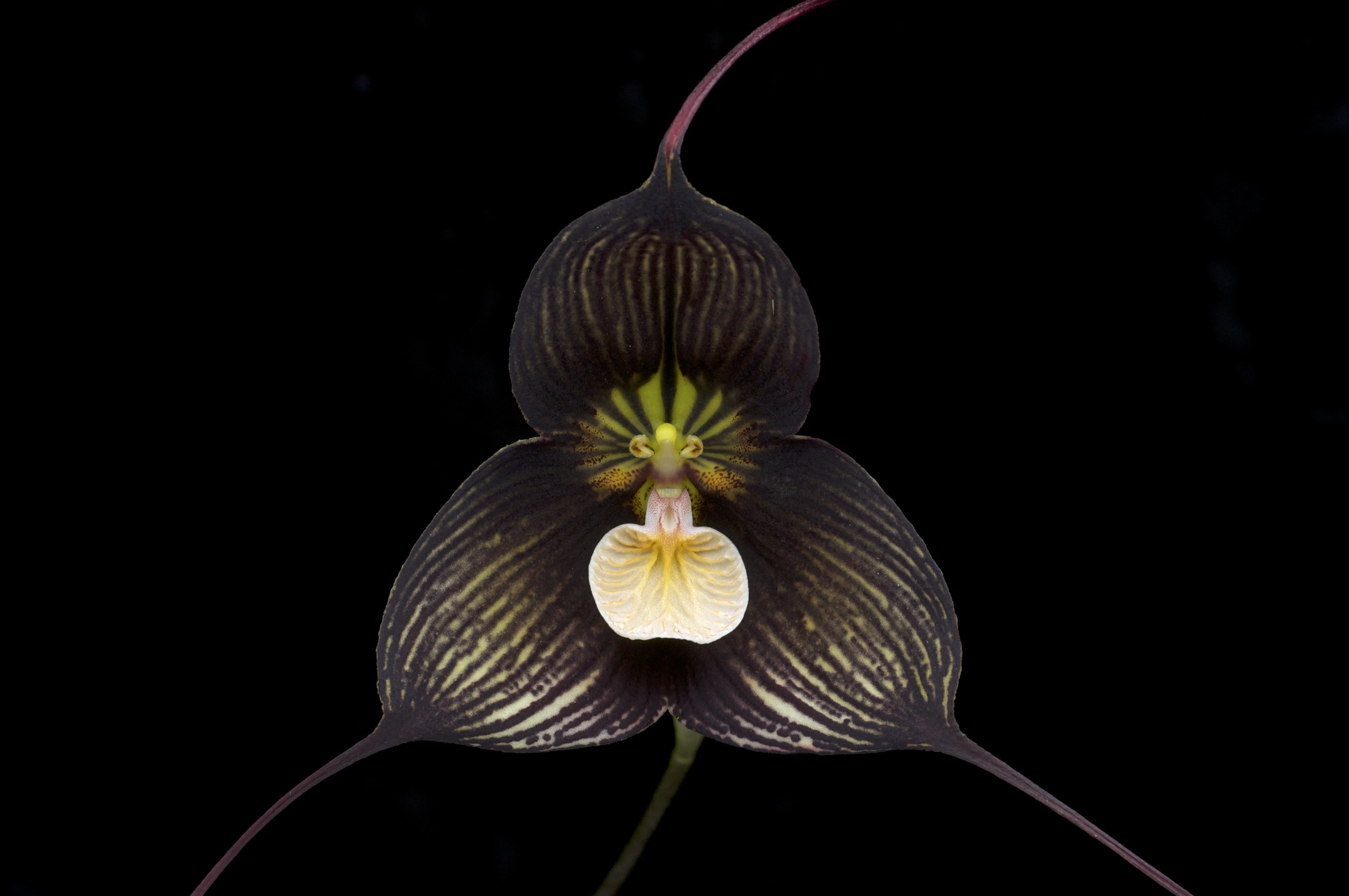
Dracula is a genus of roughly 118 species of orchids in the family Orchidaceae (order Asparagales), concentrated in the cloud forests of Ecuador, Colombia, and neighboring parts of Central America and Peru, with a small presence in southern Mexico. The genus is abbreviated Drac in the horticultural trade.
Plants in this genus are epiphytic or terrestrial and grow in caespitose tufts from a short rhizome. Unlike many orchid genera, Dracula species lack pseudobulbs entirely; their large, thin, plicate leaves — each with a sharply defined midrib and a small terminal mucro — take on a spongy character to compensate for the missing water-storage organ. Stems are slender and densely packed.
The flowers are among the most striking in the orchid family. Each stem produces a single stalk that grows horizontally or pendulously from the plant's base, sometimes descending for a considerable distance. Flowers are borne singly or successively and are fundamentally triangular in outline, defined by three sepals that extend into long, whip-like tails. The petals are small and thickened; the lip is large relative to the rest of the flower, with a cleft basal section (hypochile) and a rounded, concave terminal section (epichile). Many species produce blooms whose arrangement of petals, lip, and sepal tails creates a striking resemblance to the face of a primate — a likeness most famous in Dracula simia, commonly called the monkey-face orchid. Research suggests this resemblance is incidental; the flowers are actually pollinated by fungus gnats, which are drawn to the lip's visual and chemical mimicry of mushrooms. Dracula lafleurii, for instance, has been shown to produce volatile compounds chemically similar to locally occurring fungi.
The genus was segregated from Masdevallia in 1978 and placed in the subtribe Pleurothallidinae. Species are tentatively organized into three subgenera — Dracula, Sodiroa, and Xenosia — with further sections and subsections within the largest subgenus. Almost half of all known species occur in Ecuador, where the cool, humid montane forests provide the shade and stable temperatures these orchids require.
Etymology
The genus name Dracula is Latin for "little dragon," applied by taxonomists in reference to both the blood-red coloration of several species and the long, fang-like spurs extending from each sepal. The name also alludes to the fictional Count Dracula of vampire literature and film.
Distribution
Dracula species are native to cloud forests from southern Mexico through Central America (Nicaragua, Costa Rica, Panama) and into the northwestern Andes of Colombia, Ecuador, and Peru. Nearly half of all species are concentrated in Ecuador, where cool temperatures and deep shade on steep montane slopes create optimal growing conditions.
Ecology
Dracula orchids occupy shaded, cool, humid cloud-forest habitats and grow either epiphytically on tree branches or occasionally in the ground. Their pendulous flower stalks — which can descend well below the plant — position blooms near the forest floor, where their primary pollinators, fungus gnats, forage. The flowers mimic mushrooms both visually and chemically: the lip resembles a gill-bearing fungus cap, and at least one species (D. lafleurii) produces volatile compounds matching those of locally occurring mushroom species.
Taxonomy Notes
Dracula was formerly treated as part of the large genus Masdevallia but was raised to generic rank in 1978 and placed in the subtribe Pleurothallidinae of Orchidaceae. The genus is tentatively divided into three subgenera: the large subgenus Dracula (encompassing most species and further subdivided into sections and subsections), subgenus Sodiroa (two species), and the monotypic subgenus Xenosia. GBIF records 46 accepted descendants under its backbone taxonomy.

