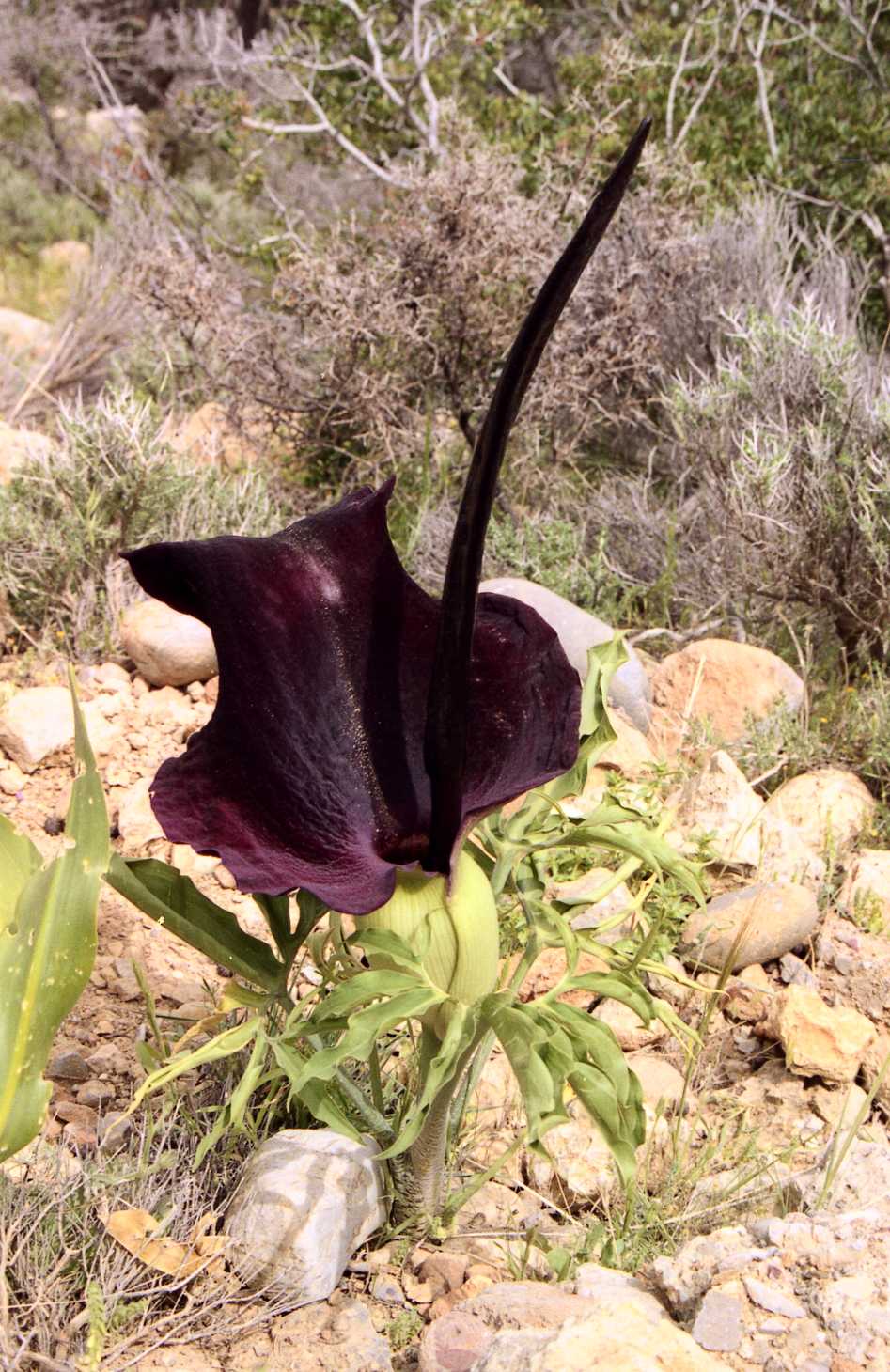
Dracunculus is a small genus of two species of tuberous perennial plants in the family Araceae, order Alismatales. The genus is native to the Mediterranean Basin, Madeira, and the Canary Islands, where plants grow on rocky hillsides, scrubland margins, and waste ground.
Plants in this genus are unmistakable in flower: they produce a dramatically large, deep purple spathe surrounding a dark, club-shaped spadix. The spathe typically emerges before or alongside the pedate (foot-shaped) leaves, which are dark green and often decorated with white mottling along the veins. At flowering, the open spathe emits a powerful, foul odor resembling rotting flesh — an adaptation that attracts carrion flies and beetles as pollinators.
The best-known member is Dracunculus vulgaris, the dragon arum or voodoo lily, which is occasionally cultivated in temperate gardens as a dramatic ornamental curiosity. The second species, Dracunculus canariensis, is endemic to the Canary Islands and Madeira.
Etymology
The name Dracunculus is Latin for "little dragon," a reference to the dramatic, dragon-like appearance of the large dark spathe and spadix. The common name "dragon arum" reflects the same imagery.
Distribution
Dracunculus is native to the Mediterranean region, including southern Europe and North Africa, as well as the Atlantic island groups of Madeira and the Canary Islands. Plants typically grow in rocky areas, hillsides, and disturbed or waste ground.
Ecology
The genus is adapted to summer-dry Mediterranean climates. The flowers produce a strong carrion-like odor when the spathe opens, which attracts flies and beetles that act as pollinators. The foul smell dissipates after pollination. Plants die back to underground tubers during the dry season and re-emerge in autumn or spring.
Cultivation
Dracunculus vulgaris is the species most commonly grown in cultivation. It is hardy in temperate gardens in well-drained soil and a sunny or partially shaded position. The plant requires a dry period in summer to mimic its Mediterranean habitat. It is grown primarily as an ornamental curiosity for its striking spathe, though growers should be aware of the short-lived but intense unpleasant odor produced at flowering.










