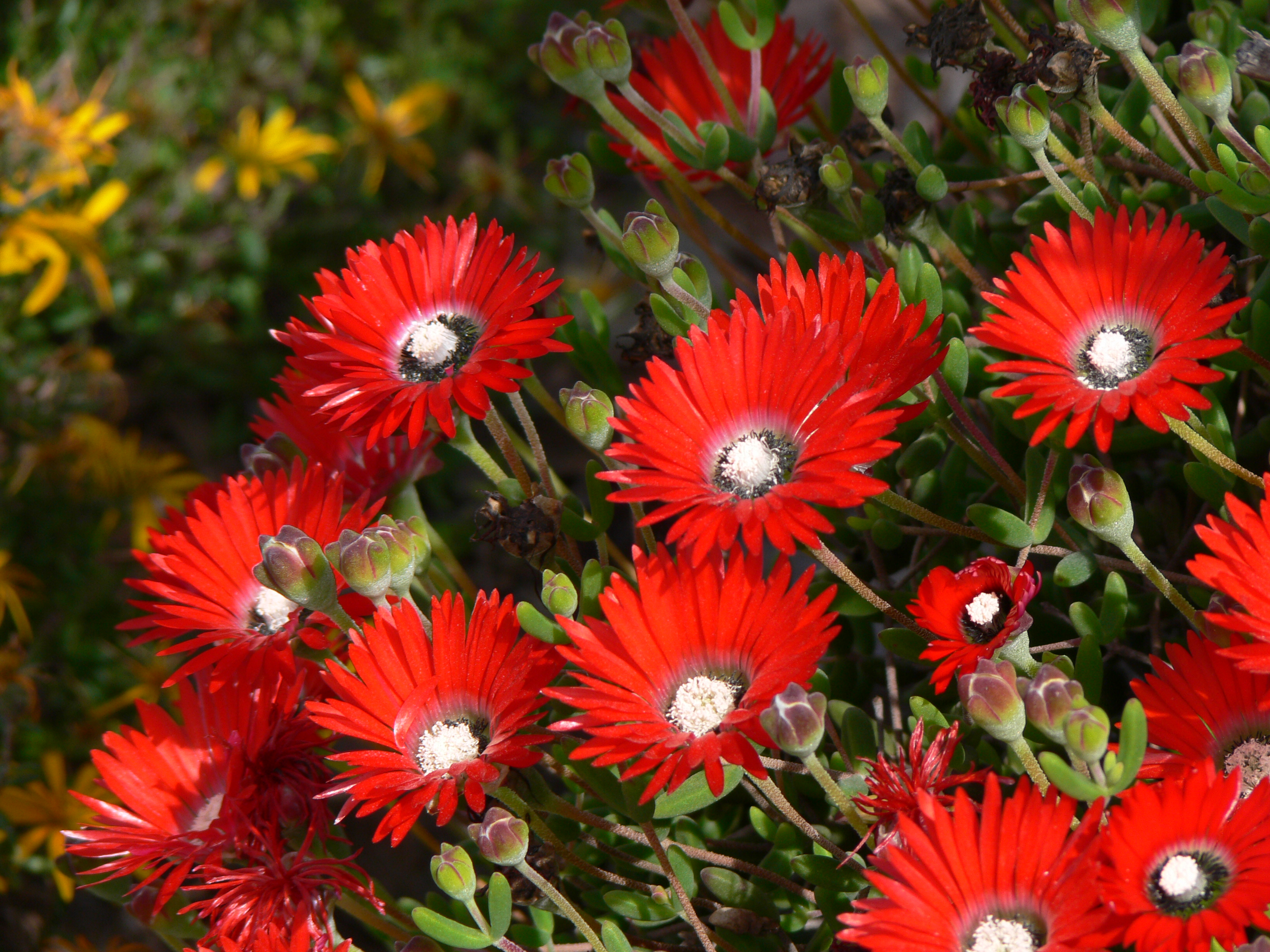
Drosanthemum, commonly known as dewflowers, is a genus of about 110 species of succulent plants in the family Aizoaceae (the ice plant family), placed in the order Caryophyllales. The genus is endemic to southern Africa, where it is found primarily in the winter-rainfall regions of Namibia and the Cape Provinces and Free State of South Africa.
Plants in this genus are low-growing to spreading shrublets with fleshy, succulent leaves densely coated in small, shiny, translucent papillae — glistening bladder cells that give the foliage a dewy or frosted appearance and inspired the genus name. This papillate texture is shared with the flower buds, and in bright light the plants appear to sparkle. Most species produce vivid, daisy-like flowers in shades of pink, magenta, orange, and white, with numerous narrow petals surrounding a central cluster of stamens.
The genus belongs to the large and diverse subfamily Ruschioideae within Aizoaceae, a family that includes many well-known South African succulents. Drosanthemum speciosum, notable for its brilliant scarlet-orange blooms, is among the most recognizable species in horticulture. Other species such as D. floribundum and D. hispidum are widely cultivated as drought-tolerant ground covers in Mediterranean-climate gardens worldwide.
Etymology
The name Drosanthemum is derived from Greek, meaning "dew-flower." It refers to the distinctive shiny, translucent papillae (bladder cells) that densely cover the succulent leaves and flower buds, giving the plants a glistening, dew-covered appearance in sunlight.
Distribution
Drosanthemum is native to the winter-rainfall regions of southern Africa, with the greatest diversity in South Africa's Cape Provinces and Free State, and extending into Namibia. The genus is adapted to semi-arid, Mediterranean-type climates with dry summers and cool, wet winters.
Cultivation
Species of Drosanthemum are widely grown as drought-tolerant ground covers and rockery plants in Mediterranean-climate gardens. They thrive in full sun with excellent drainage and require minimal water once established. Several species, including D. floribundum and D. speciosum, have naturalized beyond their native range due to horticultural use. Plants are frost-sensitive and perform best in USDA zones 9–11.










