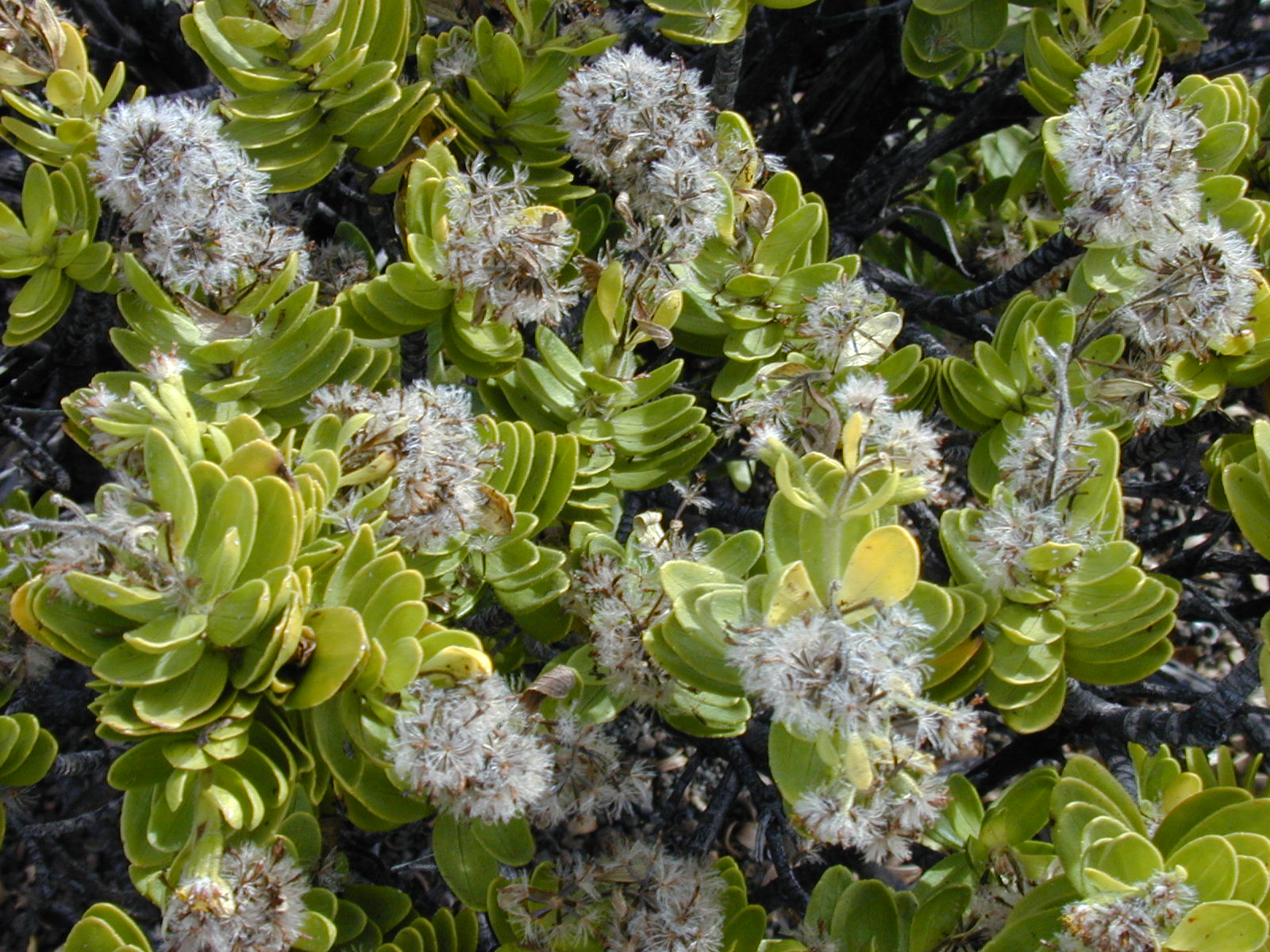
Dubautia, also known by the Hawaiian name na'ena'e, is a genus of flowering plants in the family Asteraceae (sunflower family), endemic to the Hawaiian Islands. It is the largest of the three genera that make up the silversword alliance — a celebrated adaptive radiation in the sunflower subtribe Madiinae — and is the most widespread, with species found across all the main Hawaiian islands.
The genus is extraordinarily diverse in growth form for a single lineage: it includes cushion plants, mat-forming subshrubs, erect shrubs, small trees, and lianas. This breadth of form across a geographically restricted island chain makes Dubautia and its alliance relatives a textbook model for the study of plant evolution and adaptive radiation. The entire alliance is thought to have descended from a single Pacific Coast tarweed ancestor that colonised Hawaii approximately 3.5 million years ago.
Dubautia species grow in a wide range of habitats — from dry scrub and open woodland with low rainfall to wet montane forest, bogs, and bare lava flows and cinder landscapes where few other plants can establish. Hybridisation is common both within the genus and between Dubautia and the closely related genus Argyroxiphium (the silverswords), even between morphologically distinct species. This capacity for inter-species and inter-generic hybridisation has contributed to the alliance's evolutionary dynamism.
Many Dubautia species are of significant conservation concern: 15 are listed as endangered or critically endangered on the IUCN Red List, and at least one, Dubautia kenwoodii, is believed to be extinct. Key threats include browsing pressure from introduced feral ungulates, competition from invasive plant species, and the decline of native pollinators.
Etymology
The genus name Dubautia honours Joseph Eugène DuBaut (1796–1832), a French Navy officer who took part in Louis de Freycinet's scientific circumnavigation expedition. The Hawaiian name na'ena'e is also applied to members of the genus.
Distribution
Dubautia is entirely endemic to the Hawaiian Islands, with species distributed across all the main islands. Within Hawaii the genus occupies an exceptional range of elevations and substrates, from coastal and lowland dry scrub to wet montane forest, bogs, and exposed volcanic lava fields.
Ecology
Dubautia species colonise habitats ranging from dry scrubland and open woodland to wet forest, montane bogs, and bare volcanic cinder and lava flows with minimal soil development. Many species grow sympatrically, and inter-species hybridisation — as well as hybridisation with the related genus Argyroxiphium — is frequent. The alliance as a whole is considered a premier model system for studying adaptive radiation and plant speciation on oceanic islands.
Conservation
Fifteen Dubautia species are classified as endangered or critically endangered under the IUCN Red List, with two additional species listed as threatened. Dubautia kenwoodii is believed to have gone extinct. The primary threats to the genus are browsing and trampling by introduced feral animals (pigs, goats, deer), displacement by invasive plant species, and loss of native insect pollinators.
Taxonomy Notes
Dubautia belongs to the silversword alliance, a monophyletic clade within subtribe Madiinae of the family Asteraceae, alongside Argyroxiphium and Wilkesia. The alliance comprises roughly 34 species total; Dubautia alone accounts for the majority and is the most species-rich and morphologically diverse of the three genera. The clade originated from a single colonisation event by a Pacific Coast tarweed ancestor estimated at approximately 3.5 ± 1.5 million years ago. GBIF places the genus in family Compositae (the conserved synonym of Asteraceae) with 133 accepted and synonymised taxa.










