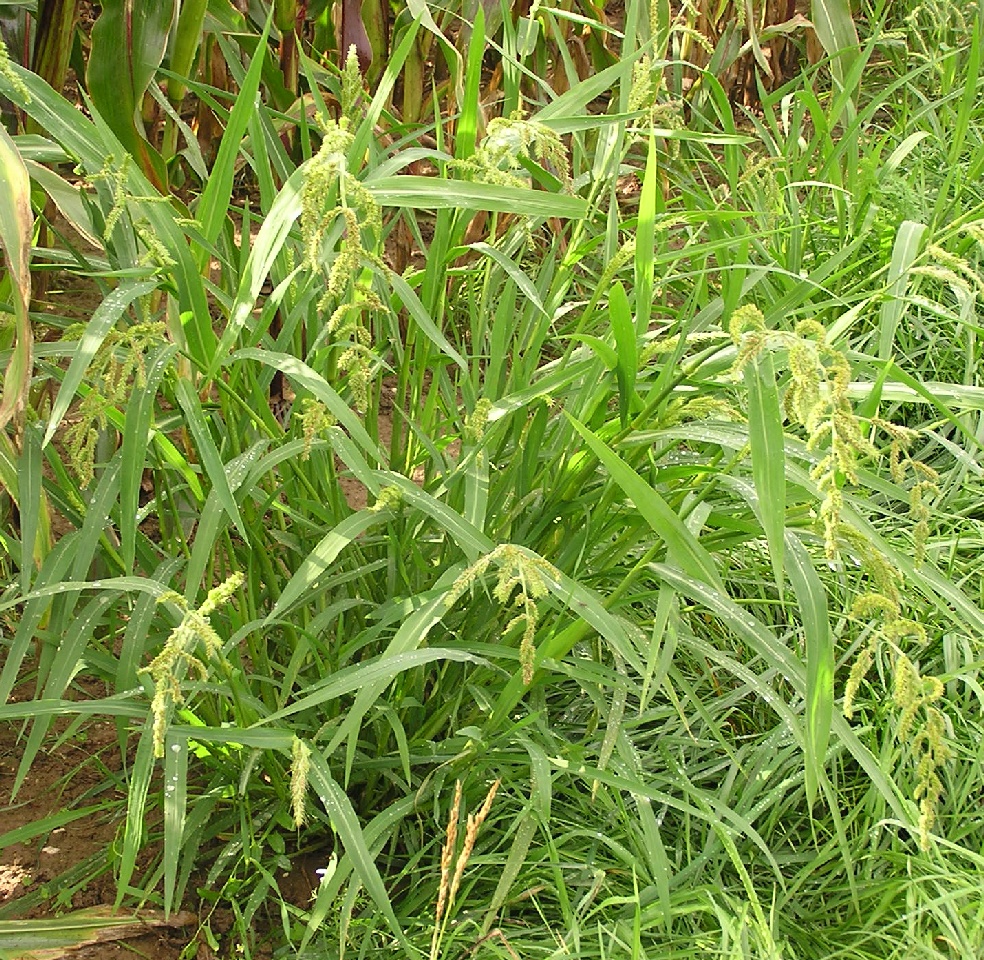
Echinochloa is a widespread genus of annual and perennial grasses in the family Poaceae (tribe Paniceae), encompassing roughly 35–40 species distributed across tropical, subtropical, and warm-temperate regions worldwide. The genus is commonly known by the names barnyard grass, cockspur grass, barnyard millet, or billion-dollar grass — the last a reference to the enormous economic losses its weedy members inflict on rice and other cereal crops globally.
Several Echinochloa species have been domesticated as grain and fodder crops. Indian barnyard millet (E. frumentacea) has been cultivated in South Asia for thousands of years as a fast-maturing, drought-tolerant cereal. Japanese millet (E. esculenta) is grown across East Asia for both human consumption and livestock feed. Burgu millet (E. stagnina) is an important food and forage resource in the floodplain systems of West Africa, particularly in the inner Niger Delta.
The genus is equally notorious for its weedy representatives. Common barnyard grass (E. crus-galli) is among the most economically damaging weeds in rice paddies worldwide, competing aggressively with the crop for water, light, and nutrients. Early barnyard grass (E. oryzoides) is a textbook example of Vavilovian mimicry: through centuries of co-cultivation with rice (Oryza sativa), it has evolved leaf shape, color, and growth habit closely resembling the crop, allowing it to evade hand-weeding. These weedy species can also act as reservoir hosts for grass pathogens such as the sac fungus Cochliobolus sativus and rice hoja blanca virus, which affect many commercially important cereals.
Etymology
The name Echinochloa derives from the Greek echinos (hedgehog or spiny) and chloa (young grass or green herb), referring to the bristly or spine-bearing spikelets characteristic of many species in the genus.
Distribution
Echinochloa species are found across tropical, subtropical, and warm-temperate regions of all continents, with particularly high diversity in Asia and Africa. Weedy species have spread to virtually all agricultural regions of the world, and several are listed among the most widespread grassland and cropland weeds globally.
Ecology
Several Echinochloa species thrive in wetland margins, irrigated fields, and disturbed habitats, making them persistent competitors in rice cultivation systems. E. oryzoides has evolved Vavilovian mimicry — morphologically converging on rice (Oryza sativa) — allowing it to persist in paddies even under intensive hand-weeding. Weedy Echinochloa can serve as reservoir hosts for serious grass pathogens, including Cochliobolus sativus and rice hoja blanca virus, potentially amplifying disease pressure on surrounding cereal crops. Biocontrol research has examined the fungi Drechslera monoceras and Exserohilum monoceras as potential agents against common barnyard grass in rice fields, though host specificity remains a concern.
Cultivation
Echinochloa frumentacea (Indian barnyard millet) and E. esculenta (Japanese millet) are the principal cultivated species. Both are valued for their short growing season, tolerance of poor soils and drought, and nutritional profile relative to major cereals. They are grown primarily as subsistence or secondary crops, and also widely used as fodder and bird-food crops. E. stagnina (burgu millet) is harvested and managed in West African floodplain systems.
Cultural Uses
Members of the genus have served as food crops across multiple cultures. Indian barnyard millet (E. frumentacea) is consumed as porridge and flatbread in South Asia, particularly during religious fasting periods when rice and wheat are avoided. Japanese millet (E. esculenta) has been cultivated in East Asia since antiquity. Burgu millet (E. stagnina) is a staple in the floodplain communities of the inner Niger Delta in West Africa.
Taxonomy Notes
The circumscription of Echinochloa has changed substantially with molecular phylogenetic study. Species formerly placed in the genus have been transferred to Acroceras, Axonopus, Brachiaria, Oplismenopsis, Oplismenus, Panicum, Pseudechinolaena, Setaria, and Urochloa. The genus belongs to the tribe Paniceae within the grass family Poaceae.










