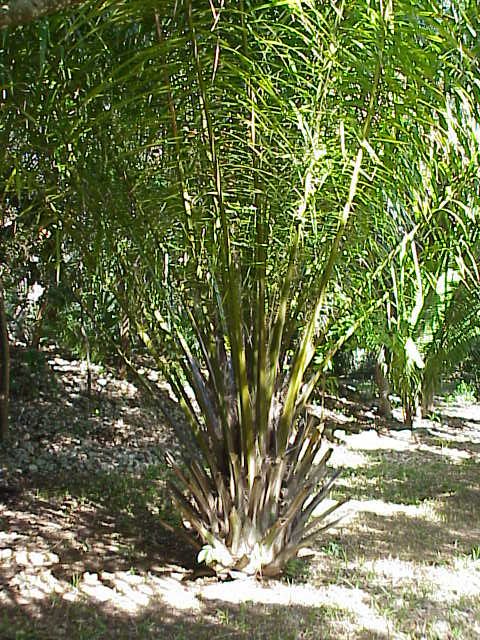
Elaeis is a genus of two species of palms in the family Arecaceae (order Arecales), commonly known as oil palms. The genus name derives from the Greek word for "oil," reflecting the primary economic importance of its members.
Mature oil palms are single-stemmed trees that can grow well over 20 metres tall. The leaves are pinnate and reach 3–5 metres in length. Flowers are produced in dense clusters; each individual flower is small, with three sepals and three petals. The fruit is reddish, roughly the size of a large plum, and grows in large, heavy bunches. Each fruit consists of an oily, fleshy outer layer (the pericarp) surrounding a single seed — the palm kernel — which is also rich in oil.
The genus contains two species: Elaeis guineensis (the African oil palm), native to west and southwest Africa from Angola to Gambia, and Elaeis oleifera (the American oil palm), native to tropical Central and South America from Honduras to northern Brazil. The two species are interfertile and can produce fertile hybrids. The genome of E. guineensis has been sequenced, with significant implications for breeding improved crop strains.
Oil palms are among the world's most economically important crop plants. Elaeis guineensis is extensively cultivated throughout the tropics, with Malaysia and Indonesia together accounting for the majority of global palm oil production. Palm oil is prized for its heat stability, resistance to oxidation, and absence of trans fats, making it widely used in food processing and as a biofuel feedstock.
Etymology
The genus name Elaeis derives from the Greek word elaeis (ἔλαιον), meaning "oil," a direct reference to the oil-rich fruit that gives these palms their common name. The epithet of the American species, oleifera, comes from the Latin oleifer, meaning "oil-producing."
Distribution
Elaeis guineensis is native to west and southwest Africa, occurring from Angola north to Gambia. Elaeis oleifera is native to tropical Central and South America, ranging from Honduras south to northern Brazil. Outside their native ranges, oil palms — particularly E. guineensis — have been planted extensively across tropical Asia, Africa, and the Americas for commercial oil production, with Malaysia and Indonesia being the dominant producers.
Cultivation
Oil palms are among the most productive oil crops in the world. Elaeis guineensis is cultivated on a massive scale across the humid tropics, especially in Malaysia and Indonesia. The palm requires a warm, wet climate with no pronounced dry season. Palm oil is extracted from the fleshy pericarp of the fruit, while a separate oil (palm kernel oil) is pressed from the seed. Because palm oil is highly heat-stable and contains no trans fats, it is used widely in food manufacturing, cosmetics, and as a biofuel. Fertile hybrids between E. guineensis and E. oleifera are grown in Latin America to combine the high yields of the African species with the disease resistance of the American species.
Cultural Uses
Human use of oil palms in coastal west Africa is thought to extend back approximately 5,000 years. Archaeological evidence — palm oil residues recovered from a tomb at Abydos, Egypt, dated to around 3000 BCE — suggests the oil was traded into North Africa in antiquity, likely carried by Arab traders. Today palm oil remains a staple cooking fat across West and Central Africa, and E. oleifera is used locally for oil production in its native range in tropical America.
History
Commercial palm oil production expanded dramatically during the 19th century as European demand for industrial lubricants and soap-making fats grew. Cultivation spread from West Africa to Southeast Asia in the early 20th century; Malaysia and Indonesia subsequently became the world's dominant suppliers. The sequencing of the E. guineensis genome has opened new avenues for breeding programmes aimed at higher yields and improved disease resistance.










