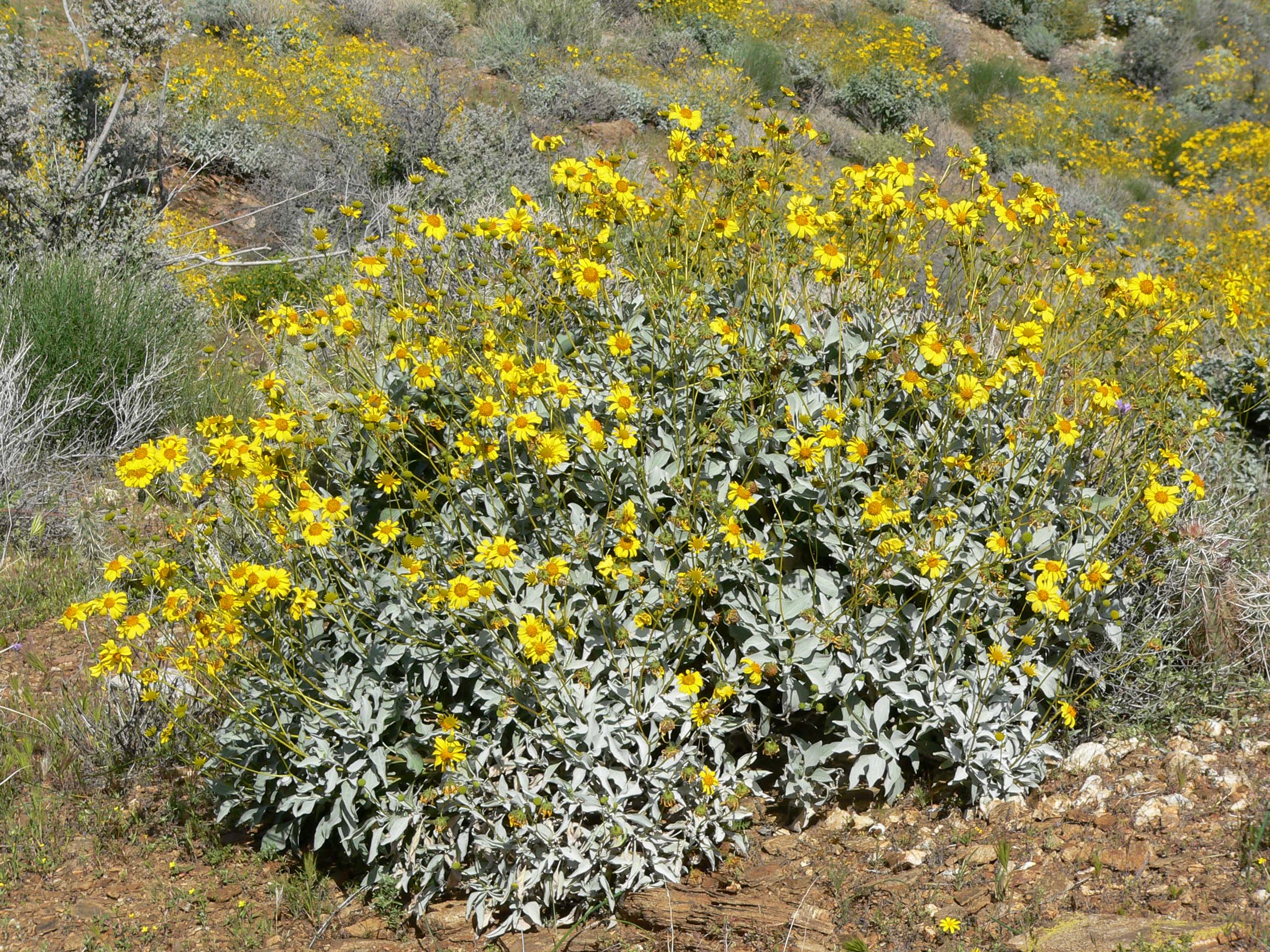
Encelia is a genus of flowering shrubs in the family Asteraceae (order Asterales), commonly known as brittlebushes. The genus comprises roughly 20 species of shrubs — plus one geophyte — native to arid and semi-arid landscapes across southwestern North America and western South America, with the greatest diversity concentrated in the Sonoran and Mojave deserts, Baja California, and the Andean foothills of Peru and Chile.
All Encelia species share a chromosome number of n = 18. North American members are obligate outcrossers, meaning they require cross-pollination to set seed. In cultivation, species hybridize readily, producing fertile first-generation (F1) hybrids, F2s, and backcrosses; yet in natural zones of sympatry these later-generation hybrids are absent or very rare, suggesting strong natural reproductive barriers maintain species boundaries in the wild.
Encelia sits within a small alliance alongside the closely related genera Enceliopsis and Geraea — collectively known informally as the "Encelia alliance" — which form its phylogenetic sister clade. The genus has ecological importance as a larval food plant for certain Lepidoptera: the specialized leaf miner Bucculatrix enceliae feeds exclusively on Encelia farinosa, one of the most widespread and iconic members. That species, brittlebush (Encelia farinosa), is particularly notable for its silvery-grey foliage and bright yellow flower heads, which color entire desert hillsides in spring across Arizona, California, and Sonora.
Etymology
The genus name Encelia honors the German biologist Christophorus Enzelius (1517–1583).
Distribution
Encelia is distributed across arid environments in southwestern North America — including California, Arizona, Utah, Nevada, New Mexico, Texas, and the Baja California Peninsula — and extends into western South America in Peru, northern Chile, and Bolivia. One species, Encelia hispida, is native to the Galápagos Islands.
Ecology
Encelia species are characteristic plants of hot desert scrub and arid chaparral. North American species are obligate outcrossers and hybridize freely in cultivation, but natural hybrid zones show strong barriers to F2 and backcross formation, indicating ecological or phenological isolation in the field. Several species serve as larval host plants for Lepidoptera; the leaf miner Bucculatrix enceliae feeds exclusively on Encelia farinosa.
Taxonomy Notes
Encelia belongs to the tribe Heliantheae within Asteraceae. Its closest relatives are Enceliopsis and Geraea; these three genera form an informal group called the "Encelia alliance." All species share a base chromosome number of n = 18. GBIF recognizes 28 descendant taxa under the genus.










