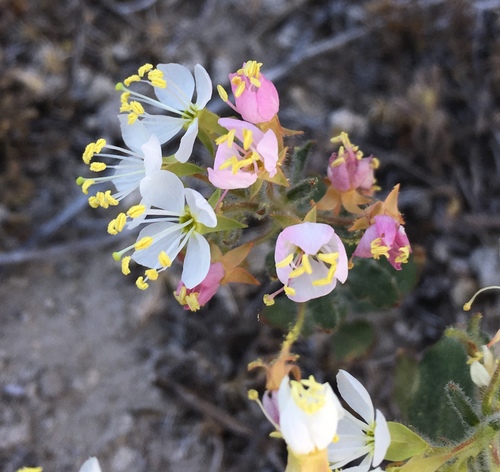
Eremothera is a small genus of flowering plants in the family Onagraceae, the evening-primrose family. It comprises approximately 7 accepted species (with an additional 5 infraspecific taxa recognized by some authorities), all native to arid and semi-arid regions of Western North America. The genus was segregated from the broader genus Camissonia and formally described by W.L. Wagner and P.C. Hoch, whose names appear as authors after each species epithet. In overall form, members of Eremothera are low-growing annual or perennial herbs characteristic of open desert scrub, chaparral margins, and dry rocky slopes—habitats suggested by the name itself, which combines the Greek eremos (desert, solitary) with the suffix -thera. Species include Eremothera boothii, E. minor, E. gouldii, E. pygmaea, E. refracta, E. nevadensis, and E. chamaenerioides, several of which bear multiple recognized subspecies adapted to distinct desert subregions from California and the Great Basin eastward. As members of Onagraceae, Eremothera species typically produce flowers with four petals and inferior ovaries, characteristics shared across the family that includes well-known genera such as Oenothera and Epilobium.
Etymology
The name Eremothera is derived from the Greek eremos, meaning desert or solitary, combined with the suffix common to genera in Onagraceae related to Oenothera. The name reflects the genus's characteristic habitat in arid and desert regions of western North America.
Distribution
Eremothera is native to Western North America, ranging across desert scrub and dry open habitats from California and the Great Basin into the broader arid interior west. Species diversity is centered in the Californian Floristic Province and adjacent desert regions.
Taxonomy Notes
Eremothera was segregated from Camissonia and described by W.L. Wagner and P.C. Hoch. GBIF recognizes it as an accepted genus in Onagraceae with 12 descendant taxa (species and subspecies). SEINet lists 7 accepted species: E. boothii, E. chamaenerioides, E. gouldii, E. minor, E. nevadensis, E. pygmaea, and E. refracta.

