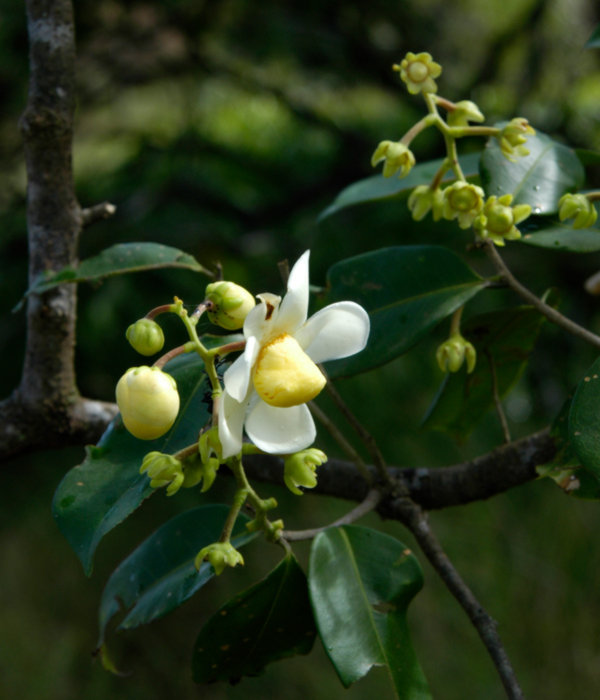
Eschweilera is a large genus of tropical woody plants in the family Lecythidaceae, the Brazil-nut family, placed within the order Ericales. It was first formally described by C.F.P. von Martius and Augustin Pyramus de Candolle in 1828 (published in Prodromus 3: 293), and has since grown to encompass approximately 71–134 accepted species depending on the taxonomic authority.
The genus is distributed across the Neotropics, ranging from southern Mexico through Central America and into South America as far south as Bolivia and Brazil, with an outlier presence in Trinidad. The center of diversity is the Amazon Basin and adjacent Guiana Shield. Members are large-canopy to mid-canopy trees characteristic of humid tropical forests, and the family Lecythidaceae to which they belong is a defining element of Amazonian tree communities.
Eschweilera is closely related to the Brazil-nut tree (Bertholletia excelsa) and shares the family's hallmark: large, woody, urn-shaped fruits (pyxidia) with a removable lid. The genus belongs to tribe Lecythideae and is distinguished within Lecythidaceae by its zygomorphic staminal hood, which forms a coiled or flat ligule that assists in guiding bee pollinators.
Taxonomy within Eschweilera has been revised substantially. A 2024 phylogenetic study by Vargas et al. demonstrated that the genus as traditionally circumscribed is polyphyletic. The study proposed retaining only the core Parvifolia clade within Eschweilera while segregating additional clades into three newly described genera: Imbiriba (the Tetrapetala section of Lecythis), Scottmoria (the Integrifolia clade), and Waimiria (a monotypic genus for E. amazoniciformis, isolated as a sister lineage to Corythophora and Imbiriba). These rearrangements are ongoing and not yet universally adopted.
Etymology
The genus Eschweilera was named in honor of Johann Baptist von Eschweiler (1796–1831), a German botanist and physician who worked on Brazilian flora and lichenology. The name was established by Martius and de Candolle in their 1828 Prodromus (3: 293).
Distribution
Eschweilera is native to the Neotropics, occurring from southern Mexico and Central America (Honduras, Nicaragua, Costa Rica, Panama) southward through South America including Colombia, Venezuela, Ecuador, Peru, Bolivia, Brazil, Guyana, Suriname, French Guiana, and Trinidad-Tobago. The genus reaches its greatest diversity in the Amazon Basin and the Guiana Highlands, where it forms a significant component of the upper and mid-canopy of lowland rainforest.
Ecology
Species of Eschweilera are prominent canopy and sub-canopy trees of humid tropical lowland and montane forests in the Neotropics. Like other members of Lecythidaceae, they produce large woody fruits (pyxidia) whose seeds are dispersed by agoutis, monkeys, and other large mammals. Flowers are visited and pollinated predominantly by large bees (including euglossine and xylocopine bees) that access nectar concealed beneath the staminal hood. The genus is an ecologically dominant element of Amazonian tree communities, with individual species often co-occurring at high densities.
Taxonomy Notes
Eschweilera belongs to family Lecythidaceae, tribe Lecythideae, within order Ericales. It was authored by Mart. ex DC. and published in Prodromus Systematis Naturalis Regni Vegetabilis 3: 293 (1828). A 2024 molecular phylogenetic study (Vargas et al.) found the genus to be polyphyletic and proposed splitting it into four segregate genera: Eschweilera sensu stricto (Parvifolia clade), Imbiriba, Scottmoria, and Waimiria (monotypic, for E. amazoniciformis). The GBIF backbone currently treats Eschweilera as accepted with 134 descendants, while the Wikipedia article lists approximately 71 accepted species — reflecting differences in circumscription between authorities.










