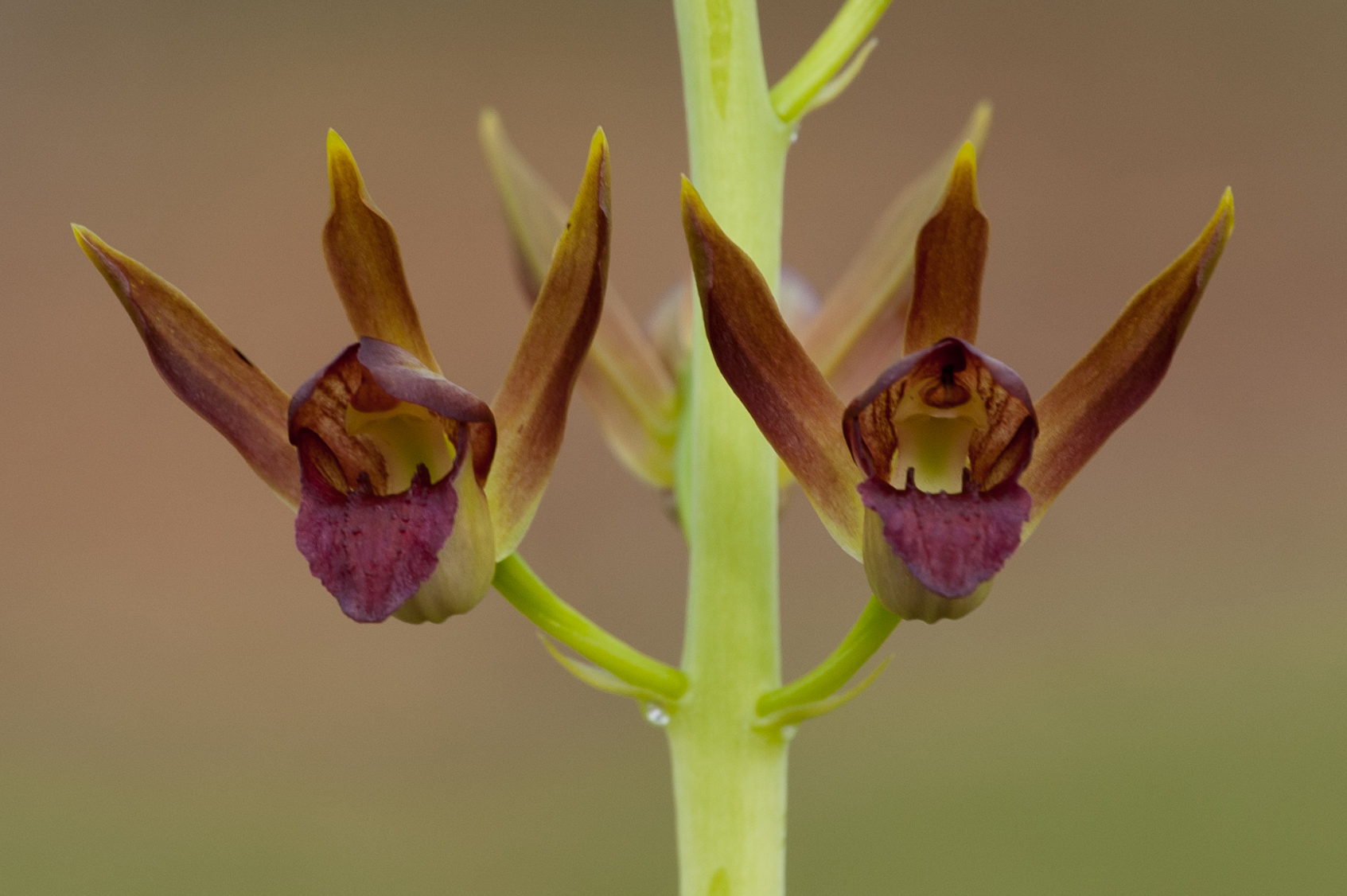
Eulophia is a large genus of approximately 200 species of orchids in the family Orchidaceae, placed within the order Asparagales. The genus was formally described by Robert Brown, published by John Lindley in 1821 in Botanical Register (Bot. Reg. 7: t. 573). Most members are terrestrial herbs growing from underground rhizomes or surface pseudobulbs. The leaves, when present, are long and narrow and sometimes pleated. Flowers are characterised by sepals that are larger than the petals, and a three-lobed labellum (lip) bearing spurs or pouches. A small number of species lack leaves altogether, relying on chlorophyll in their pseudobulbs or corms; only two epiphytic species are known, both from Madagascar.
The genus name comes from the Ancient Greek eu ("good" or "well") and lophos ("mane", "crest", or "ridge"), a reference thought to reflect the callus ridges on the labellum of certain species. The common name Wild Coco is applied to some members, particularly in the Americas. GBIF recognises 417 descendant taxa under Eulophia, which has historically absorbed numerous other genera: Lissochilus, Geodorum, Cyrtopera, Oeceoclades, and roughly 20 other genus names are now treated as synonyms.
Species are distributed across tropical and subtropical Africa, South Asia, Southeast Asia, Queensland in Australia, and the Americas. Africa is the centre of diversity. Many species have adapted to seasonal drought by storing water and nutrients in bulbous corms. Eulophia petersii, native to East African and Somali deserts, is one of the few orchids adapted to genuinely arid desert conditions. As of 2021, 12 primary hybrids and 13 intergeneric hybrids had been registered with the Royal Horticultural Society.
Etymology
The genus name Eulophia derives from two Ancient Greek words: eu, meaning "good" or "well", and lophos, meaning "mane", "crest", or "ridge". This is thought to refer to the callus ridges or crest structure on the labellum (lip) of the flower, a characteristic feature of several species in the group. The genus was formally published by John Lindley in 1821, though Robert Brown is credited as the authoring botanist (abbreviated R.Br. in the name Eulophia R.Br.).
Distribution
Eulophia species occur across a broad tropical and subtropical range. The greatest diversity is concentrated in sub-Saharan Africa, where the majority of species are found. The genus also extends through South Asia (including India and the Andaman Islands), Southeast Asia, into Queensland in northeastern Australia, and into the Americas, where species such as Eulophia alta are native to the Caribbean and parts of Central and South America.
Within Africa, species occupy a wide range of habitats from rainforest understoreys to open savannah and scrubland. Eulophia petersii extends into the arid Horn of Africa, representing one of the few orchid species genuinely adapted to desert conditions.
Ecology
Most Eulophia species are terrestrial, growing in soil rather than on tree bark or rocks. They inhabit shady rainforests or open scrub and woodland across the tropics and subtropics. A key ecological adaptation in many species is the presence of bulbous corms or pseudobulbs that allow the plant to survive prolonged dry seasons by becoming dormant, with leaves dying back and the plant persisting underground until moisture returns.
Eulophia petersii is a notable exception, being adapted to hot desert conditions in East Africa and the Horn of Africa — an unusual niche for an orchid. Only two species in the genus are epiphytic, both from Madagascar; the remainder are terrestrial. Some species produce little or no photosynthetic foliage, relying instead on mycoheterotrophic or other nutritional strategies during part of their life cycle.
Taxonomy
Eulophia was published in Botanical Register volume 7, plate 573, in 1821. The name is attributed to Robert Brown (R.Br.), the botanist who circumscribed the genus, though formal publication was made by John Lindley. The genus is placed in the family Orchidaceae, order Asparagales, class Liliopsida (monocots).
Eulophia is a broad genus that has absorbed a considerable number of formerly separate genera. GBIF records 20 synonymous genus names, including Lissochilus R.Br., Geodorum Andrews, Cyrtopera Lindl., Oeceoclades Lindl., Acrolophia Pfitzer, Eulophidium Pfitzer, Eulophiella Rolfe, Caloglossum Schltr., and Orthochilus Hochst. ex A.Rich., among others. This synonymy reflects ongoing consolidation in orchid systematics, particularly following molecular phylogenetic work that demonstrated the polyphyly of several segregate genera. GBIF records 417 total descendant taxa under this genus key, of which a significant portion are synonyms. As of September 2021, the Royal Horticultural Society had registered 12 primary hybrids and 13 intergeneric hybrids involving Eulophia.
Cultivation
In frost-free climates, species such as Eulophia speciosa and Eulophia petersii can be grown outdoors year-round. In California and similar Mediterranean-climate gardens, they do well in well-drained, cactus-and-succulent potting mix and require a dry winter dormancy period to mimic their native seasonal drought cycle. Their sympodial growth pattern — where new growth arises from the base of the previous season's pseudobulb — makes them straightforward to manage in containers or garden beds.
Propagation
Eulophia species propagate readily through division, which takes advantage of their sympodial growth habit. When a plant has developed multiple pseudobulb growths, these can be separated at repotting time. Each division should retain at least one healthy pseudobulb and preferably some active root tissue to ensure establishment.










