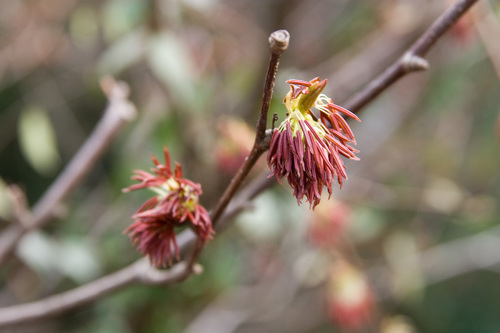
Euptelea is a small genus of deciduous shrubs and small trees in the family Eupteleaceae, a monogeneric family within the order Ranunculales. The genus comprises two species — Euptelea pleiosperma and Euptelea polyandra — both native to eastern Asia, with a range extending from Assam (northeastern India) through southern China to Japan.
Plants in this genus are notable for their early-spring flowering before leaf emergence, producing clusters of small, wind-pollinated flowers that lack petals. The family Eupteleaceae was previously subsumed within Trochodendraceae, but has been consistently recognized as a distinct family by major angiosperm classification systems including APG (1998), APG II (2003), APG III (2009), and APG IV (2016), which place it in the order Ranunculales among the eudicots.
The fossil record of Euptelea extends back to the Paleocene epoch, and during much of the Cenozoic era the genus had a much wider distribution across the Northern Hemisphere. Today its range is restricted to montane forests of eastern Asia, representing a classic example of a Tertiary relict lineage.
Distribution
The two species of Euptelea are native to eastern Asia. The genus ranges from Assam in northeastern India eastward through China to Japan. Its current restricted range contrasts with a broader Cenozoic distribution across the Northern Hemisphere, as evidenced by fossil material dating to the Paleocene.
Taxonomy Notes
Euptelea is the sole genus in the family Eupteleaceae. The family was historically grouped with Trochodendraceae but is now consistently placed in the order Ranunculales by the APG classification system (APG through APG IV, 1998–2016). The family is characterized by its single genus and two species, making it one of the smallest angiosperm families.
History
The fossil record of Euptelea extends to the Paleocene epoch. During much of the Cenozoic era the genus was distributed widely across the Northern Hemisphere, making its present-day restriction to eastern Asia the result of a long-term range contraction. This history makes Euptelea a notable example of a Tertiary relict plant lineage.










