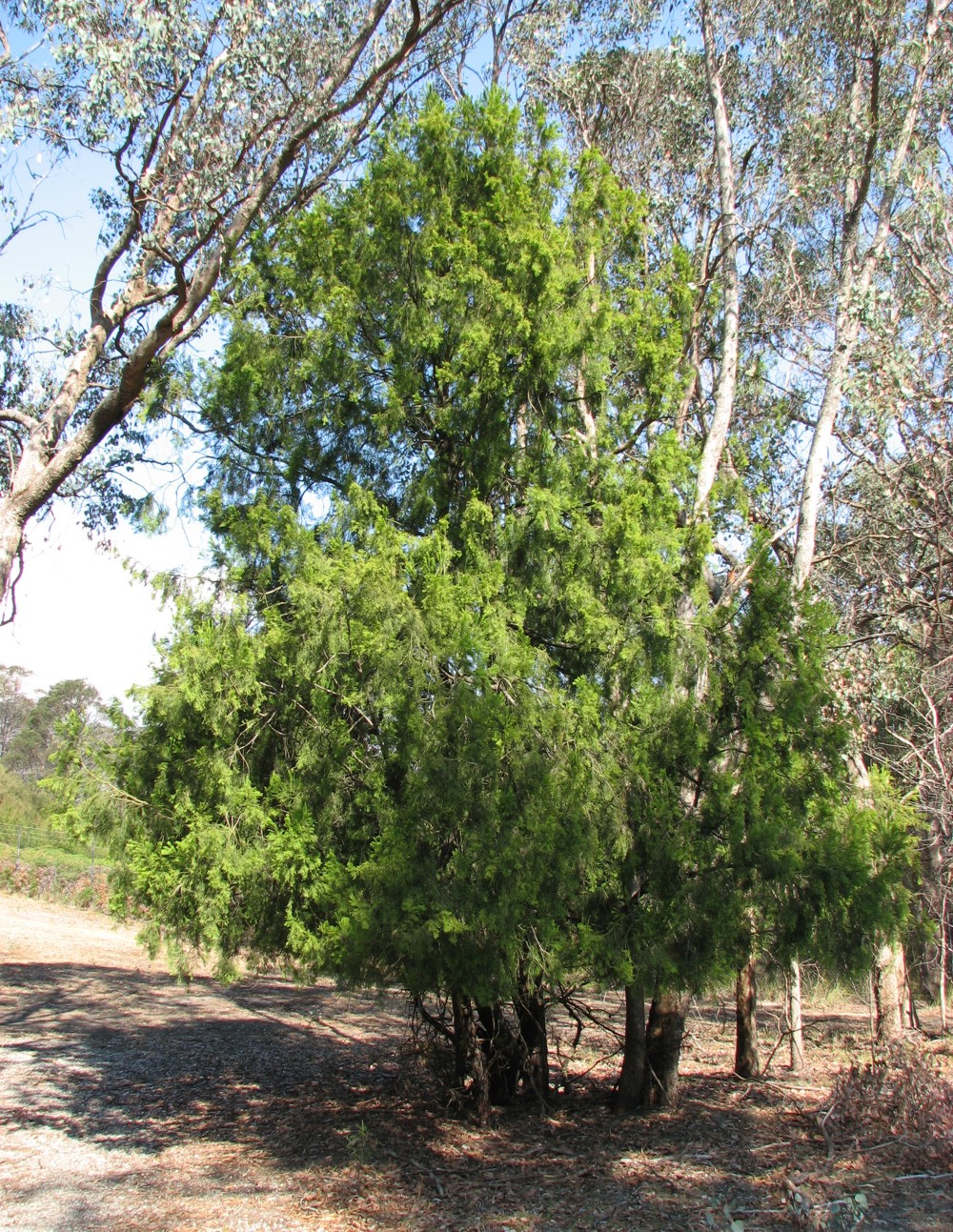
Exocarpos is a genus of about 29 species of semi-parasitic flowering shrubs and small trees in the sandalwood family, Santalaceae, within the order Santalales. The name comes from the Ancient Greek for "outside fruit" (ἔξω + καρπός), a direct reference to the genus's most distinctive feature: the small nut or drupe perches on top of an enlarged, fleshy, often brightly coloured receptacle rather than being enclosed within it — the "cherry" of the popular name refers to this receptacle, not a true cherry fruit.
Members of Exocarpos are hemiparasites, attaching to the roots of host trees via haustoria to supplement their nutrition — a strategy widespread across Santalaceae and shared by the closely related sandalwoods. The plants are typically shrubs or small trees with scale-like or reduced leaves (some nearly leafless) and small, inconspicuous flowers.
The genus ranges from Vietnam south and east through Malesia and New Guinea to Australia, New Zealand, and across the Pacific Islands as far as Hawaiʻi. Australia is the centre of diversity, where species grow in a wide variety of habitats from coastal scrub to montane woodland. In Australia they are collectively called ballarts or, for species with prominent red or yellow receptacles, cherries (e.g. cherry ballart, E. cupressiformis; broad-leaved cherry, E. latifolius).
Exocarpos was first described by the French botanist Jacques Labillardière in 1792, based on material he collected in Australia; he named the type species Exocarpos cupressiformis for its cypress-like foliage. The genus is conventionally cited as Exocarpos Labill. (1798). With 29 accepted species, it is one of the larger genera in Santalaceae.
Etymology
The name Exocarpos is formed from the Ancient Greek ἔξω (éxō, "outside") and καρπός (karpós, "fruit"), coined by Jacques Labillardière in 1792 to describe the unusual structure in which the seed or nut sits exposed on top of a swollen, fleshy receptacle rather than being enclosed within it. This "outside fruit" arrangement gives the plants their common names of ballart and cherry in Australia.
Distribution
Exocarpos ranges from Vietnam through Malesia and New Guinea to Australia, New Zealand, and the Pacific Islands (including Hawaiʻi). Australia is the centre of diversity, with species occupying habitats from coastal plains to alpine zones; New Zealand has at least one endemic species (E. bidwillii), and Hawaiʻi harbours two endemic species (E. luteolus and E. gaudichaudii).
Ecology
All Exocarpos species are root hemiparasites, tapping into the root systems of neighbouring trees and shrubs via haustoria while retaining the ability to photosynthesize. This obligate semi-parasitism is characteristic of the broader Santalaceae family and limits where the plants can establish — they require suitable host species in the vicinity. The fleshy receptacles that subtend the fruit are eaten by birds, which disperse the seeds.
Cultural Uses
In Australia, the swollen receptacles of several species — particularly E. cupressiformis (cherry ballart) and E. latifolius (broad-leaved cherry) — are edible and were eaten by Aboriginal Australians. The small, sweet receptacles were gathered as a bush food and the plants held wider cultural significance for many groups across the continent.










