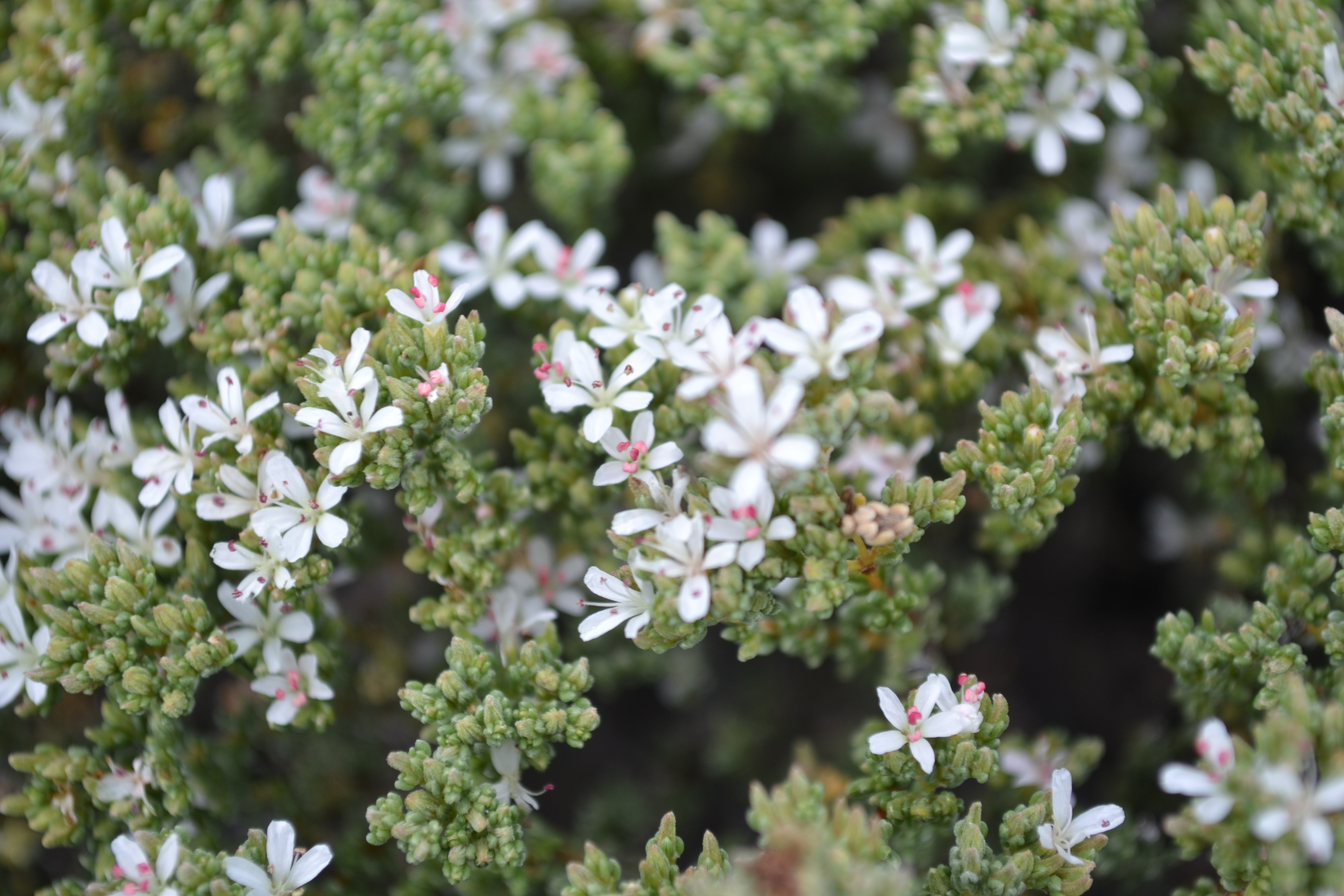
Frankenia, commonly known as sea heath, is the sole genus in the family Frankeniaceae, a group of flowering plants in the order Violales. The genus comprises approximately 70–80 species of shrubs, subshrubs, and herbaceous plants, all adapted to the challenges of saline and arid environments across temperate and subtropical regions of the world.
Members of the genus are characterised by their salt tolerance (halophytism) and drought tolerance (xerophytism). The leaves are opposite, simple, and typically small, resembling those of heather, and are often equipped with specialised glands in sunken pits that excrete excess salt. Flowers are small and may be solitary or arranged in cymes; each has four to seven sepals fused at the base into a tube, and four to seven overlapping petals narrowed toward the base. The stamens are commonly arranged in two whorls of three. The ovary consists of one to four carpels, and the fruit is a capsule enclosed within the persistent sepals.
The genus was formally described by Carl Linnaeus in 1753, with Frankenia laevis as the first-named species. Several other genera — including Anthobryum, Hypericopsis, and Niederleinia — have been placed in the family Frankeniaceae at various times, but morphological and molecular phylogenetic studies have consistently shown they fall within Frankenia, leaving it as the only accepted genus in the family.
Frankenia has a widespread but discontinuous global distribution, occurring in coastal salt marshes, inland salt flats, and arid scrublands across the Mediterranean basin, western and southern North America, temperate South America, southern Africa, and Australia. A small number of species are cultivated as ornamental ground covers, particularly in rock gardens.
Etymology
The genus Frankenia was named by Carl Linnaeus in 1753 to honour Johan Franck (also written Frankenius; 1590–1661), a Swedish physician and professor of botany at Uppsala University. The common name "sea heath" reflects the plants' typical coastal, saline habitats and their superficial resemblance to true heaths (Erica).
Distribution
Frankenia has a widespread but patchy distribution across temperate and subtropical regions, being entirely absent from the tropics. In the Americas it occurs in Mexico, western and southern states of the US, and has a western and southern range in South America. In the Old World it is found around the Mediterranean, Black, and Caspian Seas, with outliers as far north as Great Britain, as far south as South Sudan, and eastward to India; it is also native to southern Africa and Australia. Species occupy coastal and arid habitats as halophytes or xerophytes.
Ecology
Frankenia species are highly specialised halophytes and xerophytes, found in coastal salt marshes, salt flats, and arid or semi-arid scrublands. Their leaves bear sunken glandular pits that actively excrete salt, reducing ionic stress, and their small, compact leaf form limits water loss. These adaptations enable them to thrive in environments — saline soils, seasonally dry rocky ground — that exclude most other plants.
Cultivation
A small number of Frankenia species are grown as ornamental ground covers, particularly suited to rock gardens where they form spreading mats. In the United Kingdom, F. hirsuta, F. laevis, and F. thymifolia are recommended choices, all bearing small white to rose-purple flowers. Their tolerance of poor, dry, and saline soils makes them low-maintenance plants for challenging garden sites.
Taxonomy
The genus was erected by Linnaeus in 1753; Augustin Saint-Hilaire first proposed Frankeniaceae as a separate family in 1815, and it was formalised in 1817. At least six genera have been placed in the family over time — among them Hypericopsis, Anthobryum, and Niederleinia — but both morphological (2003) and molecular phylogenetic (2004) studies concluded that all fall within Frankenia, making it the sole accepted genus in the family as of 2018.

