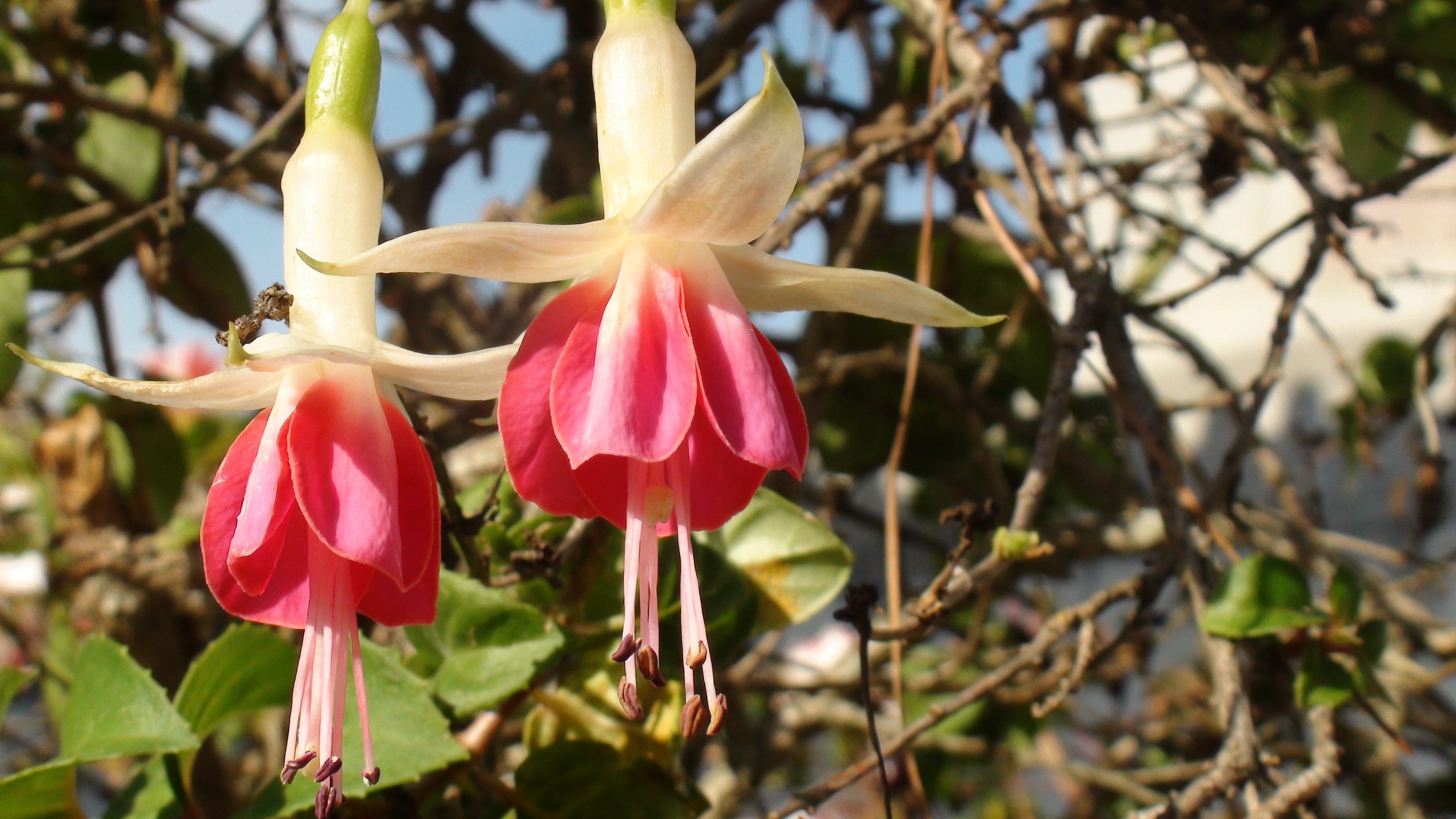
Fuchsia is a genus of flowering shrubs in the family Onagraceae, comprising approximately 110 recognised species arranged across 12 sections. The genus was formally accepted by Carl Linnaeus in 1753 in his Species Plantarum, though the name itself was coined by the French botanist Charles Plumier shortly before 1703 in honour of the German physician and botanist Leonhart Fuchs (1501–1566).
Most fuchsias are shrubs ranging from 0.2 to 4 metres in height, though the New Zealand tree fuchsia (F. excorticata, known as kōtukutuku) can reach 12–15 metres, making it the world's largest fuchsia. Leaves are typically opposite or in whorls of three to five, simple and lanceolate, 1–25 cm long. The flowers are distinctively pendulous, with four long slender sepals and four shorter, broader petals — most commonly bright red sepals contrasting with purple petals, though colour combinations vary widely across species and the thousands of garden hybrids developed since the nineteenth century. Fruits are small berries, 5–25 mm, ripening to dark reddish-green, deep red, or deep purple.
The centre of diversity lies in Central and South America, with one section (Skinnera) native to New Zealand and Tahiti, and one species extending as far south as Tierra del Fuego. Fuchsias are predominantly bird-pollinated — hummingbirds are primary pollinators attracted by the vivid coloration of the sepals — and seeds are likewise dispersed by birds.
In cultivation, fuchsias are valued as ornamental garden plants flowering continuously from mid-summer to early frosts. They are grown in borders, bedding schemes, and containers. Some species and cultivars are reliably hardy in temperate climates including Britain, Ireland, the Pacific Northwest, and New Zealand; others require frost-free conditions or overwintering under glass. Hybrids have been developed in enormous diversity since the 1800s, when the introduction of F. fulgens from Mexico in the 1830s opened a new era of breeding.
Etymology
The genus name Fuchsia was coined by the French botanist Charles Plumier shortly before 1703 to honour Leonhart Fuchs (1501–1566), a German physician, professor at the University of Tübingen, and pioneering herbalist. Fuchs was among the most influential botanists of the sixteenth century; his 1542 illustrated herbal De Historia Stirpium was a landmark work. Plumier described the first species — F. triphylla — from specimens collected on the island of Hispaniola around 1696–1697. The name was formally validated when Linnaeus accepted it in his Species Plantarum of 1753.
Distribution
Fuchsia is native primarily to Central and South America, spanning from Mexico south through the Andes to Tierra del Fuego at the southern tip of South America. One section of the genus — section Skinnera — is native to New Zealand and Tahiti, representing a remarkable disjunct distribution across the Pacific. The approximately 110 recognised species are distributed across 12 infrageneric sections, with the greatest species richness concentrated in the Andean cloud forests of South America.
Ecology
Fuchsia flowers have evolved a pronounced association with hummingbird pollination across most of their range in the Americas. The long pendulous flowers, with their vivid red or orange sepals and contrasting petals, are characteristic adaptations to ornithophily (bird pollination). In New Zealand, where hummingbirds are absent, F. excorticata is pollinated by native honeyeaters and silvereyes. Seed dispersal is also primarily by birds, which consume the small fleshy berries. This dual bird association — for both pollination and seed dispersal — is a recurring theme across the genus.
History
The genus was first described by Charles Plumier based on material from Hispaniola (the Caribbean island shared by modern Haiti and the Dominican Republic), collected around 1696–1697. The type species, Fuchsia triphylla, appears in Plumier's posthumous publications. Carl Linnaeus formally incorporated the genus in Species Plantarum (1753), citing Plumier's work.
Commercial cultivation in Europe began after Fuchsia coccinea reached Kew Gardens in 1788. Hybridisation accelerated dramatically in the nineteenth century; the introduction of the Mexican F. fulgens in the 1830s proved especially consequential, contributing the large, long-tubed flower form that dominates modern cultivars. By the mid-1800s hundreds of named cultivars were in circulation, and fuchsias became a defining feature of Victorian glasshouses and gardens.
Cultivation
Fuchsias are widely grown as ornamental plants, valued for their long flowering season from mid-summer to the first frosts. In garden design they are used in containers, hanging baskets, bedding displays, and borders. Two broad horticultural categories are recognised: hardy fuchsias, which can remain outdoors year-round in temperate climates, and tender fuchsias, which require frost protection.
Species and hybrids from sections Quelusia, Encliandra, Skinnera, and Procumbentes have proven especially hardy and can survive winters in Britain, Ireland, the Pacific Northwest of North America, and New Zealand. In colder areas, tender cultivars are typically grown as summer bedding or conservatory plants. Fuchsias tolerate a range of soil types — from sandy to clay — and prefer moist, well-drained conditions with neutral to slightly alkaline pH. They thrive in partial shade or full sun, though in hotter climates afternoon shade is beneficial. Young spring growth, even on established plants, is frost-tender and should be protected from early morning frost.
Propagation
Fuchsias are readily propagated by inter-nodal softwood or semi-ripe cuttings, typically taken in May/June or again in July/August. Cuttings root reliably with high success rates and are the standard method for maintaining named cultivars. Seed propagation is also viable: seeds should be surface-sown in a warm greenhouse and typically germinate within six weeks. Seed-raised plants will not come true to hybrid parents but are useful for producing new cultivars or growing species.
Taxonomy
Fuchsia L. is the accepted genus name, published in Linnaeus's Species Plantarum 2: 1191 (1753), and placed in the family Onagraceae (order Myrtales). The GBIF Backbone Taxonomy accepts the genus under usageKey 5938221, recording approximately 227 species and infraspecific taxa. About 110 of these represent distinct species, arranged in 12 sections. No Fuchsia species appear in the IUCN Global Invasive Species Database.










