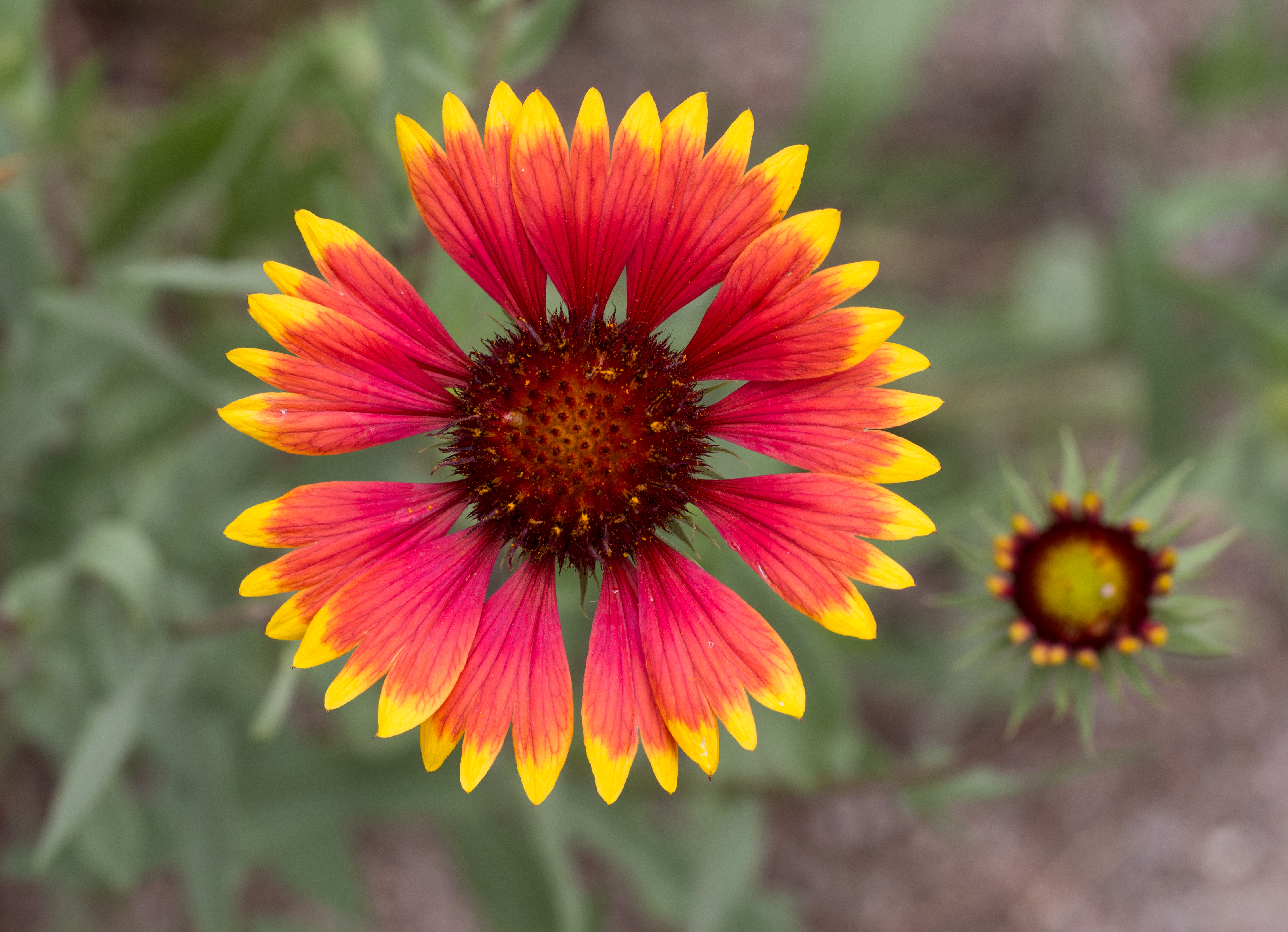
Gaillardia, commonly known as blanket flower, is a genus of flowering plants in the family Asteraceae, native to North and South America. The genus comprises annual and perennial herbs and subshrubs, sometimes with rhizomes, typically growing to around 80 centimetres in height on branching, erect stems. Leaves are alternately arranged and often glandular; in some species only basal leaves are present.
The inflorescence is a solitary flower head bearing 15 or more ray florets — though some taxa lack ray florets entirely — in a striking range of colours including yellow, orange, red, purple, brown, white, and bicolours. The tubular disc florets at the centre share a similar colour palette and are usually tipped with hairs. The fruit is equipped with a pappus of scales. This bold floral display is the origin of the common name: the inflorescence pattern resembles the brightly coloured blankets woven by Native Americans, and wild colonies can blanket the ground in flower.
The genus was named in honour of Maître Gaillard de Charentonneau, an 18th-century French magistrate and enthusiastic botanist. Species range from Canada and the United States south through Mexico and into Argentina, with the greatest diversity in arid and semi-arid regions. Many cultivars have been developed for ornamental horticulture, and Gaillardia is widely grown as a garden plant for its long-lasting, vivid blooms and tolerance of dry conditions.
Etymology
The genus name Gaillardia honours Maître Gaillard de Charentonneau, an 18th-century French magistrate who was a keen amateur botanist. The common name "blanket flower" alludes either to the resemblance of the vivid, patterned flower heads to the brightly coloured blankets traditionally woven by Native American peoples, or to the tendency of wild populations to blanket the ground in dense, flowering colonies.
Distribution
Gaillardia is native to the Americas, with species distributed from Canada and the northern United States south through Mexico to Argentina. The genus shows its greatest diversity in the arid and semi-arid grasslands, plains, and open habitats of North America, including the southwestern USA and northern Mexico, with several species extending into the Southern Cone of South America.
Ecology
Gaillardia species serve as larval food plants for several specialist moths in the genus Schinia (Noctuidae). Schinia bina has been recorded feeding on G. pulchella, while Schinia masoni and Schinia volupia are monophagous on G. aristata and G. pulchella respectively, illustrating tight ecological relationships between these plants and their specialist herbivores.
Cultivation
Gaillardia has been extensively developed for ornamental horticulture, with numerous cultivars bred for garden use. Plants are valued for their long blooming season, drought tolerance, and vivid flower colours spanning yellow, orange, red, and bicoloured combinations. They perform best in full sun and well-drained soils, and are popular in prairie-style plantings, borders, and wildflower gardens across temperate regions.










