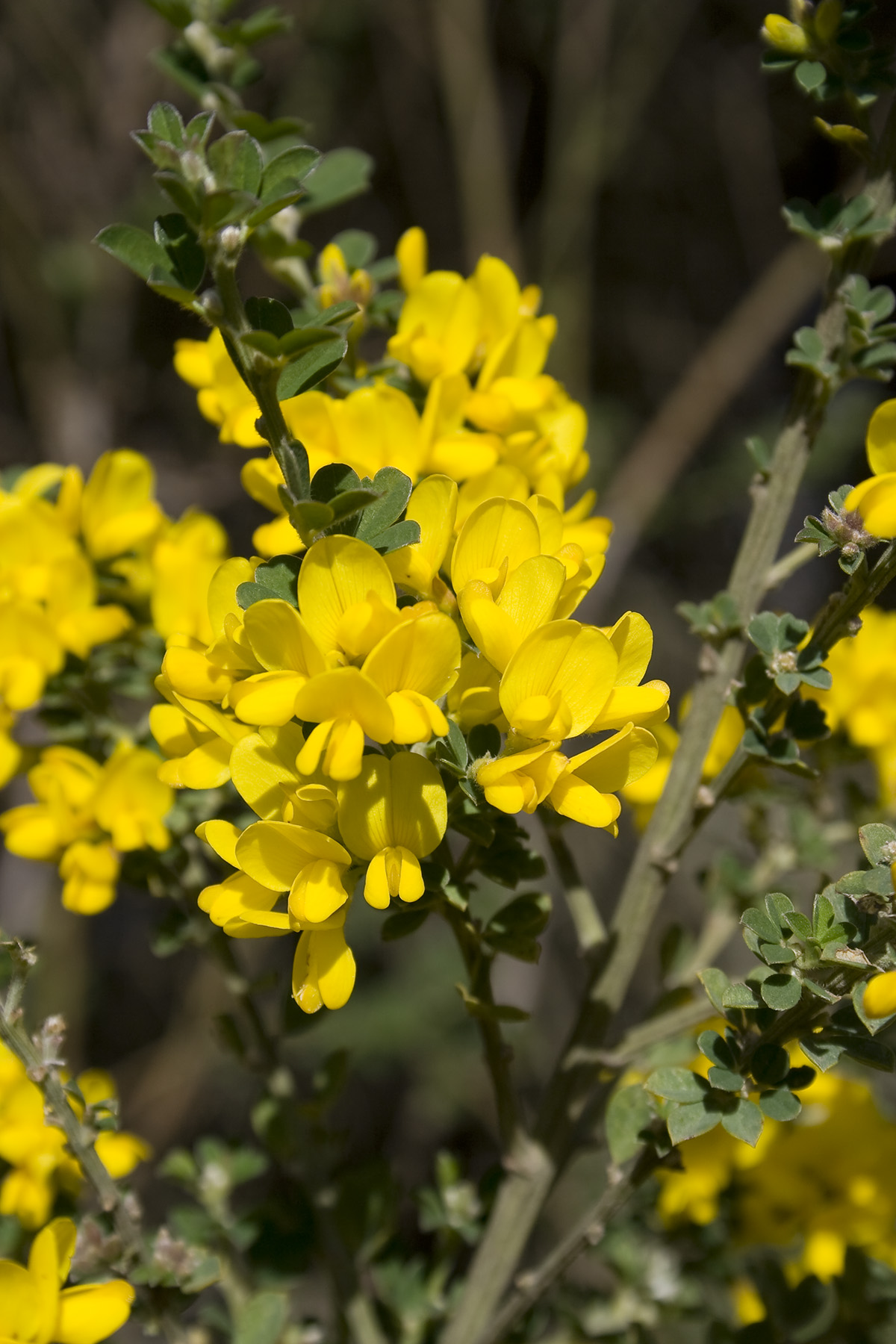
Genista is a genus of around 144 accepted species of deciduous to semi-evergreen shrubs and small trees in the legume family Fabaceae. Commonly known as greenweeds or brooms, they are native to open habitats — moorland, pasture, rocky hillsides, and scrubland — across Europe and western Asia. Most species form low to medium-sized bushes with wiry, often spiny stems that serve to deter browsing animals. Their foliage is typically small and brush-like, and the plants bear masses of small, pea-like yellow flowers that are sometimes fragrant and appear early in the season.
A distinctive feature of many Genista flowers is an explosive pollination mechanism: when an insect lands on the keel petals, the style bursts through the upper seam and strikes the underside of the visitor, dusting it with pollen. This strategy promotes cross-pollination and is shared with several related genera in the tribe Genisteae.
Genista occupies a large and complex taxonomic position within subfamily Faboideae. Over the centuries it has absorbed numerous segregate genera — including Chamaespartium, Pterospartum, Teline, Dendrospartum, and more than a dozen others — making it one of the more synonymously rich genera in the family. The genus shares the common name "broom" with closely allied genera such as Cytisus, Retama, Spartium, and Ulex, and distinctions between them can be subtle without botanical examination.
Several Genista species are valued in horticulture for their prolific early-season bloom and tolerance of poor, well-drained soils. The genus also carries notable historical significance: the name of England's Plantagenet royal dynasty is derived from planta genista, a dialectal form of the Latin genus name.
Etymology
The Latin word genista (or genesta) referred to the broom plant in classical antiquity. Its most celebrated cultural echo is the dynastic name Plantagenet: the royal house that ruled England from 1154 to 1485 took its name from the Latin planta genista, meaning "broom plant," which was used as a heraldic emblem by the dynasty's founders. The name is thus one of the few plant-genus names with a direct connection to a ruling royal family.
Distribution
Genista is native to open, often nutrient-poor habitats across Europe and western Asia, including moorland, pasture, rocky garrigue, and open hillsides. The genus has its strongest diversity in the western Mediterranean region. Its core range extends from central France through the Balkans (to Albania) and into southern Italy. Swiss flora documentation records nine species in Switzerland alone, including G. anglica, G. cinerea, G. germanica, G. pilosa, G. radiata, G. sagittalis, G. scorpius, and G. tinctoria, illustrating how the genus is well represented even in central Europe. Several species (notably G. monspessulana) have also become naturalised beyond their native range and are regarded as invasive weeds in parts of the Pacific Coast of North America and in Australia.
Ecology
Genista species are adapted to exposed, well-drained, often acidic and nutrient-poor soils. Like other members of Fabaceae, they are nitrogen-fixing plants through root symbioses, enriching the soils they colonise. The spiny stems found in many species serve as an anti-herbivory adaptation.
The flowers of many Genista species employ an explosive pollination mechanism: the weight of a visiting insect depresses the keel petals and releases the pollen-laden style, which springs through the upper seam and forcefully contacts the underside of the insect. This promotes outcrossing and is a trait shared across several genera in tribe Genisteae. The flowers also supply nectar and pollen to a range of pollinators including bees.
Cultivation
Genista species are widely grown as ornamental shrubs for their prolific early-season display of yellow flowers. They perform best in full sun and require well-drained soil; they are notably drought-tolerant and well-suited to poor, sandy, or rocky soils with a pH range of approximately 5.0–8.0. Most species are intolerant of heavy or waterlogged soils. Hardiness varies considerably, with many species suited to USDA zones 5–8. Genista is suitable for use as groundcover, for erosion control on slopes, and in containers. The cultivar 'Porlock' has received the Royal Horticultural Society's Award of Garden Merit.
Conservation
No Genista species are currently recorded in the IUCN Global Invasive Species Database at genus level. Some species (particularly G. monspessulana) are considered invasive weeds in introduced ranges such as California and parts of Australia, where they displace native vegetation on disturbed land. Note that parts of the plant are toxic: ingestion can in extreme cases cause paralysis or death, making accidental consumption a safety concern.
Cultural uses
Several Genista species, particularly Genista tinctoria (dyer's greenweed or dyer's broom), have been used historically as a source of yellow dye for textiles. The dye, extracted from the shoots and flowers, was widely used in medieval Europe, often in combination with woad (Isatis tinctoria) to produce the colour known as "Kendal green." Beyond dyeing, the genus has little documented edible use; indeed the plants carry a toxicity caution. The name Plantagenet, borne by the English royal dynasty from 1154 to 1485, derives from planta genista — a broom sprig, which served as a heraldic badge.
Taxonomy notes
Genista L. was formally described by Carl Linnaeus in 1753 and is placed in the family Fabaceae (legumes), subfamily Faboideae, tribe Genisteae, order Fabales. The genus has a complex synonymy: at least 20 genus-level names have been subsumed under Genista, among them Argelasia Fourr., Chamaespartium Adans., Dendrospartum Spach, Enantiosparton K.Koch, Genistella Ortega, Pterospartum (Spach) K.Koch, Rivasgodaya F.Esteve Chueca, and Teline (which was historically recognised as a distinct genus for Macaronesian species). GBIF records 366 descendant taxa under the accepted concept, while current checklists recognise approximately 144 accepted species. ITIS covers only those species present in North America and dependent territories.
The genus is closely related to Cytisus, Chamaecytisus, Retama, Spartium, Stauracanthus, and Ulex — all of which share the English vernacular "broom" — and boundaries between genera have been subject to ongoing revision as molecular phylogenies refine tribal relationships within Genisteae.










