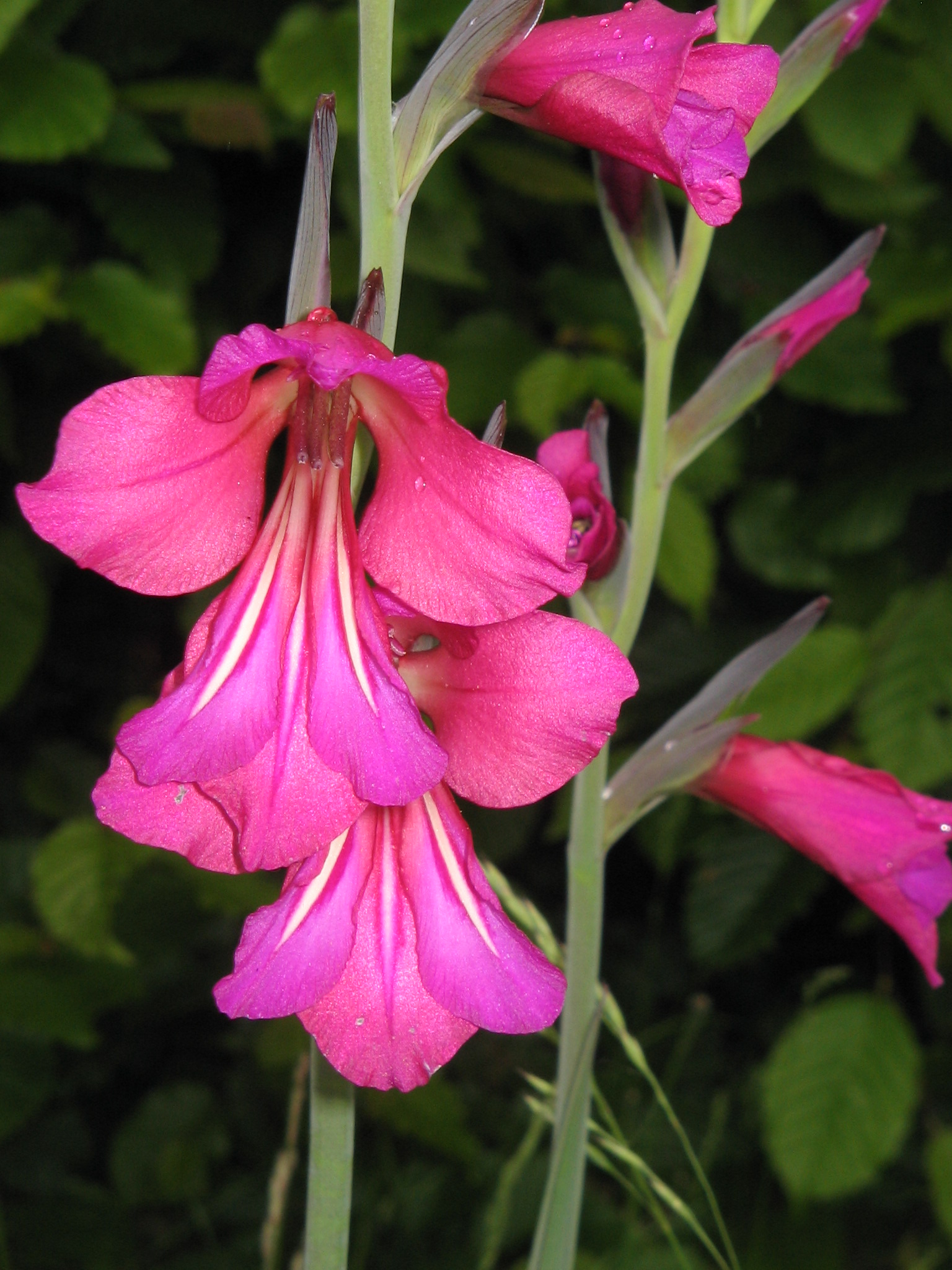
Gladiolus is a genus of perennial cormous flowering plants in the family Iridaceae, commonly known as gladioli or sword lilies. The plants grow from round, symmetrical corms wrapped in brownish fibrous tunics and typically produce unbranched stems bearing one to nine narrow, sword-shaped leaves arranged in upright fans — an architecture that gives the genus its Latin name, derived from gladius, the Roman sword.
In the wild, individual flowers range from small to roughly 40 mm across, while the towering spikes familiar from gardens and florists are the product of centuries of hybridisation and selection. Flowers open sequentially from bottom to top along slender stalks, displaying colours that span pink, reddish, and light purple with white contrasting markings, as well as white, cream, and orange to red. Wild species typically reach around 0.9 m in height.
With approximately 260 species endemic to southern Africa and the Cape Floristic Region as the clear centre of diversity, the genus also extends to roughly 76 species in tropical Africa and about 10 native to Eurasia including the Mediterranean. The three main horticultural hybrid groups — Grandiflorus, Primulines, and Nanus — trace their lineage to crosses between just four or five wild species.
Etymology
The genus name Gladiolus comes from Latin and is the diminutive form of gladius, meaning "sword." The name alludes to the narrow, sword-shaped leaves characteristic of all species in the genus. Carl Linnaeus formally adopted and published the name in 1753 in Species Plantarum, building on the earlier usage by Tournefort.
Distribution
The genus is predominantly African, with approximately 260 species endemic to southern Africa, centred on the Cape Floristic Region of South Africa. A further roughly 76 species occur in tropical Africa, and about 10 are native to Eurasia, distributed across Mediterranean Europe and western Asia. In Switzerland, four species are documented by Info Flora: Gladiolus communis, G. imbricatus, G. italicus, and G. palustris. Within southern Africa, native populations include the Drakensberg Mountains of KwaZulu-Natal.
Ecology
South African gladioli originally relied on long-tongued anthophorini bees for pollination, but over evolutionary time the genus has diversified its pollination systems to include sunbirds, hawk-moths, and flies — a range reflecting the breadth of floral forms across the genus. The plants serve as larval food sources for certain Lepidoptera and are frequently visited and damaged by thrips.
Cultivation
Gladioli thrive in full sun (at least six hours of direct light daily) in rich, well-drained loam with high organic matter. They tolerate most soils except heavy clay and prefer consistently damp but not waterlogged conditions. In USDA hardiness zones 7a–10b, hardier varieties can overwinter in the ground with heavy mulch; elsewhere, corms must be lifted after the first frost. For frost-free storage, corms are dried and kept in mesh bags with good air circulation at 2–5°C (35–41°F). Successive plantings every two weeks from spring onward extend the flowering season into autumn. Plants are excellent cut-flower subjects and suit border plantings, containers, and cutting gardens. Common pest and disease issues include aphids, thrips, spider mites, Botrytis, crown rot, rust, wilt, and mosaic virus; treating corms with insecticide and fungicide before storage helps limit recurrence.
Propagation
Gladioli can be propagated by two methods. The most straightforward is division: corms are dug in October after foliage dies back, dried at around 20°C, stored frost-free, and replanted in spring (approximately 10 cm deep in April). Parent corms naturally produce small offset cormlets that can be separated and grown on. The second method is seed, sown in spring at 15°C in a greenhouse where germination is reliable; both seed-raised plants and cormlet offsets require several years to reach flowering maturity.
Cultural Uses
Gladiolus has accumulated a range of cultural associations. It is the traditional birth flower for August and the flower given to mark 40th wedding anniversaries. In the Netherlands it is presented to every finisher of the International Four Days Marches Nijmegen, one of the world's largest walking events. The gladiolus is the symbolic flower of Punjab. The flowers are edible — raw or lightly cooked, they can be used in salads, as garnishes, or as natural serving vessels (with anthers removed) for dips and spreads, though their culinary use is minimal in most traditions. In art, Vincent van Gogh included gladioli in his 1886 painting "Vase with Red Gladioli," and Scott Joplin composed his "Gladiolus Rag" (1907). The word "gladiolus" achieved a footnote in American popular culture when it was the winning word at the inaugural US National Spelling Bee in 1925.
Taxonomy Notes
The genus Gladiolus Tourn. ex L. was formally established by Carl Linnaeus in Species Plantarum (1753) and sits within Order Asparagales, Family Iridaceae, Class Liliopsida (monocots). As of 2025, approximately 300 species and hybrids are recognised, with the GBIF backbone recording 423 described descendant taxa. Most wild species are diploid (2n=30); the Grandiflorus horticultural hybrids are tetraploid (2n=4x=60). Several former genera — including Acidanthera and Antholyza — have been synonymised into Gladiolus following molecular phylogenetic revision. The three principal horticultural hybrid groups are Grandiflorus, Primulines, and Nanus, all derived from crosses among four or five wild African species.










