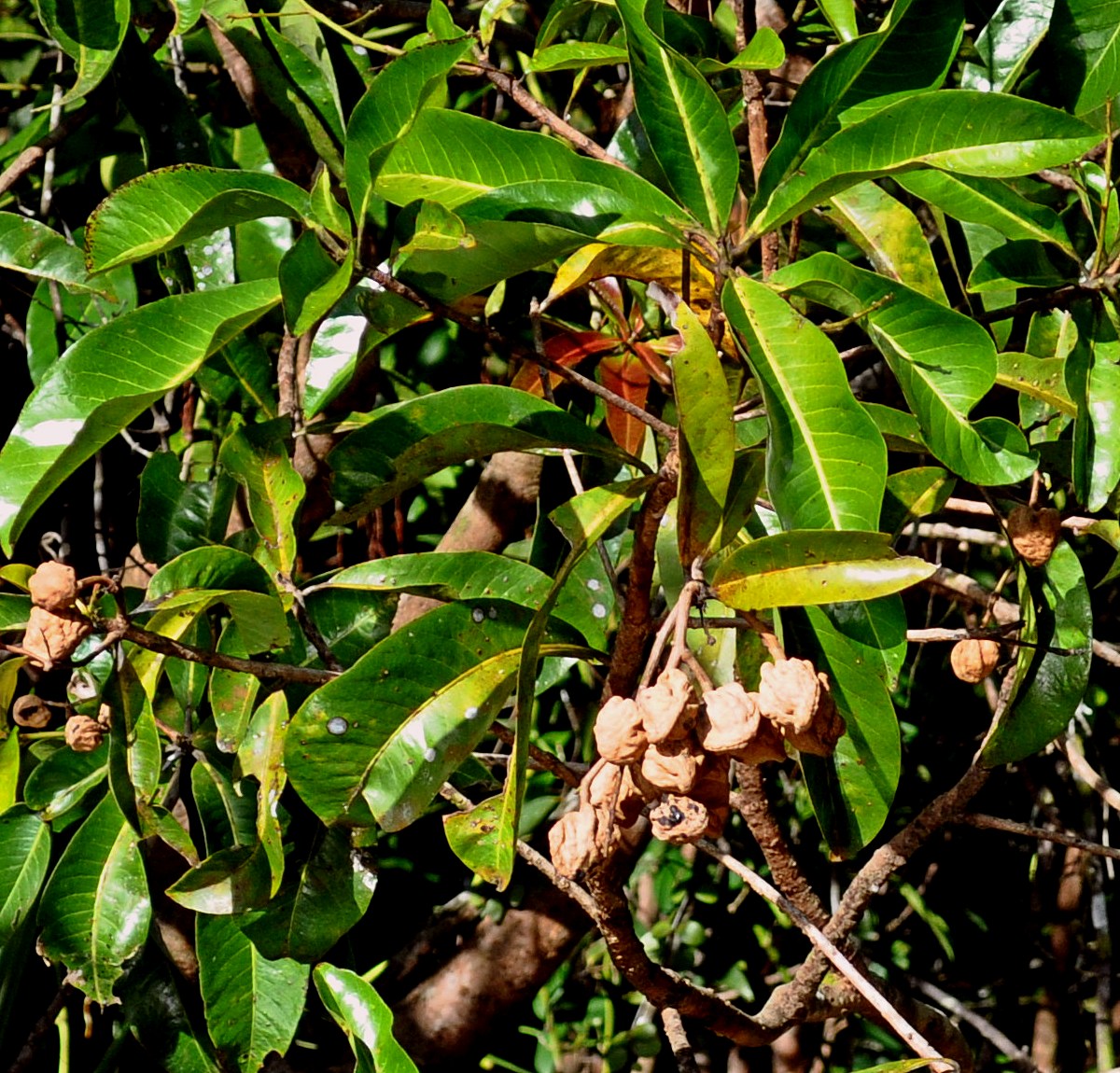
Gluta is a genus of tropical trees in the family Anacardiaceae (order Sapindales), placed in the subfamily Anacardioideae. The genus comprises around 35 accepted species, distributed from Madagascar and India through Indo-China and the Malay Archipelago (Malesia) to New Guinea.
Members of the genus are typically forest trees of considerable stature. Gluta wallichii, one of the best-documented species, reaches heights of up to 36 metres with trunk diameters of 50 centimetres and prominent buttress roots. The bark is brown to grey and scaly; the leaves are large, obovate to oblong; and the white flowers are borne in panicles. Several species favour swamp forests and lowland dipterocarp forests up to about 1,000 metres elevation.
A defining characteristic of the genus is the production of caustic, allergenic sap. Contact with the resinous exudate causes severe contact dermatitis in a manner comparable to poison ivy (Toxicodendron radicens) and poison oak. Smoke from burning wood can cause severe irritation, particularly to the eyes. Timber from certain species must be dried and seasoned for several years before it is safe to work or handle.
Economically, the most celebrated species is Gluta laccifera, long valued for the natural lacquer that can be tapped from its trunk. The collected sap is used as a varnish and, when thickened with sawdust or ash, as a cement and moulding compound. The heartwood is deep blood-red, darkening on exposure, and is prized for fine furniture, cabinetwork, decorative veneers, and joinery.
Until the revisionary work of Dutch botanist Ding Hou in 1978, many species now assigned to Gluta were placed in the related genus Melanorrhoea. Ding Hou's treatment consolidated the two genera, with Melanorrhoea names becoming synonyms under Gluta.
Distribution
Gluta species are native to a wide arc of tropical Asia, from Madagascar and India through Indo-China and the Malay Archipelago to New Guinea. Species such as Gluta wallichii are concentrated on the Sundaic islands (Borneo, Sumatra, Peninsular Malaysia), typically in swamp and lowland dipterocarp forests up to around 1,000 metres elevation.
Taxonomy Notes
The genus was substantially revised by Dutch botanist Ding Hou, who in 1978 transferred numerous species formerly placed in Melanorrhoea into Gluta, effectively subsuming that genus. Gluta wallichii, for example, was originally described as Melanorrhoea wallichii by Joseph Dalton Hooker in 1876. Plants of the World Online recognises approximately 35 accepted species as of 2025.
Cultural Uses
Gluta laccifera has been tapped for centuries across mainland Southeast Asia for its natural lacquer, which is applied as a wood varnish and, thickened with fillers, used as a moulding cement. The timber of lacquer-producing Gluta species — once safely dried and seasoned to dissipate volatile irritants — is valued for fine furniture, cabinetwork, and decorative veneers. The poisonous constituent of the sap is volatile and diminishes over several years of drying.
Ecology
Several Gluta species are characteristic trees of lowland swamp forests and dipterocarp forests in Sundaland. The genus's highly allergenic sap may function as a chemical deterrent against herbivores. The smoke from burning wood is an acute irritant, suggesting volatile urushiol-like compounds are present throughout the plant.










