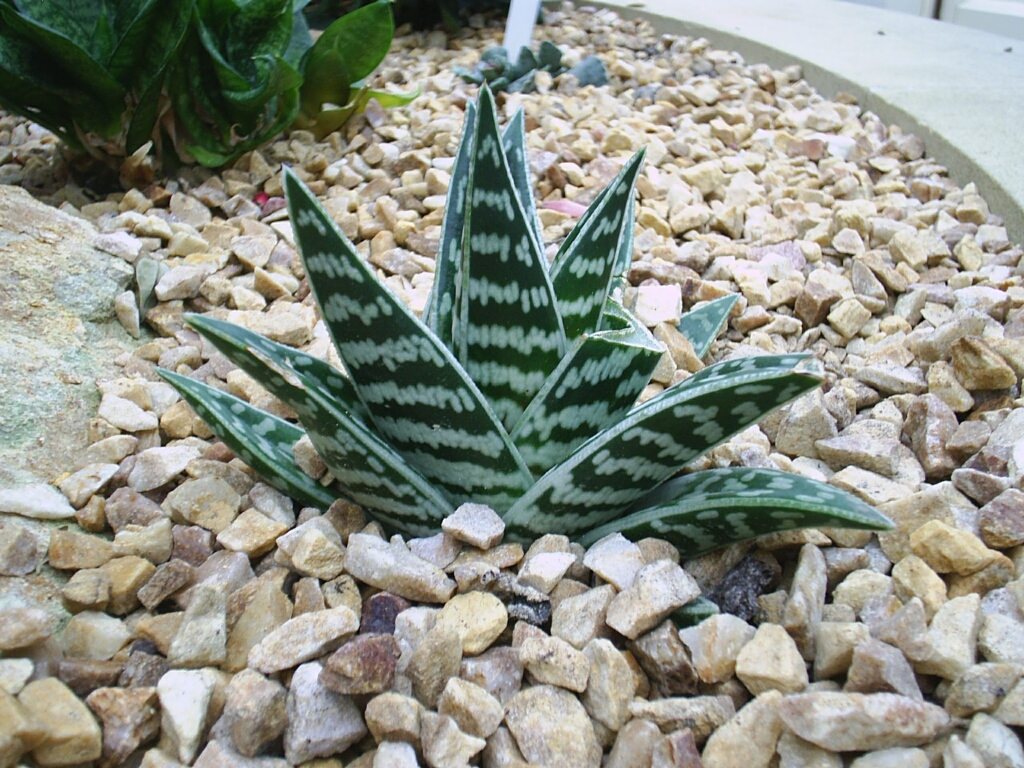
Gonialoe, commonly known as the partridge aloes, is a small genus of three succulent plant species in the family Asphodelaceae (order Asparagales). The genus is endemic to the coastal regions of southern Africa, occurring in South Africa, Namibia, and Angola.
All three species—Gonialoe variegata, Gonialoe sladeniana, and Gonialoe dinteri—share a distinctive growth form: compact rosettes with triangular, succulent leaves arranged in three vertical or spiraling ranks (trifarious), a feature that makes them easy to distinguish from other aloe relatives. This leaf arrangement is the defining morphological character of the genus.
Gonialoe was formerly included within the broader genus Aloe, but molecular phylogenetic studies revealed that Aloe as traditionally circumscribed is polyphyletic—meaning its members do not all share a single common ancestor exclusive to the group. As a result, Aloe was divided into several segregate genera, including Aloe, Kumara, Aloiampelos, and Gonialoe, among others. Phylogenetic analyses place Gonialoe closest to the related genera Astroloba and Tulista within the family Asphodelaceae.
Gonialoe variegata (formerly Aloe variegata, the tiger aloe or partridge-breasted aloe) is the best-known member of the genus and has long been cultivated as an ornamental succulent.
Distribution
Gonialoe is endemic to the coastal regions of southern Africa, with the three species distributed across South Africa, Namibia, and Angola.
Taxonomy Notes
Gonialoe was segregated from Aloe after phylogenetic studies demonstrated that Aloe sensu lato is polyphyletic. The genus belongs to Asphodelaceae (order Asparagales) and is most closely related to Astroloba and Tulista. The split has been supported by multiple independent phylogenetic analyses.










