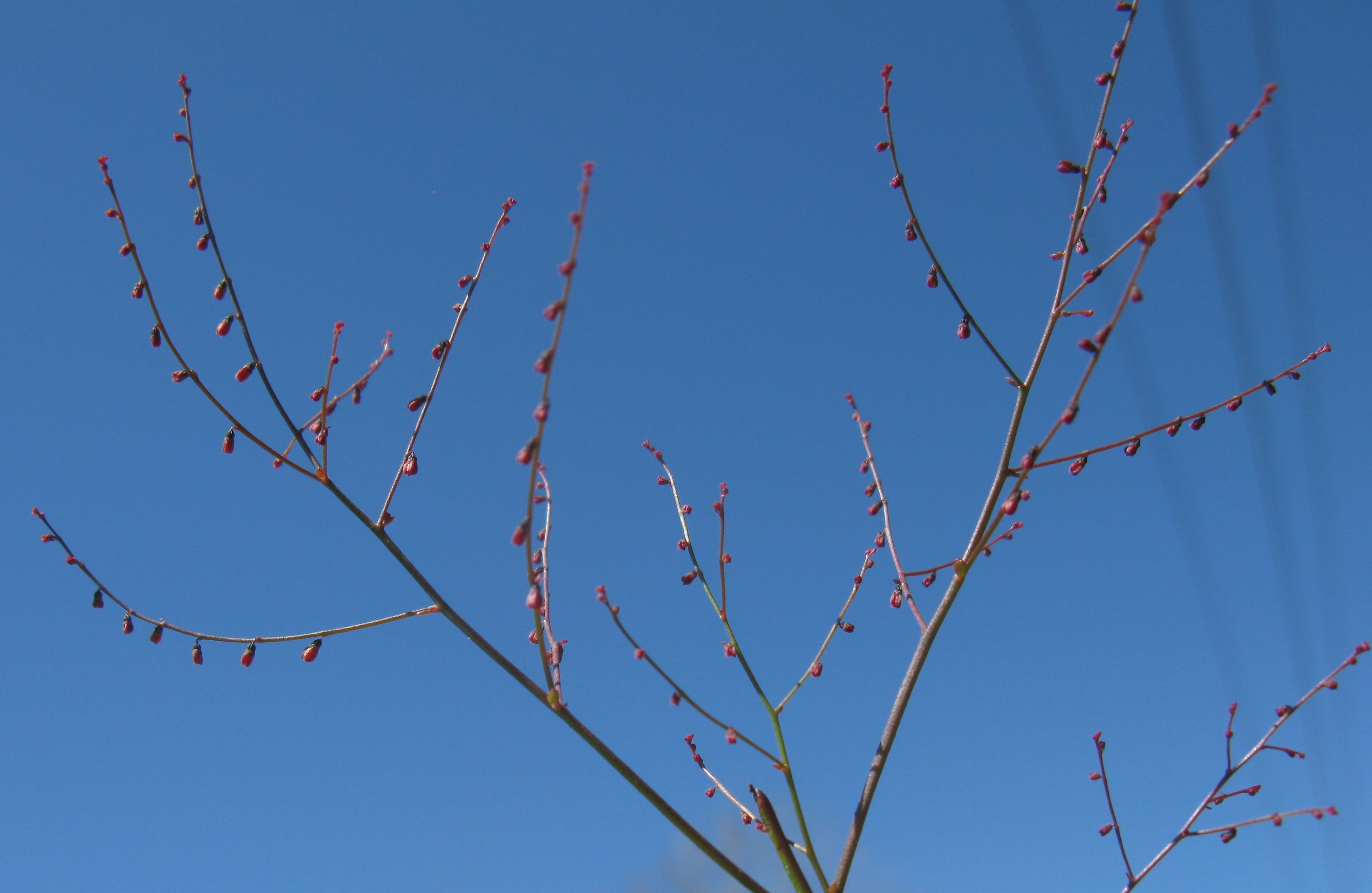
Gonocarpus, commonly known as raspworts, is a genus of flowering plants in the family Haloragaceae, placed in the order Saxifragales. The genus comprises around 41 species of annual or perennial herbs and subshrubs, distributed across Australia, New Zealand, and Malesia (Southeast Asian archipelago), with the great majority — some 36 species — endemic to Australia, where they occur across all states.
Plants are typically small to mid-sized herbs, sometimes slightly woody at the base, and may be glabrous, scabrous (rough-textured), or pilose (hairy). Leaves are simple and may be arranged alternately, oppositely, or rarely in whorls of three; they are sessile or short-petiolate, with margins that are entire or toothed. The inflorescences are indeterminate and spike-like, usually lateral on the stem. Flowers are small and typically 4-merous: four sepals (often bearing a prominent callus at the base and persisting in fruit) and four petals that are hooded and keeled, usually with a short claw. Stamens are normally eight, with short filaments; the ovary is incompletely 4-locular with mostly four styles. Fruit is ovoid to hemispherical, smooth or ribbed, and contains a single seed that fills the entire fruit cavity.
The genus includes both widespread and regionally restricted species. Well-known members include Gonocarpus tetragynus (common raspwort), Gonocarpus micranthus (creeping raspwort), and Gonocarpus humilis (shade raspwort). Most species inhabit open or lightly shaded habitats in sclerophyll vegetation, heathlands, and grasslands.
Etymology
The name Gonocarpus derives from Greek roots: gonos (angle, corner) and karpos (fruit), referring to the angled or ribbed fruits characteristic of many species in the genus. The common name "raspwort" alludes to the rough or scabrous texture of the stems and leaves found in several species.
Distribution
Gonocarpus is predominantly an Australasian genus. Of approximately 41 recognised species, around 36 are found in Australia, occurring across all states and territories. The remaining species extend into New Zealand and Malesia (the Malay Archipelago and adjacent islands). Within Australia, species grow in a wide range of habitats including heathlands, open sclerophyll forests, grasslands, and montane areas.
Taxonomy Notes
Gonocarpus belongs to the family Haloragaceae (order Saxifragales), a small family of mostly aquatic or semi-aquatic flowering plants. The genus was revised extensively by A.E. Orchard, who transferred many species formerly placed in Haloragis or described under other genera into Gonocarpus. Note that a separate Gonocarpus described by William Hamilton ("Ham.") is a synonym of Combretum (family Combretaceae) and is unrelated; the raspwort genus Gonocarpus Thunb. has nomenclatural priority.

