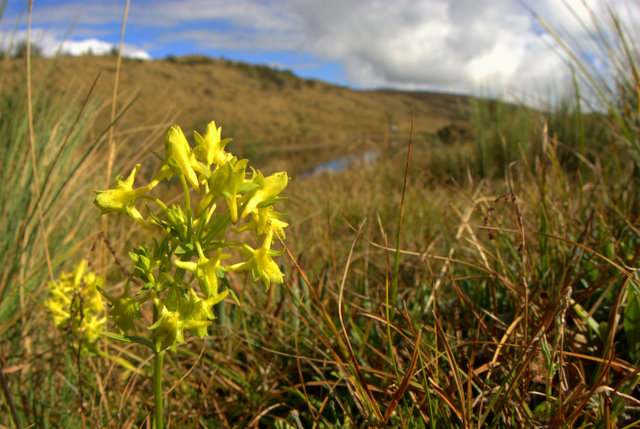
Halenia, commonly known as spurred gentians, is a genus of annual and occasionally perennial herbs in the family Gentianaceae (order Gentianales). The genus comprises approximately 40 to 100 species — estimates vary between regional flora treatments — distributed primarily across the Americas from North America through Central America to South America, with a smaller representation in Asia and Europe.
Plants are typically glabrous herbs with opposite or rarely whorled leaves that may be sessile or, in basal and proximal-cauline positions, slightly petiolate. The inflorescences are cymes, often umbelloid in form, or thyrses. The most distinctive feature of the genus is the corolla: flowers are 4-merous, campanulate (bell-shaped), and bear four conspicuous nectar spurs — one projecting outward from the base of each corolla lobe — which gives the plants their common name and sets them apart from most other members of Gentianaceae. Corolla color ranges from yellow or pale green through violet; the calyx is lobed nearly to the base. Stamens are inserted in the corolla sinuses, and the stigma is 2-lobed. Fruits are compressed-ovoid capsules containing many seeds with an almost smooth seed coat.
The genus was established by Moritz Balthasar Borkhausen in 1796, and was comprehensively monographed for the American species by C. K. Allen in 1933. In North America, the most widespread native species is Halenia deflexa, found across eastern regions; the neotropical H. brevicornis reaches northwestern Chihuahua in Mexico. In China, two species occur: H. corniculata (yellow-flowered, found across Siberia and temperate Asia) and H. elliptica (blue-to-purple flowered, widespread at higher elevations in China and the Himalayas). The genus occupies temperate to alpine habitats across its range.
Etymology
The genus name Halenia was given by Moritz Balthasar Borkhausen in 1796 in honor of Jonas Petersson Halenius (1727–1810), a Swedish physician and botanist who studied under Carl Linnaeus. The common name "spurred gentian" refers to the four distinctive nectar-bearing spurs projecting from the base of the corolla tube, the most visually arresting trait of the genus.
Distribution
Halenia occurs across temperate to alpine zones of the Americas — from eastern North America (primarily H. deflexa) through Mexico, Central America, and the length of South America — and extends into Asia and Europe, where only a handful of species are found. In China, just two species occur (H. corniculata and H. elliptica), with the bulk of diversity concentrated in the Andean highlands and adjacent regions of Latin America.
Taxonomy Notes
Halenia was established by Borkhausen in Arch. Bot. (Leipzig) 1(1): 25 (1796) and is placed in the family Gentianaceae, order Gentianales. The genus was monographed for its American species by C. K. Allen in 1933 (Ann. Missouri Bot. Gard. 20: 119–222). Species counts differ between flora treatments: Flora of North America recognizes approximately 40 species, while Flora of China states approximately 100; the discrepancy likely reflects differing species concepts and the inclusion of neotropical taxa. The base chromosome number is x = 11. GBIF currently accepts the genus with 3 confirmed descendant taxa, reflecting differences in coverage rather than actual species richness.

