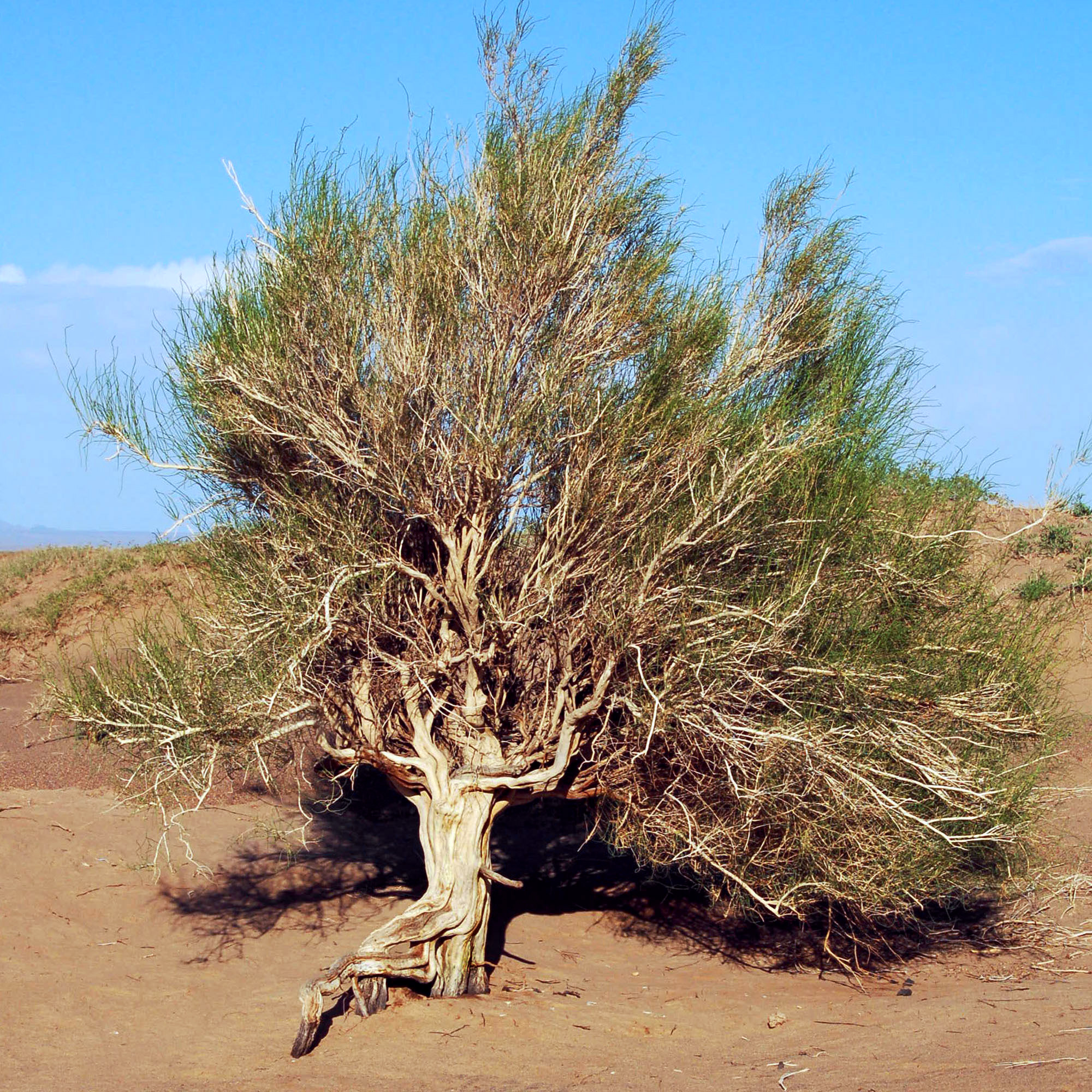
Haloxylon is a genus of shrubs and small trees in the family Amaranthaceae (order Caryophyllales), commonly known as saxaul. The genus comprises around 11 accepted species, distributed across the arid and semi-arid landscapes of southwest and Central Asia — from Egypt in the west to Mongolia and the Chinese provinces of Xinjiang and Gansu in the east.
Plants typically grow 1–8 metres tall, occasionally reaching 12 metres. They develop a thick, gnarled trunk with numerous spreading branches; the branches produced in the current growing season are green, and may be erect or pendant. Leaves are highly reduced to small, scale-like structures, an adaptation to desert conditions. Flowers are very small and bisexual or male, borne on short shoots along the previous year's stems. In fruit, the perianth segments expand into spreading wings, producing a winged fruit approximately 8 millimetres in diameter.
Haloxylon species are psammophytes — plants adapted to sandy desert soils. Their extensive root systems anchor shifting sands, making them ecologically important in Central Asian desert ecosystems. Dense stands of saxaul woodland support a suite of specialist wildlife, including the saxaul sparrow (Passer ammodendri).
The genus was formally described by the Russian-German botanist Alexander Bunge (ex Eduard Fenzl) in 1851, with Haloxylon ammodendron (black saxaul) as the type species. It is placed in the subfamily Salsoloideae within Amaranthaceae. Phylogenetic studies have led to the transfer of several former Haloxylon species to the genus Hammada, and Haloxylon stocksii has been reclassified as Soda stocksii.
Notable species include H. ammodendron (black saxaul), prized for its extremely dense, waterlogged wood, and H. persicum (white saxaul), which colonises deep sandy desert substrates. Both species have long been used by Central Asian nomads as firewood and have been planted extensively for ecological restoration, most notably on the exposed bed of the shrinking Aral Sea.
Etymology
The genus name Haloxylon derives from Greek, meaning "salt wood" — a reference to the saline desert habitats where these plants grow. The vernacular name saxaul (also spelled sacsaoul or saksaul) entered English via Russian саксаул (saksaul), which was itself borrowed from the Kazakh word сексеуiл (seksewil).
Distribution
Haloxylon is distributed across southwest and Central Asia, ranging from Egypt in the west through the Arabian Peninsula, Iran, Afghanistan, and the Central Asian republics to Mongolia and western China (Xinjiang and Gansu). Species grow predominantly in sandy desert and semi-desert habitats, functioning as psammophytes adapted to shifting dune systems and loose soils.
Ecology
In the deserts of Central Asia, saxaul woodland forms a structurally important habitat supporting numerous bird species, including the saxaul sparrow (Passer ammodendri). The deep, spreading root systems of Haloxylon plants stabilise sandy substrates, reducing wind erosion. This ecological role has been applied deliberately on the exposed former bed of the Aral Sea, where large-scale saxaul planting programmes aim to halt the wind dispersal of contaminated sediments across populated areas.
Cultural Uses
Haloxylon wood is exceptionally dense and slow-burning, making it a traditional and valued fuel source for nomadic peoples across the Central Asian steppes. Despite the arid and often remote environments where these trees grow, they have been harvested for firewood for centuries. In more recent times, saxaul has been planted on a large scale for ecological restoration, particularly on the dried Aral Sea bed, where it is used to stabilise contaminated sand and prevent further environmental degradation.
Taxonomy Notes
The genus Haloxylon was established by Alexander Bunge (ex Eduard Fenzl) in 1851, with Haloxylon ammodendron as the type species. It belongs to the subfamily Salsoloideae of Amaranthaceae. Plants of the World Online recognised 11 species as of February 2026. Phylogenetic analysis has shown that several species formerly included in Haloxylon are not closely related to the core genus; these have been transferred to Hammada. Additionally, Haloxylon stocksii (synonym H. recurvum) has been moved to Soda stocksii. Note: GBIF places the genus under the family name Chenopodiaceae, which is the older synonym for Amaranthaceae sensu lato used in some backbone treatments.










