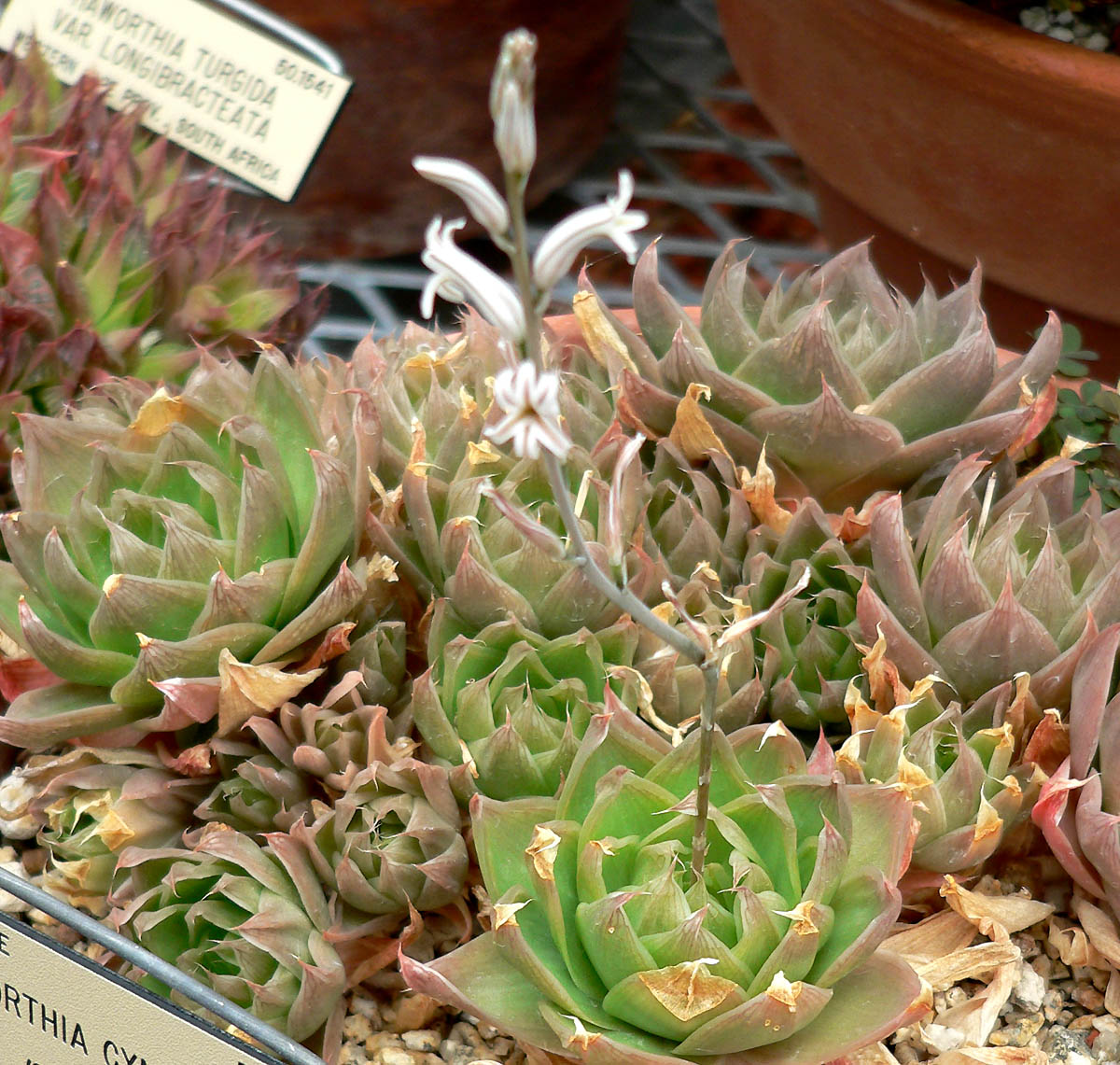
Haworthia is a genus of small succulent plants in the family Asphodelaceae (tribe Aloeae), native to Southern Africa. Plants form compact rosettes typically 3 to 30 centimetres in diameter, with firm, fleshy leaves that are usually dark green. The genus is notable for its morphological diversity: some species carry hard, opaque leaves with raised white tubercles or stripes, while others feature translucent "windows" at the leaf tips that allow diffuse light to reach the internal photosynthetic tissues — an adaptation for growing in shaded or partially buried conditions in the wild.
Flowers are small and generally white, borne on slender racemes that extend well above the rosette. All species are perennials, and many freely produce offsets (pups) around the base, giving rise to clustering mats over time.
The genus was described by Henri Auguste Duval in 1809 and named in honour of the British botanist and succulent collector Adrian Hardy Haworth (1767–1833). In its traditional circumscription Haworthia was divided into three subgenera, but phylogenetic studies demonstrated the group was polyphyletic. As a result, the subgenus Hexangulares was transferred to the genus Haworthiopsis, and the subgenus Robustipedunculares to Tulista, leaving a narrower but more natural Haworthia. The number of accepted species varies considerably by authority: B. Bayer's 2012 conservative treatment recognised approximately 60, whereas other taxonomists recognise considerably more.
In their native range — primarily the Western and Eastern Cape provinces of South Africa, with outliers in Namibia, Eswatini, and coastal Mozambique — Haworthias grow in rocky outcrops, sandy soils, and under the partial shade of shrubs or rock overhangs. They are adapted to excellent drainage and tolerate periods of drought. Their modest size, tolerance of lower light, and minimal care requirements have made them among the most popular succulent houseplants worldwide.
Etymology
The genus name Haworthia was given by Henri Auguste Duval in 1809 to honour Adrian Hardy Haworth (1767–1833), an English botanist, entomologist, and devoted succulent plant collector. Haworth is best known for his monograph Synopsis Plantarum Succulentarum (1812), which systematised many Southern African succulents then new to European science. Individual species epithets within the genus often describe leaf shape: cymbiformis (boat-shaped), truncata (truncated or cut off), and retusa (blunt or rounded).
Distribution
Haworthia is endemic to Southern Africa. The great majority of species occur within South Africa, with the highest concentration of diversity in the Western Cape and Eastern Cape provinces. Some species extend into adjacent territories: southern Namibia, Eswatini (formerly Swaziland), Lesotho, and the coastal lowlands of southern Mozambique (Maputaland). No species are native outside this region.
Taxonomy
Haworthia was established by H.A. Duval in 1809 within what is now the family Asphodelaceae, tribe Aloeae. For most of the twentieth century, the genus was divided into three informal subgenera — Haworthia, Hexangulares, and Robustipedunculares — based on stem, flower, and leaf characters. Molecular phylogenetic analyses eventually showed these groupings did not reflect true evolutionary relationships: the Hexangulares clade is more closely allied to Gasteria, while the Robustipedunculares clade is closer to Astroloba, and the remaining core Haworthia forms an outgroup to Aloe. To restore monophyly, those two clades were segregated into the genera Haworthiopsis and Tulista. Species limits within the residual Haworthia remain contentious, with species counts ranging from about 60 (Bayer 2012, conservative) to well over 100 in broader treatments, owing to the large number of varieties, forms, and synonyms accumulated over two centuries of collection and description.
Ecology
In their natural habitat, Haworthia species favour semi-shaded microsites — beneath shrubs, in rock crevices, or sheltered under overhangs — where direct sun is filtered for at least part of the day. This light regime is associated with the leaf-window adaptation found in several species, which maximises photosynthesis under low-light conditions. Soils are typically thin, sandy, or rocky with very rapid drainage; waterlogging is fatal. The genus is drought-adapted and survives extended dry periods through its succulent leaf tissue. Offsets allow clonal spread in stable populations.
Cultivation
Haworthias are among the most beginner-friendly succulents. They perform well in bright indirect light or filtered sun; while they tolerate lower light than most succulents, direct midday sun can scorch the leaves. A position near a well-lit window is generally ideal indoors. Outdoors they are reliably hardy in USDA zones 9–11 and can be grown year-round where frosts are absent or rare.
The most critical cultural requirement is sharp drainage. A gritty, sandy potting mix — purpose-blended cactus-and-succulent compost or a standard mix amended with perlite — should be used, and pots must have drainage holes. Watering should be thorough but infrequent: allow the medium to dry out completely between waterings. Overwatering is the leading cause of failure and leads to root rot. During winter dormancy, watering can be reduced further.
Average household humidity and temperature are adequate. Because of their small size, Haworthias are well suited to terrariums, dish gardens, and desktop or windowsill displays. They are also suitable for outdoor rock gardens and succulent beds in frost-free climates.
Propagation
The most reliable method of propagation is division of offsets (pups), which most species produce freely around the base of the mother rosette. Offsets can be separated once they have developed their own roots, then potted individually into a well-draining mix and kept slightly drier than usual until established.
Leaf cuttings are possible but less consistent: a healthy leaf is removed cleanly at the base, allowed to callus for a day or two, then laid on or partially inserted into a dry, gritty medium. Success rates vary by species. Seed propagation is straightforward but slow; fresh seed germinates more readily and seedlings require several years to reach mature size. Tissue culture is used commercially for some cultivars.
Cultural Uses
Haworthias are grown primarily as ornamental plants. Their compact size, low light tolerance, and minimal watering needs have made them one of the most widely sold succulent genera worldwide, appearing in garden centres, supermarkets, and online plant shops. They are popular as desktop houseplants, windowsill collections, and elements of dish-garden arrangements. Species such as Haworthia cymbiformis enjoy particular popularity among casual houseplant growers, while the broader genus has a substantial specialist collector community that prizes unusual forms, hybrids, and cultivars — particularly windowed species and variegated selections. No significant medicinal, food, or industrial uses are documented.










