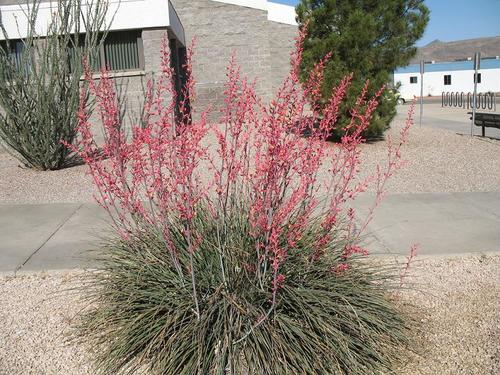
Hesperaloe is a small genus of perennial, yucca-like flowering plants in the family Asparagaceae (subfamily Agavoideae), order Asparagales. Native to the arid and semi-arid regions of Texas and northern Mexico, the roughly eight to nine accepted species form striking basal rosettes of long, narrow, fibrous leaves — often with curling white filaments along the leaf margins — and send up tall panicles or racemes of tubular flowers in shades of red, coral, pink, or white, depending on species.
Despite the superficial resemblance to both yuccas and aloes, Hesperaloe is not closely related to either genus: Aloe belongs to an entirely different family (Asphodelaceae), while the similarities to yucca are convergent adaptations to arid habitats. The genus name reflects this western affinity, deriving from the Greek hesperos ("western") combined with aloe, acknowledging the aloe-like appearance of the plants.
The most widely cultivated species is Hesperaloe parviflora (red yucca), prized in xeriscape and drought-tolerant landscaping across the American Southwest and beyond for its coral-red flowers that attract hummingbirds and its tolerance of heat, drought, and poor soils. Other species include Hesperaloe funifera (giant hesperaloe), which produces white flowers and is notable for its very large stature, and Hesperaloe nocturna, whose white flowers open at night.
Etymology
The name Hesperaloe combines the Greek ἕσπερος (hesperos, meaning "western") with aloe, reflecting both the plants' geographic origin in the western part of North America and their visual resemblance to Aloe. Despite this name, Hesperaloe is not closely related to true aloes (Aloe spp.), which belong to the family Asphodelaceae.
Distribution
Hesperaloe species are native to the arid and semi-arid zones of Texas in the United States and adjacent northern Mexico. Their range encompasses the Chihuahuan Desert and surrounding desert scrub, where they grow in rocky and well-drained soils. Several species are widely cultivated well outside their native range as drought-tolerant ornamentals.
Cultivation
Members of Hesperaloe are popular xerophytic ornamentals, particularly in xeriscape gardens and low-water landscaping across the American Southwest. They thrive in full sun with excellent drainage and minimal supplemental irrigation once established, tolerating heat, poor soils, and periodic drought. Hesperaloe parviflora is the most commonly cultivated species, valued for its long-blooming coral-red flowers that attract hummingbirds.

