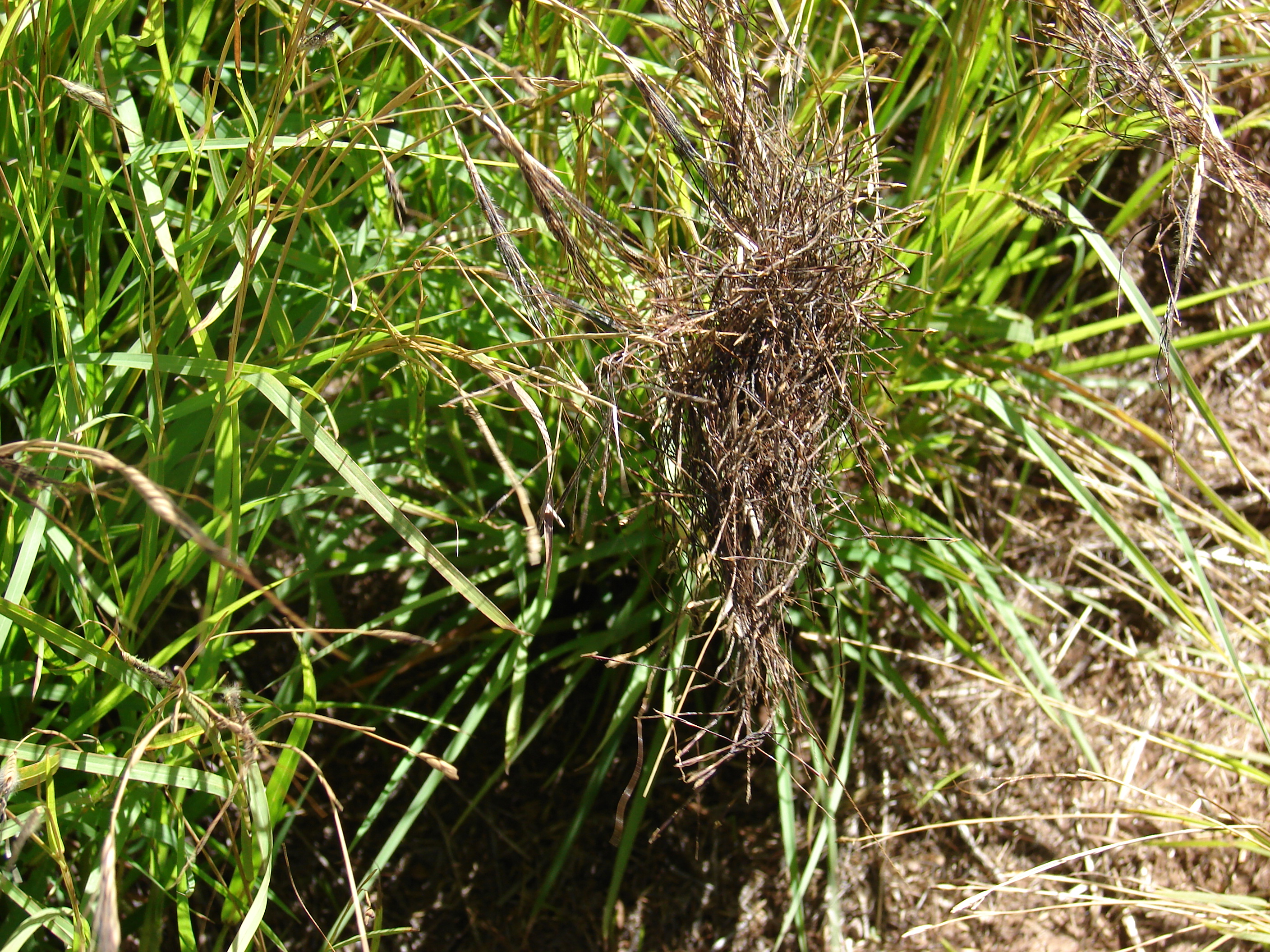
Heteropogon, commonly known as tangleheads, is a genus of annual and perennial grasses in the family Poaceae (order Poales), distributed primarily across tropical and subtropical regions of Africa, Asia, Australia, Europe, and the Americas.
Plants grow as erect tussocks. Their most distinctive feature is a unique paired-spikelet arrangement: lower pairs along the inflorescence are homogamous (equal in size and form), while upper pairs are heterogamous — one spikelet is bisexual and carries a prominent awn, and the other is sterile and awnless. This dimorphic structure is the morphological basis of the genus name and distinguishes tangleheads from many related grass genera.
The genus contains around seven accepted species. The most ecologically significant is Heteropogon contortus, a pantropical grass found from Africa and southern Asia across to Australia, the Pacific Islands, and the Americas, where it is considered a major component of tropical savannas and grasslands. Heteropogon melanocarpus is another widespread species ranging across the Americas, Africa, Madagascar, and parts of Asia. Heteropogon triticeus occurs in Southeast Asia, New Guinea, Queensland, and the Indian subcontinent.
Heteropogon belongs to the subfamily Panicoideae and tribe Andropogoneae. Several genera once included within Heteropogon — among them Dichanthium, Hyparrhenia, and Trachypogon — are now recognized as distinct genera.
Etymology
The genus name Heteropogon is derived from the Ancient Greek words ἕτερος (héteros, "different") and πώγων (pṓgōn, "beard"), a reference to the unlike spikelets of each pair — one bearing a prominent awn ("beard") and one without.
Distribution
Tangleheads are widespread across tropical and subtropical zones worldwide. Heteropogon contortus, the most range-extensive species, occurs across Africa, southern Asia, southwestern Europe (Spain, France, Italy, Switzerland, the Balkans), Mesoamerica, the West Indies, tropical South America, the southern United States, northern Australia, and various oceanic islands. Other species are largely restricted to South and Southeast Asia or the Americas.
Ecology
The genus is characteristic of open tropical savannas, dry grasslands, and disturbed sites. Heteropogon contortus is particularly noted as a dominant or co-dominant grass of tropical grasslands and is associated with fire-maintained savanna ecosystems across Africa, Asia, and Australia.
Taxonomy Notes
Heteropogon is placed in the tribe Andropogoneae within the subfamily Panicoideae of Poaceae. A number of genera previously treated within Heteropogon or closely allied to it have been segregated: Agenium, Dichanthium, Diectomis, Diheteropogon, Elymandra, Hyparrhenia, Parahyparrhenia, and Trachypogon are all now recognized as distinct genera. GBIF currently accepts 7 species in the genus.










