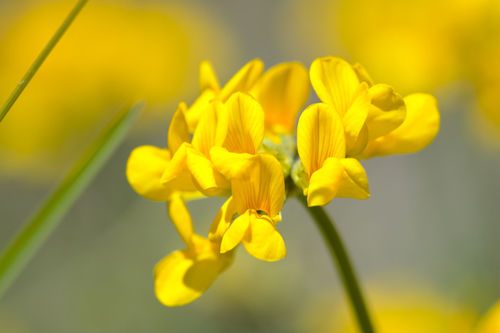
Hippocrepis is a genus of flowering plants in the legume family, Fabaceae (order Rosales), comprising approximately 34 accepted species. The genus is distributed across Europe, northern Africa, and western Asia, with its greatest diversity centred on the Mediterranean basin.
Members of Hippocrepis are herbaceous or sub-shrubby plants whose most distinctive feature is their lobed, horseshoe-shaped pod segments — the trait that gives the genus its name (from the Greek hippo-, "horse", and -krepis, "shoe"). This segmented fruit breaks apart at maturity into single-seeded horseshoe-shaped units, a strategy for dispersal.
Among the best-known species is Hippocrepis comosa (horseshoe vetch), a low-growing perennial of calcareous grasslands in western and central Europe. It is an important larval food plant for several chalk-grassland butterflies, notably the Adonis blue (Polyommatus bellargus) and the chalkhill blue (Polyommatus coridon), giving the genus ecological significance beyond its modest stature. Other species include Hippocrepis emerus (scorpion senna), a shrubby species sometimes placed in the genus Coronilla, and the Balearic endemic Hippocrepis balearica.
Etymology
The name Hippocrepis derives from the Greek words hippo- ("horse") and -krepis ("shoe"), meaning literally "horseshoe." This name is descriptive of the characteristic shape of the fruit segments found in many species of the genus.
Distribution
Hippocrepis is native to Europe, northern Africa, and western Asia, with the majority of its approximately 34 species concentrated in the Mediterranean region. The genus occupies a range of habitats including calcareous grasslands, rocky slopes, and scrubland.
Ecology
Several Hippocrepis species, most notably H. comosa (horseshoe vetch), are key larval food plants for chalk-grassland butterflies including the Adonis blue and chalkhill blue in western and central Europe. The genus is predominantly associated with well-drained, calcareous substrates such as chalk and limestone grasslands and rocky hillsides.










