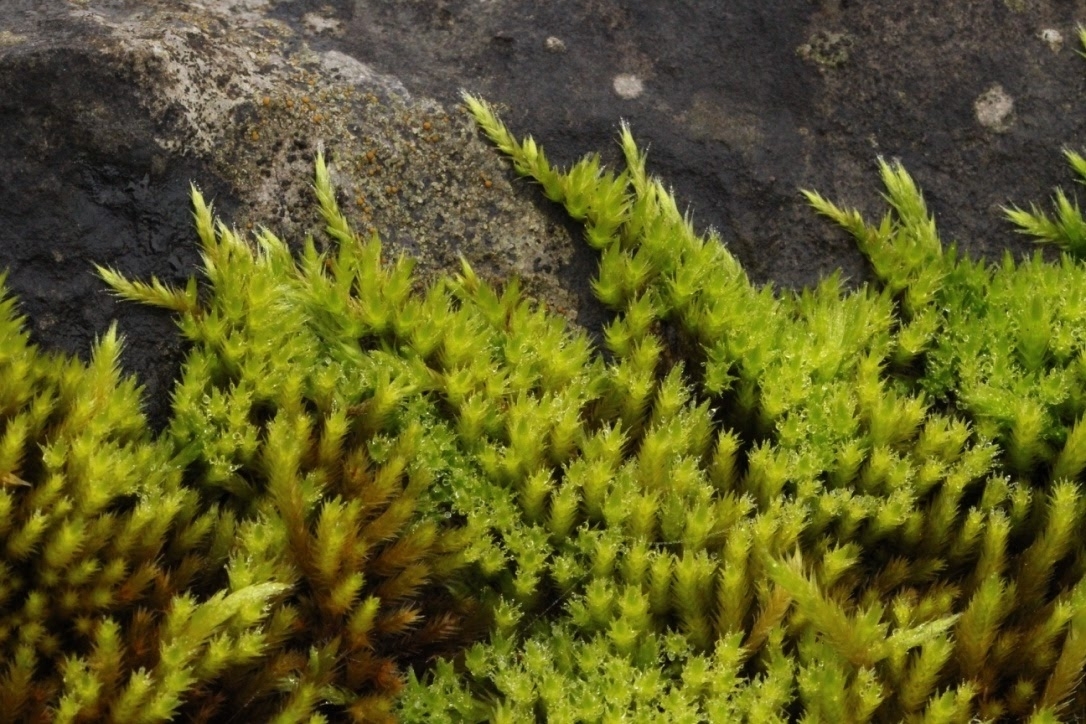
Homalothecium is a genus of pleurocarpous mosses in the family Brachytheciaceae, order Hypnales. The genus was established by Wilhelm Philipp Schimper in his landmark 1851 work Bryologia Europaea, with Homalothecium sericeum serving as the type species. It belongs to the phylum Bryophyta (true mosses) and the class Bryopsida, the largest and most diverse class of mosses.
Members of Brachytheciaceae are typically pleurocarpous — meaning they produce sporophytes (capsules) on short lateral branches rather than at the tips of the main shoots — and form creeping to loosely ascending mats on their substrates. The genus name reflects a characteristic smoothness or uniformity of the theca (capsule). Species in Homalothecium are generally small to medium-sized mosses with silky, often golden-green to yellow-green coloration; H. sericeum, whose epithet means "silky," is a familiar example of this sheen.
The genus encompasses roughly 26 accepted species worldwide. Its closest relatives and older synonyms include Camptothecium Schimp. and Trachybryum (Broth.) W.B. Schofield, names that now fall within Homalothecium. Species are distributed across temperate and boreal regions of Europe and North America, with H. sericeum and H. lutescens among the most frequently recorded in the British Isles, Scandinavia, and France.
Etymology
The genus name Homalothecium is derived from the Greek homalos (smooth, even) and theke (box or case), referring to the smooth capsule (theca) that characterises the sporophytes. The genus was named by W. P. Schimper in 1851.
Distribution
Homalothecium has its centre of diversity in temperate Europe; GBIF records show the highest occurrence counts in Great Britain, Sweden, France, Belgium, the Netherlands, Norway, and Denmark. The genus also has a significant presence in North America, particularly in the United States and Canada, and individual species extend into Spain, Switzerland, Poland, and Ireland.
Taxonomy Notes
The genus was established by Schimper in Bryologia Europaea (1851, fasc. 46–47) and has absorbed several synonymous genera over time, including Camptothecium Schimp., Camplothecium Schimp. ex Schur, and Trachybryum (Broth.) W.B. Schofield. The type species is Homalothecium sericeum (Hedw.) Schimp. GBIF places it in family Brachytheciaceae, order Hypnales, class Bryopsida, phylum Bryophyta.

