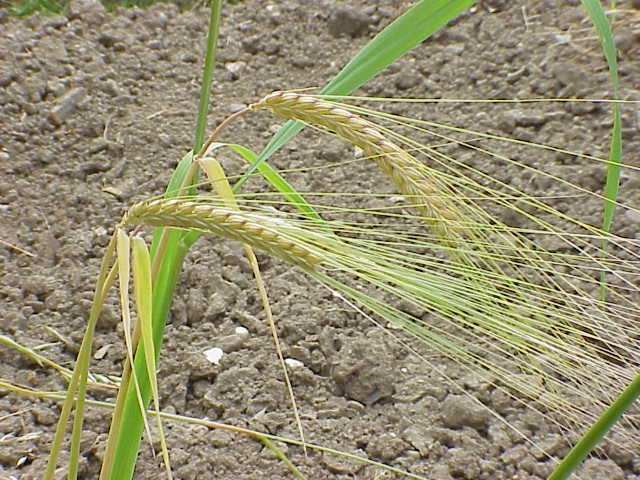
Hordeum is a genus of grasses in the family Poaceae, encompassing roughly 30 to 32 accepted species of annuals and perennials. Commonly known as the barleys, the genus was formally described by Carl Linnaeus in 1753 in his foundational work Species Plantarum. It belongs to the subfamily Pooideae and the tribe Triticeae — a group that also includes wheat (Triticum) and rye (Secale).
Plants in the genus are cespitose (forming tufts) or sometimes shortly rhizomatous, with culms that can reach up to 150 cm in height. The most diagnostic characteristic is the spikelike inflorescence bearing three spikelets at each node, with disarticulation occurring along the rachis so that spikelets fall in triplets. The genus displays polyploid variation, with chromosome counts of 2n = 14, 28, and 42 recorded across species.
The genus is distributed across the temperate zones of Africa, Eurasia, and the Americas, with particularly rich diversity in the Mediterranean, Central Asia, and South America (especially Argentina and Chile). Several species have naturalized widely and are common weeds of disturbed ground, roadsides, and arable land.
Hordeum vulgare, domesticated barley, is the most economically significant member of the genus and one of the world's most important cereal crops. Cultivated since at least the Neolithic period in the Near East, barley is grown globally for human food, animal fodder, and — critically for malting — the production of beer and whiskey. The ornamental species Hordeum jubatum (foxtail barley) is widely recognized for its silky, arching, often purplish-tinged awns and is cultivated as a garden plant, though it readily escapes and can become a weed in pastures.
Etymology
The genus name Hordeum is the classical Latin word for barley. It derives from the Latin verb horreō or horrēre, meaning "to bristle" or "to stand on end" — a reference to the prominent bristle-like awns that characterize the inflorescences of most species in the genus. The same Latin root gives English the word "horror." Linnaeus formalized the name in Species Plantarum in 1753, where it appears on page 84.
Distribution
Hordeum is a temperate-zone genus with a natural range spanning Africa, Eurasia, and the Americas. Diversity centers include the Mediterranean basin, the steppe and semi-arid zones of Central Asia, and the southern cone of South America, particularly Argentina and Chile. The genus is also well represented in western and southwestern North America, where species such as H. brachyantherum, H. jubatum, and H. pusillum occur in native grasslands, meadows, and disturbed habitats. In Europe, H. murinum (wall barley) and H. secalinum (meadow barley) are widespread, and both H. murinum subsp. murinum and subsp. leporinum are documented across the continent including Switzerland. Several species have been introduced far beyond their native ranges through agriculture and the movement of livestock, and now occur as naturalized weeds on multiple continents.
Ecology
Hordeum species occupy a broad range of habitats from coastal saltmarshes and wet meadows to semi-arid steppes and disturbed roadsides, reflecting the genus's wide ecological amplitude. Growth habit varies from annual to perennial, with some species forming dense tufts (cespitose) and others spreading by short rhizomes. The genus exhibits polyploidy, with chromosome counts of 2n = 14, 28, and 42, which has contributed to its adaptability and to hybridization events that complicate species boundaries. Larvae of certain Lepidoptera, including the flame moth and rustic shoulder-knot, feed on Hordeum species, integrating the genus into temperate grassland food webs. Some members of the genus — notably H. murinum and H. jubatum — have become significant weeds of disturbed ground, pastures, and agricultural margins globally, spreading readily after disturbance.
Cultural Uses
Barley (Hordeum vulgare) is one of humanity's oldest and most widely cultivated cereal crops, first domesticated in the Fertile Crescent of the Near East during the Neolithic period. It has been a dietary staple and fermentation substrate across cultures for millennia. Today it is grown globally as a food grain, as fodder for livestock, and — most significantly in industrial terms — as the primary malting grain for the brewing of beer and the distillation of whiskey and other spirits. Barley malt provides fermentable sugars and contributes enzymes and flavor compounds fundamental to brewing. Beyond H. vulgare, the genus has cultural resonance as ornamental plants: Hordeum jubatum is cultivated in gardens worldwide for its decorative feathery seed heads, which are also used in dried flower arrangements.
Taxonomy Notes
Hordeum L. is the accepted genus name, published by Linnaeus in Species Plantarum (1753, p. 84). It is placed in the family Poaceae, subfamily Pooideae, tribe Triticeae — a tribe notable for containing the most economically important temperate cereals. The type species is Hordeum vulgare L.
The GBIF backbone recognizes 211 descendant taxa across all ranks within the genus. Estimates of accepted species-level diversity typically fall around 30 to 32 species, with the remainder being subspecies, varieties, synonyms, and cultivar groups. Over the history of botanical taxonomy, numerous species formerly placed in Hordeum have been transferred to related genera such as Elymus, Leymus, and Arrhenatherum as molecular phylogenetics has refined circumscriptions within Triticeae.
Within the Swiss checklist, Hordeum distichon L. is treated as a taxon distinct from H. vulgare, reflecting ongoing disagreement over whether two-row barley should be ranked as a species or subspecies.










