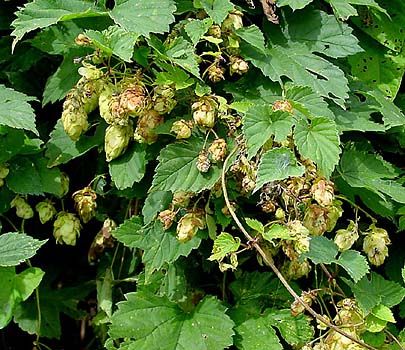
Humulus, commonly known as hops, is a small genus of twining perennial herbaceous plants in the family Cannabaceae, placed in the order Rosales. The genus contains only a handful of species, all native to temperate regions of the Northern Hemisphere, spanning North America, Europe, and Asia.
Unlike true vines, which climb using tendrils or suckers, Humulus species are technically bines: they ascend by wrapping their stout, bristle-covered stems clockwise around any available support, reaching heights of 2 to 15 metres depending on the structure available. Each autumn the above-ground shoots die back to cold-hardy underground rhizomes, and new growth emerges each spring, capable of advancing 20 to 50 centimetres per week at peak growth. The leaves are opposite, heart-shaped, and fan-lobed with coarsely toothed margins. Plants are dioecious — male and female flowers are borne on separate individuals.
The genus is best known for Humulus lupulus, the common hop, whose dried female flower clusters (strobiles or hop cones) are indispensable to the brewing industry. They contribute bitterness through alpha-acids (chiefly humulone) and beta-acids (chiefly lupulone), which isomerize during boiling to produce the iso-alpha acids responsible for beer's characteristic bitter taste. Hops also contain xanthohumol, a prenylated chalcone that is the subject of ongoing pharmacological research. Commercial hop cultivation involves growing female plants in the absence of males to prevent seed set, since seed fatty acids can introduce off-flavors in beer.
Beyond brewing, dried hop cones have a long history in herbal medicine: pharmacopeial preparations including hop infusions, tinctures, and extracts have been used as mild sedatives and digestive aids.
Etymology
The genus name Humulus is of medieval Latin origin, appearing in early European herbals; it is generally considered to derive from a Low German or Old Dutch word for hops, though the precise root is debated. The common name "hop" traces to Old English hoppe.
Distribution
Humulus is native to temperate zones of the Northern Hemisphere, with species distributed across North America (including H. lupulus, H. americanus, H. neomexicanus, H. pubescens), East Asia (H. scandens, H. cordifolius), and Europe. H. lupulus has been widely naturalized beyond its native range through centuries of hop cultivation.
Ecology
Humulus species are fast-growing perennial bines of disturbed habitats, woodland edges, hedgerows, and riparian zones. They are dioecious wind-pollinated plants; female plants are propagated vegetatively in commercial settings to exclude pollination and seed development. The genus produces terpenophenolic metabolites including bitter acids and xanthohumol that likely serve as herbivore deterrents.
Cultivation
Humulus lupulus is one of the most economically important cultivated plants in the world, grown commercially across Europe, North America, Australia, and New Zealand for the brewing industry. Commercial bines are trained up strings or wires in dedicated hop gardens (called hop yards or hop gardens), typically reaching 5–8 m. Female plants are grown without males to prevent pollination. Harvest occurs in late summer; cones are dried in oast houses (kilns) before use or processing into pellets. Numerous cultivars have been developed for specific alpha-acid levels, aroma profiles, and disease resistance.
Cultural Uses
Hop cones (H. lupulus) have been used as a bittering and preserving agent in beer since at least the 9th century CE in Europe, becoming dominant in European brewing by the 15th–16th centuries. Beyond brewing, hops have been used medicinally as a mild sedative and digestive bitter; pharmacopeial preparations (infusions, tinctures, extracts) remain in use. Young hop shoots are eaten as a spring vegetable in Belgium, the UK, and parts of Italy. The compounds in hops — including xanthohumol — are under preliminary investigation for potential bioactive properties.










