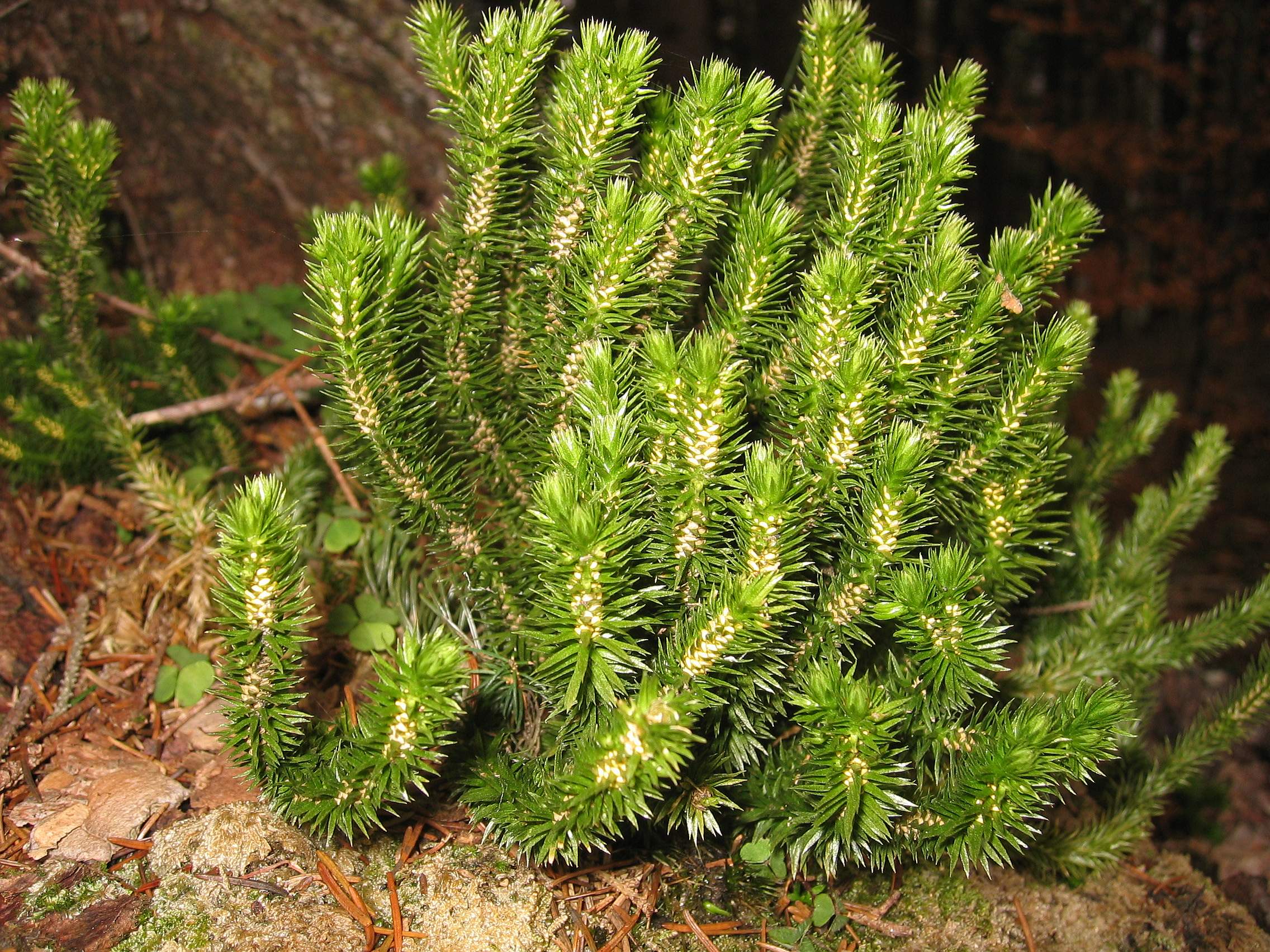
Huperzia is a genus of lycophyte plants in the family Lycopodiaceae (order Lycopodiales, class Lycopodiopsida), commonly known as firmosses or fir clubmosses. The common name refers to the superficial resemblance of north-temperate species to the branches of fir trees (genus Abies). The genus was established by Johann Jakob Bernhardi in 1801 when he separated it from the older genus Lycopodium; its type species is Huperzia selago (fir clubmoss).
Unlike Lycopodium, Huperzia has undifferentiated sporangial leaves and sporangia that are not grouped into apical cones (strobili). Sporophytes bear unbranched, generally upright shoots that are round in cross section; horizontal stems are absent. The leaves are not arranged in distinct ranks and are usually somewhat lanceolate. Among the leaves, specialized branchlets bear gemmae — small, triangular, bud-like structures with a constant arrangement of eight leaves — through which the plant reproduces asexually. The sporangia are kidney-shaped (reniform) and sit at the base of leaves that are either unmodified or slightly reduced. Roots are produced near the shoot apex and travel downward inside the stem cortex before emerging at soil level. Gametophytes are subterranean, non-photosynthetic, and mycorrhizal.
The circumscription of Huperzia has been debated. Under the Pteridophyte Phylogeny Group classification of 2016 (PPG I), the subfamily Huperzioideae of Lycopodiaceae contains three genera: Huperzia, Phlegmariurus, and Phylloglossum. In this narrow treatment Huperzia comprises approximately 25 temperate, arctic, and alpine species, mostly terrestrial or rock-dwelling, with additional occurrences in mountain habitats of tropical Asia. Under a broader, single-genus treatment still used by some authorities, Huperzia encompasses roughly 340 species with a near-worldwide range, incorporating the largely epiphytic tropical Phlegmariurus.
Etymology
The genus name Huperzia was coined by the German botanist Johann Jakob Bernhardi in 1801 when he segregated these plants from Lycopodium. The common name "firmoss" (also written "fir-moss") alludes to the resemblance of the erect, densely leafy shoots of north-temperate species to the branches of fir trees (Abies). The Flora of North America uses the variant name "gemma fir-moss," highlighting the gemmae by which these plants propagate.
Distribution
In the PPG I narrow circumscription, Huperzia occurs in temperate, arctic, and alpine habitats, including mountain ranges in tropical Asia. Species grow terrestrially or on rocks. When Huperzia is defined broadly to include all three genera of Huperzioideae, the combined range is nearly worldwide, absent mainly from North Africa, the Arabian Peninsula, and Western Asia.
Ecology
Huperzia species are terrestrial or lithophytic (rock-growing) plants of cool temperate, arctic, and alpine environments. The gametophyte generation is subterranean and non-photosynthetic, obtaining nutrition through mycorrhizal associations. Asexual reproduction via gemmae — dropped from specialized branchlets — supplements spore-based reproduction.
Taxonomy Notes
Huperzia belongs to the subfamily Huperzioideae of Lycopodiaceae (order Lycopodiales). A phylogenetic study in 2016 using both molecular and morphological data found that either a one-genus or a three-genus division of the subfamily yielded monophyletic taxa; the authors preferred the three-genus arrangement recognizing Huperzia, Phlegmariurus, and Phylloglossum. Under PPG I (2016) approximately 25 species are retained in Huperzia in the narrow sense, while the majority of species formerly placed in a broadly defined Huperzia are reclassified in Phlegmariurus. As of 2024, World Ferns noted that many species still require formal transfer between genera.










