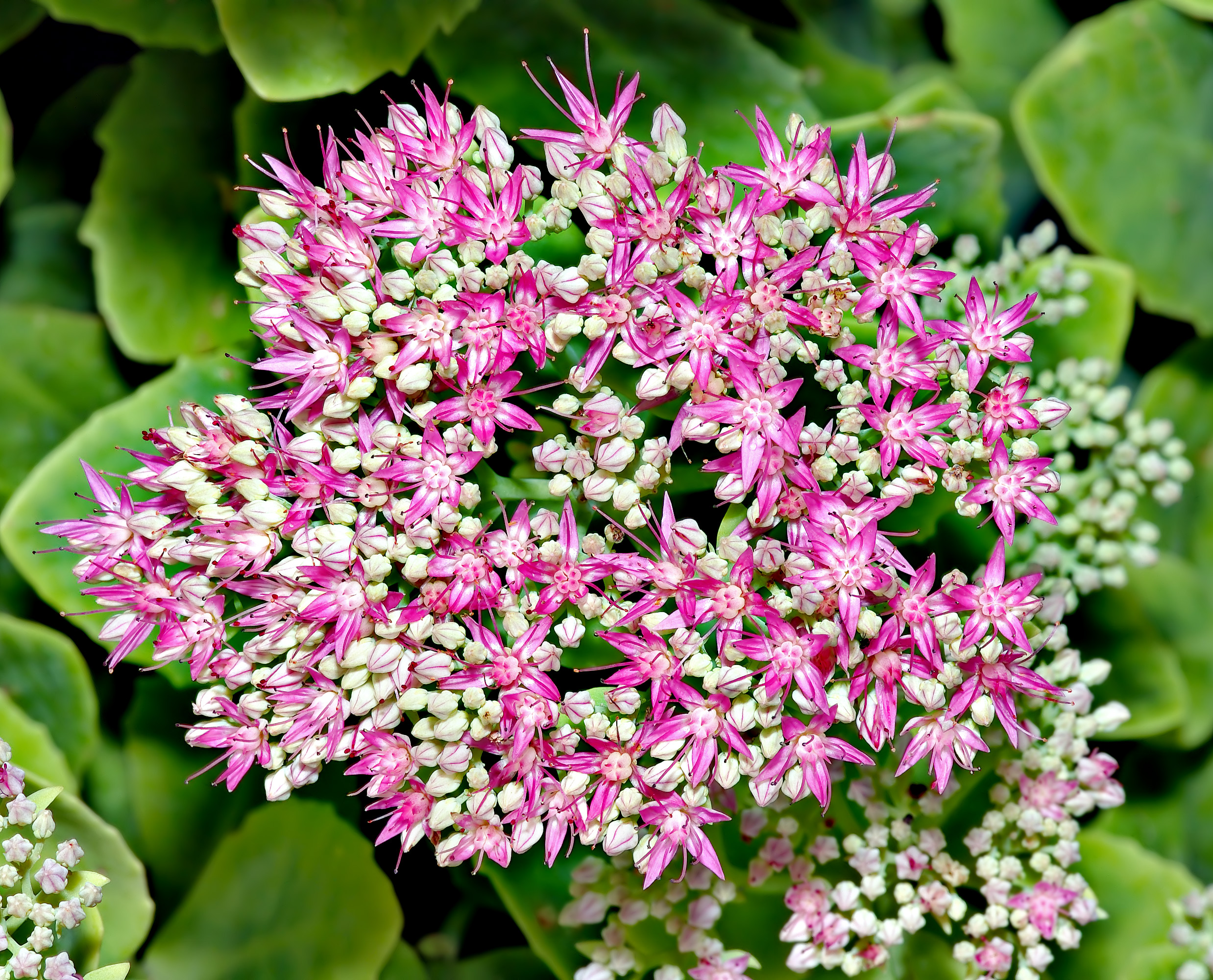
Hylotelephium is a genus of succulent, herbaceous perennial flowering plants in the stonecrop family, Crassulaceae. The genus comprises roughly 28 to 33 species (Plants of the World Online and World Flora Online recognize 28 accepted species as of 2025) distributed across temperate North America, Europe, and Asia, with its centre of diversity in East Asia.
Plants in the genus are characterised by tall, leafy stems that emerge each year from underground tuberous bases and die back seasonally — a key feature distinguishing Hylotelephium from the closely related genus Sedum. The fleshy leaves are gray-green, sometimes flushed purple or variegated, and may be arranged alternately, oppositely, or in whorls along the upright stems. Mature plants typically reach 3 to 18 inches (roughly 8–45 cm) in height and spread 1 to 4 feet across, depending on the species or cultivar.
Flowering occurs in late summer and autumn, setting the genus apart from most other members of the tribe Sedeae, which bloom in spring and early summer. The small, star-shaped flowers are borne in dense, flat-topped cymes and most commonly appear in shades of pink, purple, or red, with four to five petals. Some species, such as H. telephium, produce a honey-like scent that attracts bees, butterflies, and other pollinators. As the season progresses, the foliage of many species takes on orange or red-burgundy tones.
The genus is widely cultivated for its hardiness, drought tolerance, and long-lasting autumn flower display. Plants succeed in full sun and well-drained soils across a wide pH range and are hardy through USDA zones 3a–9b (to roughly −20 °C). Numerous hybrids and named cultivars are grown in gardens worldwide, many of them patented in recent decades.
Etymology
The genus name combines two Greek roots: hylo-, meaning "forest" or "woodland," and telephium, which has been interpreted as "distant-lover" — a reference to a folk tradition in which the plant was thought to reveal whether one's affections were returned. The epithet Telephium has been applied to plants in this group since Linnaeus's 1753 treatment of Sedum telephium, the type from which the modern genus takes its name.
Distribution
Hylotelephium has a broad temperate distribution spanning North America, Europe, and Asia, but the genus's centre of diversity lies in East Asia, where most species occur. Native ranges of individual species include China (across multiple provinces), Korea, Manchuria, Japan, and the Russian Far East, as well as the Caucasus, the Urals, and broader Eurasia. In North America, the genus is represented primarily by cultivated specimens in herbaria rather than native populations.
Ecology
In the wild, species of Hylotelephium grow on rocky cliffs, in mountain valleys, and in damp woodland margins. The genus is notable within the tribe Sedeae for its autumn flowering period, providing a late-season nectar source when many other plants have finished blooming. Flowers are self-fertile and hermaphroditic, and they attract a wide range of pollinators, including bees, butterflies, and (where the seed sets) songbirds that feed on the seed heads. Plants are also notably unpalatable to deer.
Cultivation
Hylotelephium species and hybrids are among the most widely grown ornamental succulents in temperate gardens. They thrive in full sun and well-drained soils — loam, sand, or shallow rocky substrates all suit them — and tolerate a neutral to slightly alkaline pH (about 6.0–8.0). Once established, plants are exceptionally drought-tolerant and largely indifferent to neglect; hardiness extends through USDA zones 3a–9b, equivalent to roughly −20 °C. Their main horticultural weakness is root rot in poorly drained soils. The combination of late-summer to autumn bloom, attractive foliage, and pollinator value makes them staples of rock gardens, mixed borders, pollinator plantings, containers, slope plantings, and informal edging. Many modern cultivars are patented and propagation by gardeners is restricted accordingly.
Propagation
Hylotelephium is straightforward to propagate by several methods. Division of established clumps is the simplest approach and can be carried out almost any time during the growing season, with spring or early summer giving the best results. Stem and leaf cuttings root readily — leaf cuttings in particular produce roots and form new plants with little effort. Seeds may be surface-sown in spring on well-drained compost. Note that many garden cultivars are patented and may not be propagated commercially without a licence.
Cultural Uses
The leaves of Hylotelephium species are edible raw or cooked, though they are very mucilaginous with a bland flavour; yellow-flowered relatives may cause stomach upset if eaten in quantity. The plants have a long history in folk medicine, with sources attributing antiphlogistic, depurative, and sialagogue properties. Common names in English reflect both the genus's hardiness and its older botanical history: live-forever, orpine, stonecrop, and (still widely used in horticulture) sedum.
History
Sedum telephium was first described by Linnaeus in 1753 and stood as the type for what became a sprawling, polymorphic Sedum sensu lato. Japanese botanist Hideaki Ohba validly published the genus Hylotelephium in Botanical Magazine (Tokyo) 90(1017): 46 in 1977, and in a follow-up 1978 paper proposed segregating Rhodiola, Hylotelephium, and Prometheum from the artificially broad Sedum. Subsequent morphological, anatomical, and molecular work has supported the segregation, and Hylotelephium is now consistently treated as a distinct genus in modern checklists.
Taxonomy
Hylotelephium H.Ohba (1977) sits in the family Crassulaceae, subfamily Sempervivoideae, tribe Telephieae. The genus was segregated from Sedum and is distinguished from it by distinct, basally attenuate pistils, by tall leafy stems arising from underground tuberous bases that die back seasonally, and by an autumnal flowering period. Species totals vary across databases: Plants of the World Online and World Flora Online list 28 accepted species (as of 2025), Wikipedia cites approximately 33, and regional treatments such as SEINet enumerate 15 in their coverage area. GBIF accepts the genus under nubKey 2985862, attributed to H. Ohba in Bot. Mag. (Tokyo) 90(1017): 46. 1977.










