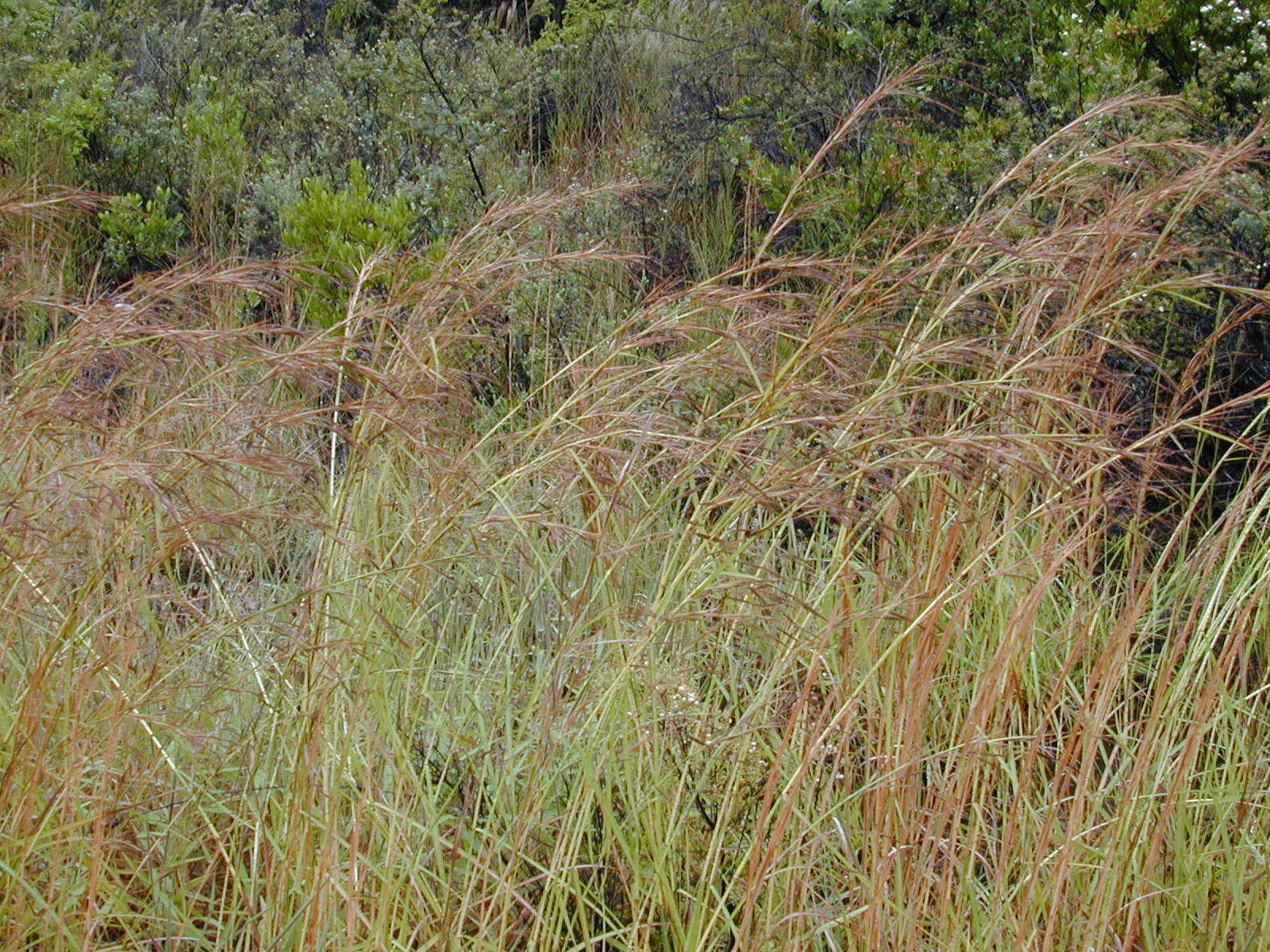
Hyparrhenia is a genus of grasses in the family Poaceae, comprising roughly 55–60 species. Members of the genus are commonly known as thatching grass, a name that reflects their long historical use as roofing material across sub-Saharan Africa. The genus belongs to the tribe Andropogoneae, a group of grasses that includes sugarcane and sorghum.
Plants in the genus are annual or perennial bunch grasses. Their most distinctive morphological feature is an inflorescence that branches into twin racemes (paired spikes) carrying paired spikelets — one sessile and fertile, one pedicellate. The stems can reach considerable height, often 1–3 metres in the more robust species, with narrow, arching leaves.
The genus is centered on tropical Africa, where the greatest diversity of species occurs from West Africa through the East African highlands to South Africa. Several species have naturally wide ranges extending into southern Europe, the Middle East, South Asia, Southeast Asia, and northern Australia. Others, notably Hyparrhenia rufa (jaragua grass) and Hyparrhenia hirta (thatching grass), have become naturalized on multiple continents and are considered invasive in parts of the Americas, Hawaii, and Australia.
Notable members include H. hirta, widespread from France to Pakistan and across Africa; H. rufa, a pantropical invasive pasture grass introduced throughout Latin America and the Caribbean; H. filipendula, ranging from West Africa to the Philippines and Queensland; and H. cymbaria, found across Africa, Madagascar, and India.
Distribution
Hyparrhenia is primarily native to tropical Africa, with species occurring across the continent from West Africa to the East African highlands and south to the Cape. Several species extend naturally into southern Europe, the Arabian Peninsula, South and Southeast Asia, and northern Australia. Hyparrhenia rufa and H. hirta have been widely introduced and have naturalized in the Americas, Hawaii, and elsewhere, where they can behave as invasive species.
Ecology
Hyparrhenia species are characteristic grasses of tropical and subtropical savannas, grasslands, and open woodlands, often dominating tall-grass communities in seasonally dry climates. They are well adapted to fire regimes and periodic drought, and their dense tussock growth supports a range of invertebrate and vertebrate fauna. Introduced species such as H. rufa can alter fire cycles and outcompete native vegetation in disturbed habitats.
Cultural Uses
Many Hyparrhenia species have been used for centuries across Africa as thatching material for roofs and walls, which is the origin of the common name "thatching grass." Hyparrhenia rufa has been widely planted as a pasture and fodder grass in tropical regions of Latin America, the Caribbean, and parts of Africa and Asia.










