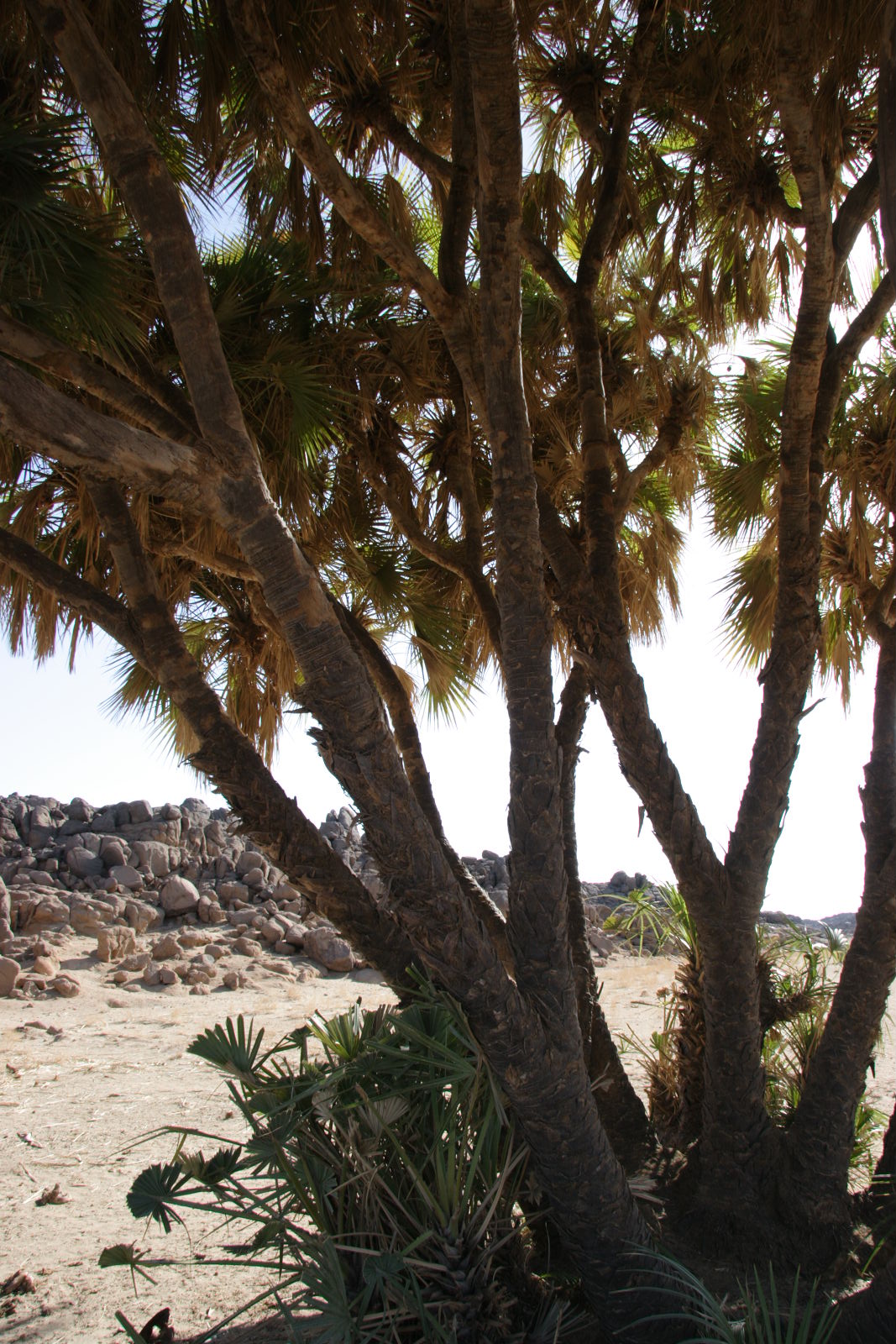
Hyphaene is a genus of palms in the family Arecaceae (order Arecales), comprising around eight species distributed across Africa, Madagascar, the Middle East, and the Indian subcontinent. The genus is remarkable within the palm family for its naturally and repeatedly branched trunks — a trait shared by very few palms — which gives mature specimens a distinctive candelabra-like silhouette.
The best-known member is the Doum palm (Hyphaene thebaica), native to northeastern and central Africa and the Middle East, long cultivated for its fruit, fibres, and timber. Other widely recognised species include H. coriacea of eastern Africa and Madagascar, H. petersiana of southern and eastern Africa, H. compressa found from Ethiopia to Mozambique, and H. guineensis across western and central Africa.
In Swahili the genus is collectively called koma. Species typically grow in hot, seasonally dry environments — savanna, semi-arid scrub, and riverine margins — where their deep root systems allow them to access groundwater. The fruits are hard-shelled drupes with a sweet, fibrous outer layer and a very hard endosperm that is used as vegetable ivory.
Etymology
The name Hyphaene derives from the Greek hyphaino (ὑφαίνω), meaning "to weave" — a reference to the use of the leaves for weaving mats, baskets, and rope in the regions where the palms grow. In Swahili the genus is known as koma.
Distribution
Species of Hyphaene occur across sub-Saharan Africa (with H. thebaica extending into Egypt and the Middle East as far as Yemen and Palestine), Madagascar, and the Indian subcontinent (H. dichotoma in India and Sri Lanka). They favour hot, semi-arid and seasonally dry habitats including savanna margins and riverine corridors.
Cultural Uses
The Doum palm (H. thebaica) has been used in Egypt since antiquity — fruits, fibres, and leaves have been found in Pharaonic tombs. Across Africa and the Middle East, leaves are woven into mats, baskets, and rope; the hard endosperm is carved as vegetable ivory; and the sweet fruit pulp is eaten fresh or dried. H. petersiana fruit is similarly consumed in southern Africa.

