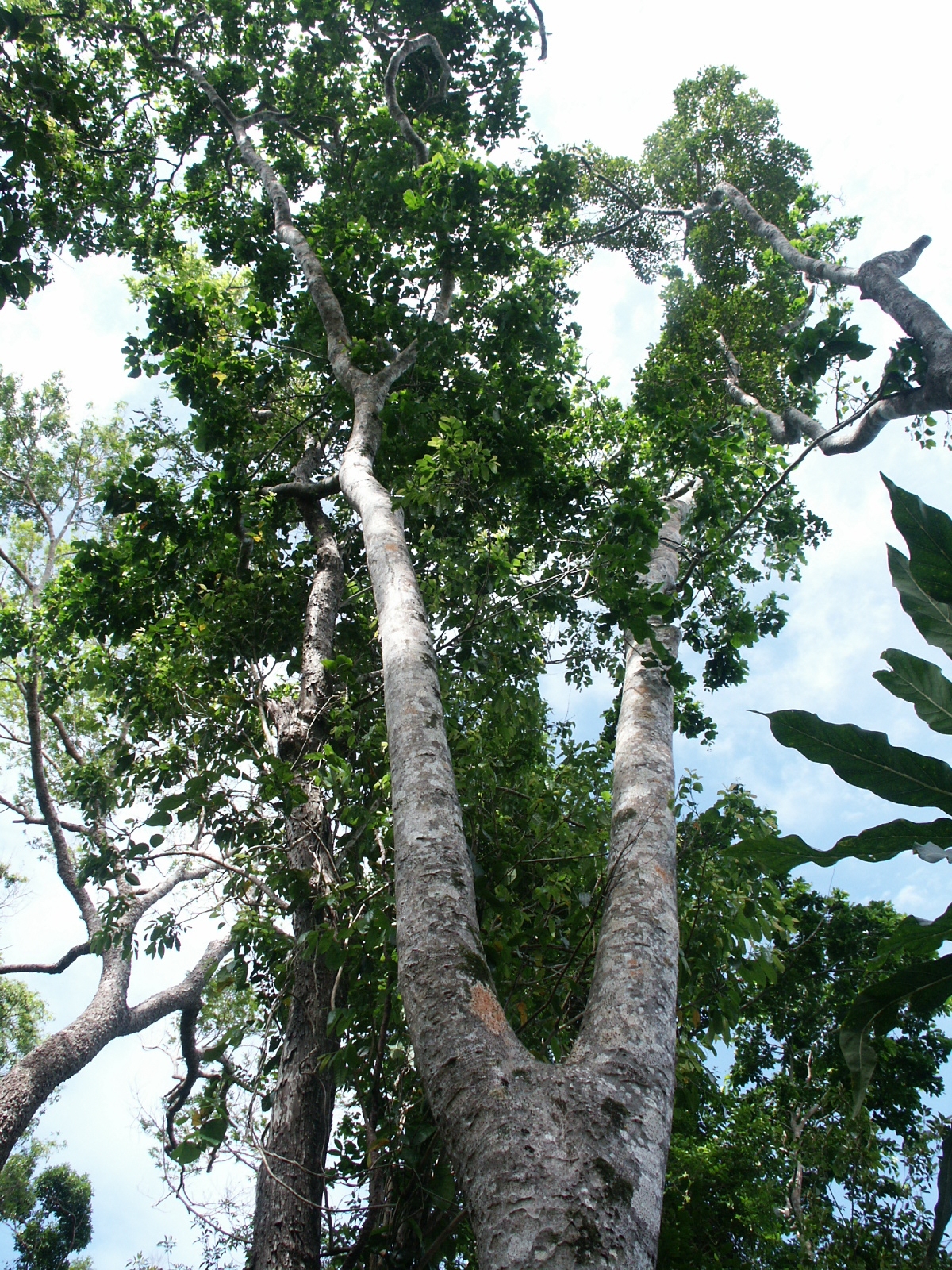
Intsia is a small genus of large tropical trees in the legume family Fabaceae (order Fabales), native to a broad arc from eastern Africa and Madagascar across the Indian Ocean to South and Southeast Asia, Australasia, and the western Pacific. The genus contains two accepted species — Intsia bijuga and Intsia palembanica — though some classifications recognise additional taxa.
Plants are imposing canopy trees reaching 40–45 metres in height. They are evergreen and unarmed (lacking thorns), and the trunk is frequently supported by prominent buttress roots, an adaptation common in tall trees of humid tropical lowland forests. The two species occupy a range of coastal and riverine habitats: coastal forest on sandy soils, lowland rainforest, the fringes of mangrove systems, tidal river mouths, and occasionally hill slopes further inland.
The genus is best known for the timber of Intsia bijuga, commercially called merbau or ipil, which is a dense, durable hardwood prized throughout the Indo-Pacific for construction, flooring, and furniture. The timber has been heavily exploited across its range, and populations of Intsia bijuga in particular are considered threatened by overlogging.
Distribution
Intsia ranges from eastern Africa (including Zanzibar) and Madagascar across the Indian Ocean Islands to India, Indochina, Taiwan, Malaysia, Papua New Guinea, the southwestern Pacific, and northern Australia. Intsia bijuga has the broader distribution spanning this entire range, while Intsia palembanica is confined to Bangladesh, Myanmar, Thailand, Malaysia, and New Guinea. Both species inhabit humid tropical lowland environments including coastal forest, rainforest, mangrove fringes, and tidal river mouths.
Ecology
Both species grow in humid tropical lowland forest at or near sea level, favouring coastal forests on sand, rainforest interiors, mangrove margins, and tidal river mouths, with occasional occurrence on inland hills. The trees are large canopy emergents, often buttressed, and are associated with the diverse lowland forest ecosystems of the Indo-Pacific.
Cultural Uses
Intsia bijuga, known commercially as merbau or ipil, yields one of the most sought-after hardwoods of the Indo-Pacific region. The timber is dense, naturally durable, and resistant to insects, making it highly valued for heavy construction, flooring, furniture, and boat-building across Southeast Asia and the Pacific. Its cultural and economic importance has driven intensive harvesting across much of the genus's range.
Conservation
Intsia bijuga is assessed as Vulnerable on the IUCN Red List due to ongoing overexploitation for its valuable merbau timber. Heavy logging pressure across Southeast Asia and the Pacific has substantially reduced populations. International trade in the timber is subject to monitoring under CITES and national regulations in several range states. Intsia palembanica is similarly threatened by habitat loss and timber extraction across its range.










