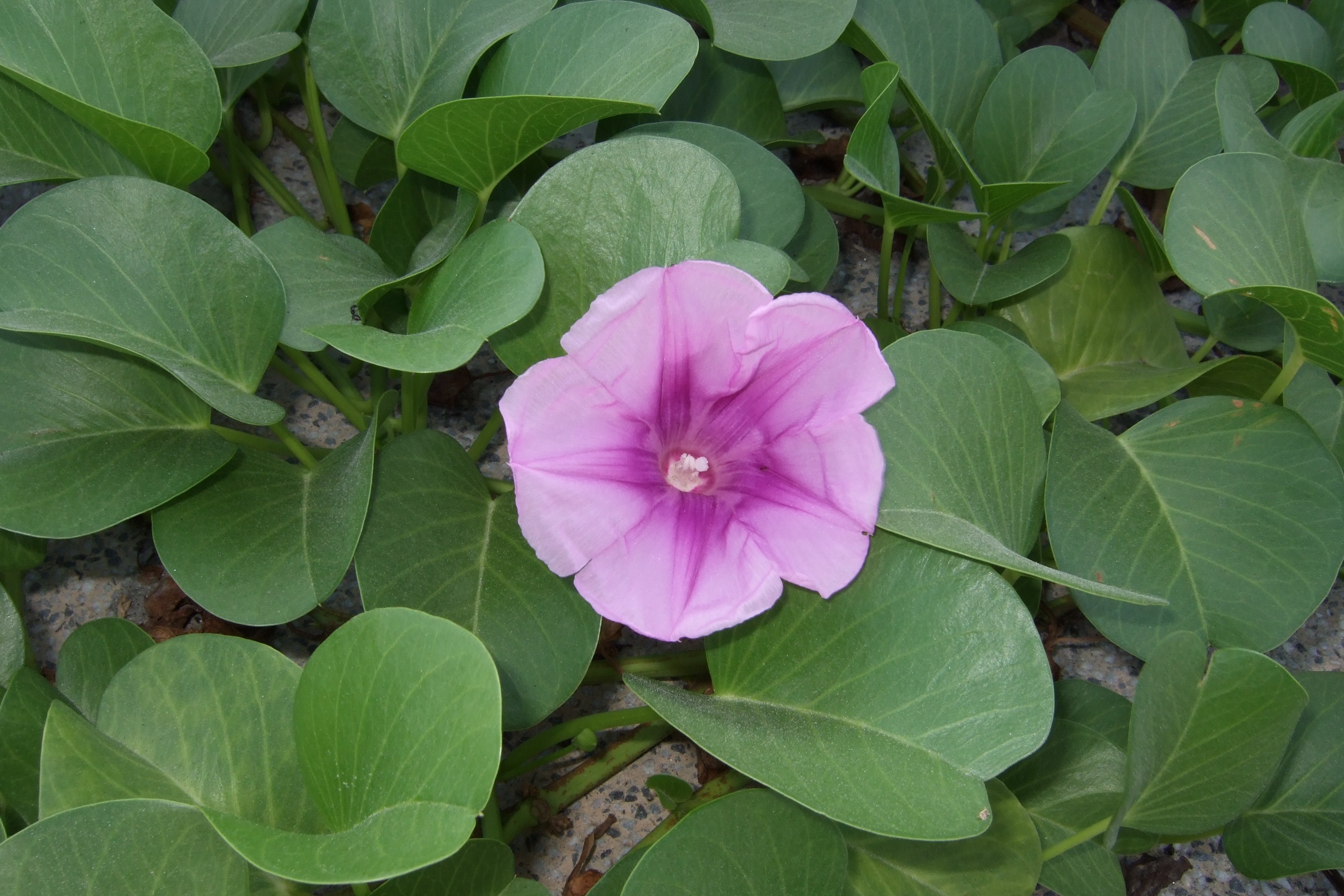
Ipomoea is the largest genus in the morning glory family (Convolvulaceae), with somewhere between roughly 500 and 650 accepted species depending on the authority; Plants of the World Online currently recognises 645. Linnaeus established the genus in Species Plantarum (1753) and it is a conserved name. The group sits in the order Solanales and includes the tribe Ipomoeeae, with Ipomoea pes-tigridis as the type species.
Habit varies more than in almost any other vining genus: most species are annual or perennial herbaceous twiners, but Ipomoea also includes prostrate or trailing creepers, woody lianas, shrubs, and even a few small trees. Stems are typically twining and herbaceous, climbing by winding around supports rather than by tendrils. Leaves are usually simple — sometimes deeply lobed or palmately divided — and only rarely compound. The flowers are showy and trumpet- to funnel-shaped, pentamerous, and produced in axillary inflorescences that may be solitary or cymose. Corollas range across blue, purple, pink, red, white, orange, and yellow; in many cultivated species they open at dawn and fade by afternoon, which gives the family its common name.
The genus is essentially pantropical. POWO describes the native range as the tropical and subtropical Old World together with the Americas, covering Africa, Asia, Australia, the Pacific islands, and the New World from the southern United States south to temperate South America. Many species have been carried far beyond their native range as ornamentals and crops, and Ipomoea is now naturalised in parts of temperate Europe and North America. Habitats span wet forests, watercourses, sandy coastal dunes, savannahs, and disturbed ground; quite a few species behave as opportunistic colonisers of cleared land.
Several Ipomoea species are economically and culturally important. I. batatas, the sweet potato, is one of the world's major food crops; I. aquatica (water spinach) is a widely eaten leafy vegetable across tropical Asia. Ornamental species include I. alba (moonflower), I. tricolor, I. nil, and I. purpurea, all standard garden morning glories. I. jalapa and I. simulans are the source of jalap, a traditional cathartic, while I. mauritiana features in the Ayurvedic tonic chyawanprash. Seeds of I. tricolor and I. violacea contain ergoline alkaloids and were used in Mesoamerican shamanic rituals. Pre-Columbian Olmecs reportedly used moon-vine sap to help vulcanise Panama rubber latex for ballgame balls — one of the earliest documented industrial uses of a plant exudate.
Etymology
The genus name Ipomoea was coined by Linnaeus from Ancient Greek ἴψ (íps, "woodworm") combined with ὅμοιος (hómoios, "resembling"). The compound refers to the twining, worm-like way the stems wrap around supports — a habit shared by the great majority of species in the genus.
Distribution
Ipomoea is broadly pantropical. POWO summarises the native range as the tropical and subtropical Old World together with the Americas, encompassing Africa, Asia, Australia, Pacific islands, and the Americas from the southern United States south through Mexico and into temperate South America. The genus is also present in the deserts and grasslands of the American Southwest, with many representatives recorded across Arizona and New Mexico. Outside its native range, numerous species have been introduced and have naturalised in temperate Europe, Canada, and elsewhere — often escaping from gardens or from cultivation as a food crop.
Ecology
Ipomoea flowers attract a wide pollinator fauna; butterflies and hummingbirds are particularly important visitors in North America. Many tropical species are bee- or moth-pollinated, and the genus's diversity of flower colours and shapes reflects this varied pollinator base. Co-occurring Ipomoea species can compete via pollination interference, with pollen exchange between sympatric species imposing measurable fitness costs.
Cultivation
Most ornamental Ipomoea are grown as fast-growing annual or short-lived perennial vines. They thrive in full sun to partial shade and tolerate a wide range of soils — clay, loam, or sand — across acidic to alkaline pH. Plants For A Future suggests fertile, well-drained loam in warm, sunny positions. Cold tolerance varies enormously by species: NC State Extension lists the genus as workable across USDA zones 2a–11b when grown as an annual, while perennial species are reliable only in roughly USDA zones 7–10. The vining habit makes them well suited to trellises, fences, container plantings, rock walls, and butterfly gardens, or as temporary screens. Note that the seeds of many species contain ergoline alkaloids and are mildly toxic; ingestion can cause hallucinations, nausea, vomiting, and diarrhoea, and the seeds are listed as toxic to cats, dogs, and horses.
Propagation
Seed is the standard method. The seed coat is hard, so nick or scarify it and pre-soak the seed for around 12 hours before sowing. Under glass in spring at about 22 °C, germination takes one to three weeks. Seedlings dislike root disturbance, so it helps to sow into individual pots and transplant once true leaves appear. Some species also propagate readily from stem cuttings or by layering, and tuberous-stemmed species can be overwintered as stored tubers.
Conservation
At the genus level Ipomoea is not of conservation concern — it is large, widespread, and many species are weedy or cultivated. The bigger management story is the other way around: several species reseed readily and behave as invasives or noxious weeds outside their native range, and a number of Ipomoea taxa appear on the USDA noxious-weed register.
Cultural uses
The genus has outsized economic and cultural importance for its size. I. batatas (sweet potato) is one of the world's major staple food crops, and I. aquatica (water spinach, kangkong) is a widely eaten leafy vegetable across tropical Asia. Many species are grown purely as ornamentals — I. alba (moonflower), I. tricolor, I. nil, and I. purpurea dominate the cottage-garden trade. Traditional medicine has long made use of the genus: I. jalapa and I. simulans yield the cathartic resin jalap, and I. mauritiana is a component of the Ayurvedic tonic chyawanprash. Several species — most prominently I. tricolor and I. violacea — contain ergoline alkaloids in their seeds (including ergine/LSA, ergometrine, and lysergol) and were used in Aztec and Zapotec shamanic rituals. I. sepiaria is one of the Dashapushpam, the Ten Sacred Flowers of Kerala. The Olmecs are reported to have used moon-vine sap as a vulcanisation aid for Panama rubber tree latex to produce balls for their ritual ball game.
History
The genus was formally established by Linnaeus in Species Plantarum (1753, p. 159) and is a conserved name (nom. cons.) under the botanical code, with Ipomoea pes-tigridis L. as the type species. Over the next two centuries the genus accreted a large number of segregate genera — Batatas, Quamoclit, Pharbitis, Turbina, and others — most of which have since been folded back into Ipomoea; POWO currently lists 57 heterotypic genus-rank synonyms.
Taxonomy notes
Different authorities give different species counts for the genus, reflecting differing treatments of segregate genera and unresolved names. POWO recognises 645 accepted species; the GBIF backbone records 1,160 descendants (including synonyms and unresolved names); SEINet still cites the older round figure of about 500. Despite these differences, all major checklists agree on the genus's placement in Convolvulaceae (order Solanales) and on Linnaeus (1753) as the protologue. Recent molecular work has subsumed the formerly recognised segregate genera Batatas, Quamoclit, Pharbitis, and Turbina into Ipomoea.

