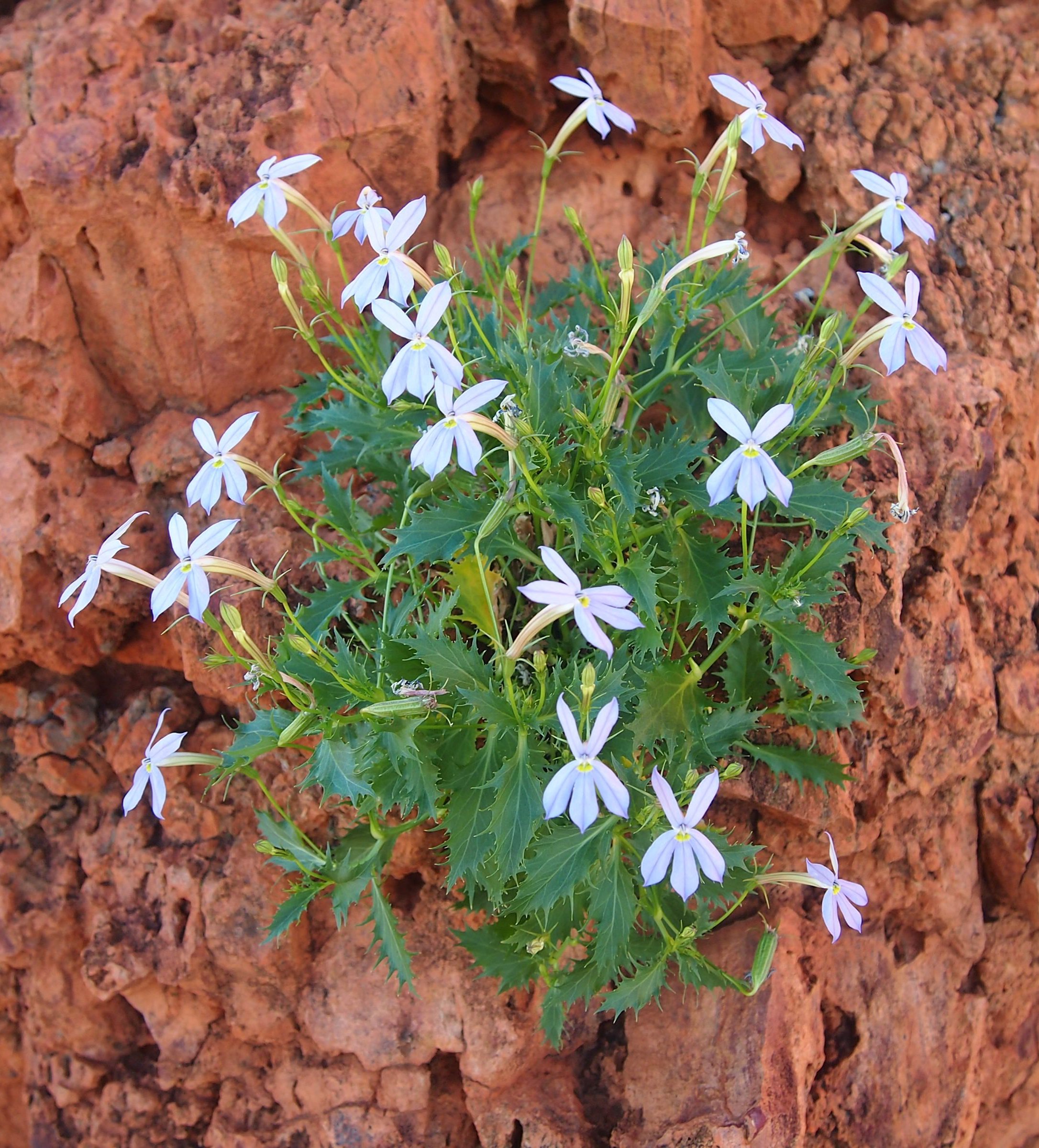
Isotoma is a genus of annual and perennial herbs in the family Campanulaceae (order Asterales), native to Australia and New Zealand. The genus comprises around a dozen accepted species, distributed across most Australian states and territories, with one species (Isotoma fluviatilis) extending to New Zealand.
Plants in the genus are characterised by milky sap and a distinct taproot, which sometimes produces adventitious roots along the branches. The leaves are arranged alternately and are usually toothed or lobed. Flowers are borne singly in leaf axils or in small clusters at the tips of branchlets. The flower structure is slightly zygomorphic: a five-lobed petal tube spreads horizontally, with the upper two lobes smaller than the lower three, which often carry distinct markings. The stamens are fused to the petal tube. Fruit is an urn-shaped or conical capsule containing numerous minute seeds.
The genus was originally described by Robert Brown in his 1810 work Prodromus Florae Novae Hollandiae et Insulae Van Diemen, where he placed the type species in section Isotoma of Lobelia. John Lindley formally elevated it to genus rank in The Botanical Register in 1826. The name Isotoma derives from ancient Greek words meaning "equal" and "a piece cut off," a reference to the nearly equal petal lobes that distinguish it from true lobelias.
Notable members include Isotoma axillaris, a popular ornamental with star-shaped blue or white flowers, and Isotoma fluviatilis (swamp isotome), a low-growing creeping species of wetland margins found across south-eastern Australia and New Zealand.
Etymology
The name Isotoma derives from ancient Greek words meaning "equal" (isos) and "a piece cut off" or "a slice" (tome). It was originally applied to a subdivision of Lobelia because, unlike typical lobelias, the five petal lobes of these plants are nearly equal in size.
Distribution
Isotoma species are native to Australia, where they occur across most states and territories including New South Wales, Queensland, Victoria, South Australia, Western Australia, Tasmania, and the Northern Territory. One species, Isotoma fluviatilis, extends to New Zealand.
Taxonomy Notes
Isotoma was first described by Robert Brown in 1810 as a section within Lobelia in his Prodromus Florae Novae Hollandiae et Insulae Van Diemen. In 1826, John Lindley raised it to genus rank in The Botanical Register based on Brown's original circumscription. The genus belongs to the family Campanulaceae, order Asterales.

