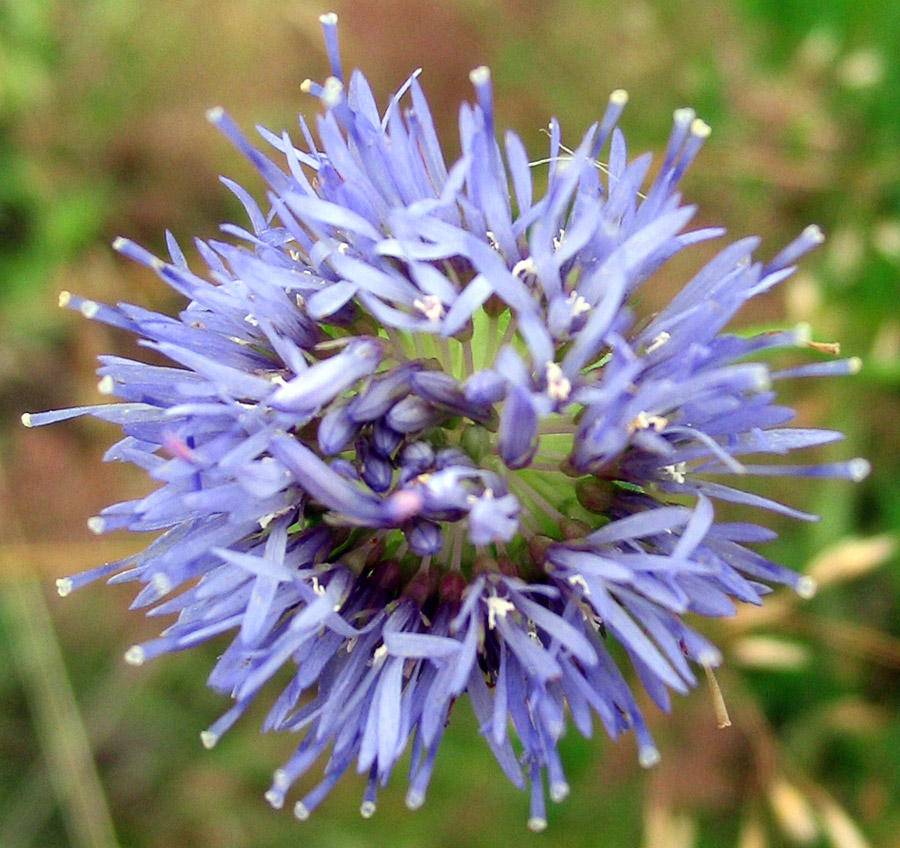
Jasione is a genus of annual and perennial flowering herbs in the bellflower family Campanulaceae, order Asterales. The genus comprises approximately 14 accepted species, distributed across Europe, Turkey, and northwestern Africa, with the greatest diversity in western and southern Europe.
Plants in the genus are typically slender, branching herbs growing 10–80 cm tall, with narrow lanceolate to linear leaves that are sessile and often have a wavy or faintly toothed margin. The most distinctive feature is the flowerhead: small blue to lilac flowers are gathered into compact, hemispherical terminal heads 1–2.5 cm across, surrounded by a ring of short involucral bracts — an arrangement superficially resembling that of the daisy family (Asteraceae), though Jasione is firmly within Campanulaceae. Each individual flower is first tubular, then splits to the base into five narrow strap-shaped lobes; the style is prominently exserted, tipped with two club-shaped united stigmas. Flowers appear from June to August.
Jasione montana L. (sheep's bit) is the most widespread and best-known member of the genus, found throughout much of western and central Europe in open, nutrient-poor, acidic grasslands and sandy soils. Other notable species include J. laevis (perennial sheep's bit), J. heldreichii (endemic to the Balkans and Greece), and J. bulgarica (Bulgaria). The genus favours calcifuge habitats — acidic, dry, low-nutrient soils with high light exposure.
Etymology
The name Jasione derives from an ancient Greek name used by Dioscorides and Theophrastus, though the precise plant it referred to in antiquity is uncertain; it was applied to this genus by Linnaeus. The common name for the most widespread species, J. montana, is "sheep's bit" in English, reflecting its preference for grazed, open habitats.
Distribution
The genus is native to Europe, Turkey, and northwestern Africa, with a predominantly West European–Mediterranean distribution. Jasione montana, the most widespread species, occurs throughout much of western and central Europe from the British Isles to the Balkans. Species occur in open, often coastal or montane habitats on acidic, sandy, or rocky soils, and are absent from heavily calcareous substrates.
Ecology
Jasione species are characteristic plants of nutrient-poor, dry, acidic, open habitats: sandy grasslands, heathlands, silicate rocky outcrops, and pioneer communities. Jasione montana functions as both a therophyte (annual) and monocarpic hemicryptophyte depending on conditions, thriving in full sun (high light indicator value) on very low-nutrient, moderately dry, acid soils (pH 3.5–6.5). It is a typical component of the Sedo-Veronicion alliance (warm silicate-rock pioneer grassland). The genus is calcifuge and intolerant of nutrient enrichment, making it sensitive to agricultural intensification and habitat loss.
Conservation
Jasione montana is assessed as Near Threatened (NT) on the Swiss national Red List and Critically Endangered (CR) in the Jura, Mittelland, and Northern Alps biogeographic regions, with ongoing decline in habitat quality (IUCN criterion B2b(iii)) cited. The primary threats are the loss of open, low-nutrient grassland habitats through agricultural intensification and succession. No international conservation priority (Bern Convention) is recorded for the genus.










