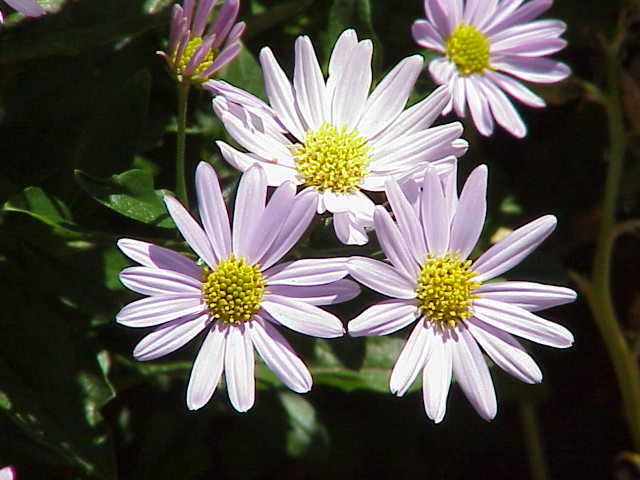
Kalimeris, commonly known as the Kalimeris asters or starworts, is a genus of flowering plants in the family Asteraceae (order Asterales). It was first described in 1825 by the French botanist Alexandre Henri Gabriel de Cassini (1781–1832), and its closest relatives within the family are the Asian members of Aster and Heteropappus.
The genus comprises herbaceous perennials that typically grow to 1–1.5 metres in height. The blue-green leaves vary considerably between species: they can be long and narrow, broadly rounded with large teeth, or deeply lobed. Flower heads are borne singly or in leafy, flat-topped inflorescences (corymbs); the central disc florets are yellow, while the surrounding ray florets are white, pink, or purple — giving the plants a daisy-like appearance. The chromosome base number is x = 9.
Kalimeris is predominantly an eastern Asian genus, with species native to China, Korea, and Japan. Some species, notably Kalimeris indica, have become naturalised beyond their native range, including in Hawaii. Well-known species include K. incisa, K. pinnatifida, K. yomena, and K. indica. Several species are cultivated as ornamental garden plants prized for their long flowering season and tolerance of a range of soil conditions.
Etymology
The genus name Kalimeris was coined by the French botanist Alexandre Henri Gabriel de Cassini when he first described the genus in 1825. The source article does not provide an explicit derivation; the name is presumed to be of Greek origin, consistent with Cassini's naming conventions for Asteraceae genera.
Distribution
Kalimeris occurs mainly in eastern Asia, with species native to China, Korea, and Japan. At least one species has become naturalised in Hawaii, extending the genus's presence beyond its core Asian range.
Cultivation
Several Kalimeris species, particularly K. incisa and K. pinnatifida, are cultivated as ornamental perennials in temperate gardens. They are valued for their long flowering season, producing daisy-like flowers over an extended summer period. Plants generally tolerate a range of soil types and are noted for their relatively undemanding care requirements compared to related aster-group genera.

