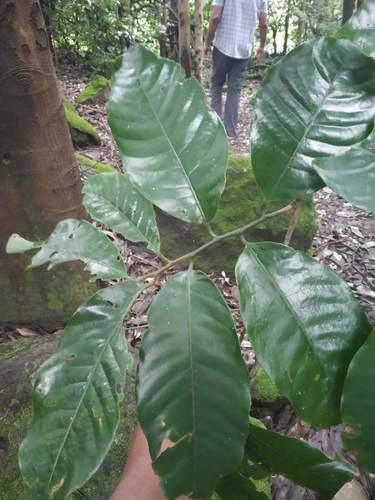
Knema is a genus of evergreen trees in the family Myristicaceae (the nutmeg family), order Magnoliales. The genus comprises approximately 85–97 accepted species, making it one of the larger genera within Myristicaceae alongside Myristica and Horsfieldia. Its members are small to medium-sized trees characteristic of lowland tropical rainforests, with a distribution stretching from northeastern and southern India through Indochina and the Malay Archipelago east to near the tip of New Guinea. Borneo, in western Malesia, holds the greatest concentration of species diversity.
Morphologically, Knema trees are dioecious — male and female flowers occur on separate individuals. The leaf blades are papery to leathery, frequently glaucous and covered with a rusty tomentum on the undersurface, with parallel tertiary venation. Inflorescences are short and stout, either unbranched or forked, and characteristically roughened by the persistent scars of fallen pedicels. Flowers are densely clustered in raceme-like or near-umbel arrangements, and in Chinese species the flowers are typically red. Male flowers are comparatively large, subglobose to urn-shaped, with a perianth of three (occasionally four) tepals; the stamens are fused into a stalked, shield-like disk bearing 8–20 short anthers along its margin. The fruit is typically tomentose, and bears a fleshy aril that may be entire or lacerate at the apex — a feature shared across Myristicaceae and associated with bird and mammal dispersal.
Knema was described by the Portuguese-born botanist João de Loureiro and is accepted under its original authorship. Within Myristicaceae, it is distinguished from the closely related Myristica primarily by the peltate staminal disk, the consistently dioecious habit, and the characteristic inflorescence architecture.
Distribution
Knema ranges from northeastern and southern India through Indochina, the Malay Archipelago, and the Philippines, extending east to near the tip of New Guinea. The center of diversity lies in Borneo (western Malesia), where the greatest number of species occur. Six species are recorded from China, primarily in Yunnan province.
Taxonomy Notes
Knema was established by Loureiro and belongs to the family Myristicaceae, order Magnoliales. It is one of the three large genera in Myristicaceae alongside Myristica (the source of commercial nutmeg) and Horsfieldia. The genus is distinguished within the family by its peltate staminal disk bearing 8–20 anthers on the rim, and by its consistently dioecious habit. Wikipedia records 97 accepted species; Flora of China cites approximately 85; GBIF's backbone currently reflects only 3 taxa, indicating the backbone is taxonomically incomplete for this genus.
Ecology
Knema species are trees of lowland tropical rainforest, typically growing in humid, shaded understory conditions. The fruits bear fleshy arils and are presumably dispersed by birds and mammals, a syndrome common throughout Myristicaceae. Plants are dioecious, requiring both male and female individuals in proximity for successful reproduction.

