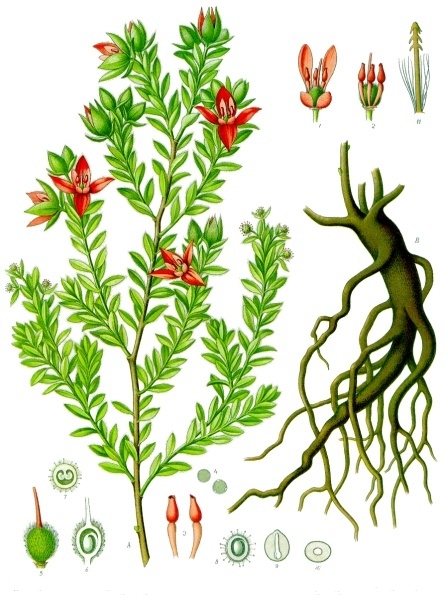
Krameria is the sole genus in the family Krameriaceae, encompassing approximately 17–18 species of perennial hemiparasitic shrubs and subshrubs. Placed in the order Zygophyllales, the genus is most closely related to the family Zygophyllaceae — a relationship that eluded taxonomists for over two centuries due to Krameria's highly distinctive morphology.
The plants occur across the Americas, from arid deserts and dry scrublands to subtropical savannas, and are commonly known as rhatany, ratany, or rattany. Their most ecologically striking feature is hemiparasitism: while capable of photosynthesis, Krameria species attach to the root systems of neighboring plants via specialized organs called haustoria, forming bulbous connections through which they draw water and nutrients. This root parasitism, combined with unusual floral structures, made Krameria a taxonomic puzzle for much of its botanical history.
The flowers bear a distinctive pair of fleshy, oil-secreting petals called elaiophores. These produce lipids harvested exclusively by female bees of the genus Centris, making Krameriaceae one of only eleven extant plant lineages to rely on oil-flower pollination — a highly specialized and obligate mutualism.
Medicinally, several species have long been harvested for their roots, which are rich in rhataniatannic acid, a potent astringent. Dried roots of Krameria argentea (para rhatany) and Krameria lappacea (Peruvian rhatany) have been used in gargles, lozenges, tooth powders, and hemostatic preparations, and the root bark has historically been used in Portugal to impart a ruby-red color to wines.
The genus was first collected by European botanists in the 1750s during an expedition to northern South America led by Swedish naturalist Pehr Löfling. It was named in honor of the Austrian physician and botanist Johann Georg Heinrich Kramer (1684–1744). Genetic studies in 1993 and 2000 finally resolved its phylogenetic placement, and current evidence supports two major clades within the family — each with North and South American subclades — consistent with two independent geographical radiation events across the Americas.
Etymology
The genus name Krameria honors Johann Georg Heinrich Kramer (1684–1744), an Austrian physician and botanist. The common name rhatany (also ratany or rattany) refers both to the plants and to the dried medicinal root preparations derived from select species.
Distribution
Krameria species are distributed across the Americas, ranging from arid deserts and dry scrublands to subtropical savannas. Phylogenetic analysis of the two major clades suggests two independent geographic radiation events between North and South America.
Ecology
Krameria plants are perennial hemiparasites that photosynthesize while also tapping host root systems via haustoria — bulbous parasitic organs that penetrate foreign roots. Their flowers produce lipid-rich elaiophores (specialized fleshy petals) harvested solely by female bees of the genus Centris, forming an obligate oil-flower pollination mutualism. Krameriaceae is one of eleven extant oil-flower lineages globally.
Cultural Uses
Rhatany root — dried root of Krameria argentea or Krameria lappacea — has been used medicinally as an astringent gargle, lozenge, and remedy for diarrhea, and as a hemostatic agent. Finely powdered roots were a common constituent of tooth powders. In Portugal, root bark has traditionally been used to color wines ruby red. The active compound is rhataniatannic acid, which acts similarly to tannic acid.
Taxonomy Notes
Krameria was first collected by Europeans during Pehr Löfling's 1750s expedition to northern South America and originally placed in Linnaeus' Tetrandria Monogynia. The genus was subsequently allied with Polygalaceae and Fabaceae due to superficial morphological similarities, but remained a "problem taxon" for over two centuries. Molecular analyses in 1993 and 2000 resolved its placement: Krameriaceae is sister to Zygophyllaceae within Zygophyllales — a relationship never previously hypothesized based on morphology alone. Within the family, two major clades (each with North and South American subclades) suggest two distinct inter-American radiation events.










