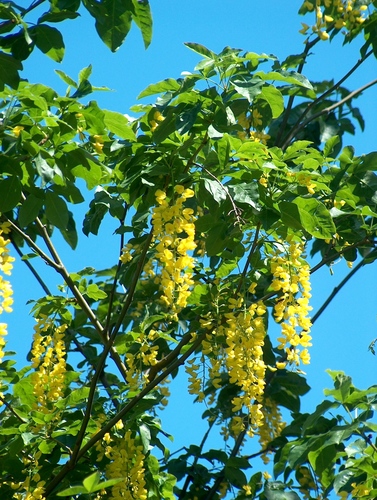
Laburnum, commonly known as golden chain or golden rain, is a genus of two species of small deciduous trees belonging to the subfamily Faboideae within the legume family Fabaceae (Leguminosae), placed in the order Fabales. The two species are Laburnum anagyroides (common laburnum) and Laburnum alpinum (alpine laburnum), both native to the mountains of Southern Europe.
The trees are deciduous with trifoliate leaves, somewhat resembling clover. In spring they produce spectacular pendulous racemes of yellow pea-shaped flowers, 10–40 cm long depending on species, which give rise to the popular name "golden chain tree." The fruit develops as a pod. All parts of the plant are toxic; the main toxin is cytisine, a nicotinic receptor agonist that can cause intense sleepiness, vomiting, convulsive movements, and coma, though fatalities are rare.
Some botanists recognize a third species, Laburnum caramanicum, native to southeast Europe and Anatolia, though it is more commonly placed in the distinct genus Podocytisus within the tribe Genisteae. The hybrid Laburnum × watereri 'Vossii' — a cross between the two main species — is the form most widely cultivated in gardens, prized for its long, dense flower racemes and low seed production. It has received the Royal Horticultural Society's Award of Garden Merit.
Etymology
The genus name Laburnum is the classical Latin name for the plant. The common names "golden chain" and "golden rain" refer to the long, pendulous racemes of yellow flowers that cascade from the branches in spring.
Distribution
Laburnum is native to the mountains of Southern Europe. In cultivation it has been widely naturalized across temperate regions, and is particularly common throughout the British Isles, where it is frequently planted as a lawn specimen or in shrub borders.
Ecology
Laburnum serves as a larval food plant for several Lepidoptera species, including the buff-tip moth (Phalera bucephala). All parts of the plant contain cytisine, a toxic alkaloid that acts as a nicotinic receptor agonist, providing chemical defense against herbivory.
Cultivation
Laburnum species and their hybrid (L. × watereri 'Vossii') are grown as ornamental trees in gardens and parks. They perform best in cool oceanic climates such as those of the Pacific Northwest and Northern Europe, and suffer in hot climates or areas with warm winters. In hot, dry summers, afternoon shade and occasional deep watering are recommended. Trees are often pruned to a single trunk to display their smooth green bark, and can be trained as espaliers on pergolas to form dramatic flowering canopies. Gardeners are advised to remove spent seedpods after flowering, as they are the most toxic part of the plant and deplete the tree's resources.










