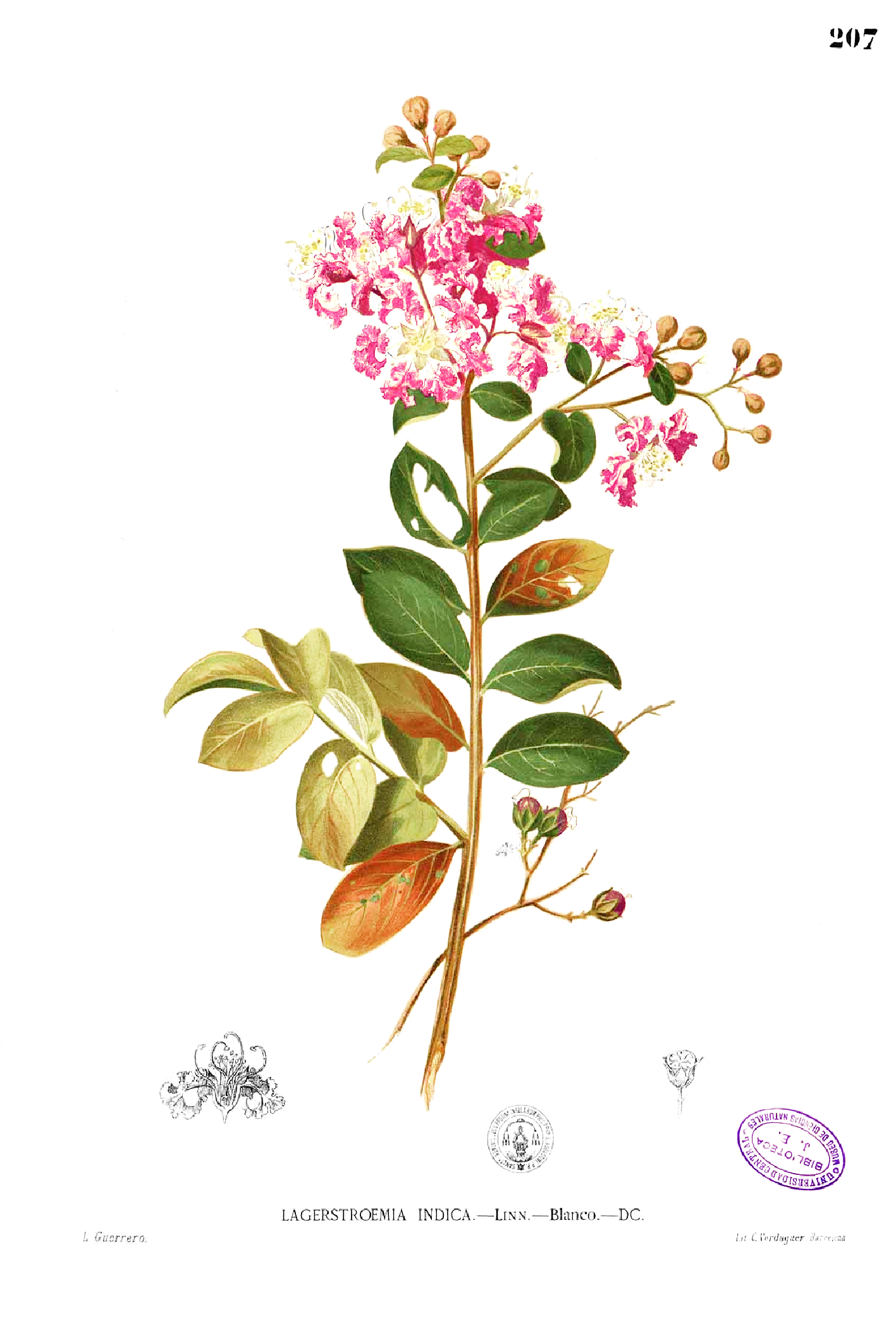
Lagerstroemia is a genus of approximately 50 species of deciduous and evergreen trees and shrubs in the family Lythraceae (the loosestrife family), within the order Myrtales. Plants in the genus range dramatically in size — from compact shrubs under 30 cm tall to canopy trees exceeding 30 m — and are widely recognized for their ornamental qualities, especially their striking summer and autumn flower displays and distinctive mottled bark.
The bark is one of the genus's most recognizable features: sinewy and fluted branches shed their outer layers throughout the year, revealing a smooth, mottled surface in tones of grey, cinnamon, and cream. Leaves are opposite, typically 5–20 cm long with smooth margins. The flowers are borne in large terminal panicles and are notable for their crinkled, crepe-paper-textured petals in shades ranging from deep purple and red through pink to pure white; no blue-flowered forms are known. After flowering, capsule fruits form and split open to release small winged seeds.
Native to a broad arc of tropical and subtropical Asia — including the Indian subcontinent, China, Southeast Asia, Indonesia, and extending to northern Australia — the genus has been widely introduced to warm-temperate and subtropical regions worldwide. In the United States, crape myrtles (particularly L. indica and its hybrids) have become iconic ornamental trees of the South. Most commercial cultivars are hybrids between L. indica and L. fauriei, combining the flower color range of the former with the superior bark interest and disease resistance of the latter.
Beyond their ornamental use, several species provide hard, durable timber used historically for bridges, furniture, and railway sleepers. Traditional medicine in parts of Asia has employed the bark, flowers, leaves, and roots of Lagerstroemia species for a variety of purposes. Ecologically, the genus supports several Lepidoptera; notably, leaves of L. parviflora serve as a food plant for Antheraea paphia, the moth whose larvae produce tassar silk, a commercially important wild silk in India.
Etymology
The genus name Lagerstroemia was coined by Carl Linnaeus and first published in his Systema Naturae, 10th edition, in 1759. It honours Magnus von Lagerström (1696–1759), a Swedish merchant and director of the Swedish East India Company who was personally acquainted with Linnaeus and supplied him with botanical specimens collected during East India Company trading voyages. The common English name "crape myrtle" (also spelled "crepe myrtle") refers to the characteristic crinkled, crepe-paper texture of the flower petals and the superficial resemblance of the leaves to those of true myrtles (Myrtus), to which Lagerstroemia is not closely related.
Distribution
Lagerstroemia is native to a wide tropical and subtropical belt stretching from the Indian subcontinent eastward through mainland and island Southeast Asia — including China, Indochina, the Malay Archipelago, and Indonesia — and reaching northern Australia and parts of Oceania. Within this native range, species occupy diverse habitats from open grassy slopes and cliffs at lower altitudes to forest margins in humid subtropical and tropical zones.
The genus has been extensively introduced beyond its native range. It is particularly well established in the southeastern United States, where L. indica has been cultivated since approximately 1790, and is now naturalized or widely cultivated across the Caribbean islands, the Pacific island nations, and the warmer parts of Europe and Africa.
Ecology
Lagerstroemia species interact with a range of invertebrates in their native range. Several Lepidoptera use species of the genus as larval food plants, including Endoclita malabaricus. Lagerstroemia parviflora is a host plant for Antheraea paphia, the tussah (tassar) silkmoth; this relationship has economic significance, as tassar silk produced by these caterpillars is an important commercial wild silk in parts of India.
In cultivation, the main ecological threats are fungal diseases, particularly powdery mildew, and infestations of aphids and bark scale insects. Alkaline soils can induce chlorosis. Hybrid cultivars derived from L. fauriei typically show significantly better resistance to powdery mildew than cultivars derived from L. indica alone.
Cultivation
Lagerstroemia thrives in full sun — a minimum of six hours of direct sunlight daily is strongly recommended, and more sun generally produces better flowering and reduces disease pressure. Plants prefer average to moderately moist, well-drained soils and tolerate a range of soil textures including loam and clay. Excessively fertile soil tends to promote vegetative growth at the expense of flowers. The genus is notably drought-tolerant once established and shows good tolerance of urban pollution, making it well suited to street and parkway plantings.
Cold hardiness varies by species and cultivar. Most cultivated hybrids and L. indica selections are reliably hardy in USDA zones 6a through 9b; in zones 5–6 plants may be killed to the ground in severe winters but typically resprout vigorously from the roots the following spring. L. speciosa, the queen crape myrtle, is far more tender and limited to frost-free climates such as peninsular Florida, extreme southern Texas, and Hawaii in North American cultivation.
Summer heat is as important as winter cold tolerance — the genus needs long, hot summers to ripen wood sufficiently for good flowering and cold survival. Plants that do not receive adequate summer heat tend to flower less and be more susceptible to winter injury.
In landscape use, Lagerstroemia species and cultivars serve as specimen trees, shrub border plants, screen or hedge material, and container subjects. The genus is particularly valued for multi-season interest: summer flowers, autumn leaf colour, winter bark display, and an attractive branching silhouette.
Cultural Uses
Several Lagerstroemia species have a history of traditional medicinal use across South and Southeast Asia. The stem bark has been employed as a febrifuge, stimulant, and styptic. Bark, flowers, and leaves have been used as a purgative and hydrogogue. Flower pastes are applied externally to cuts and wounds, and flower decoctions are taken for cold symptoms. The root is used as an astringent, detoxicant, and diuretic.
The timber of several species — particularly larger-growing ones — is hard and durable and has been used historically for bridges, building construction, furniture, and railway sleepers, though timber quality varies considerably across the genus. In India, the tussah silk industry has a traditional connection to L. parviflora as a host tree for the Antheraea paphia silkmoth.
History
Lagerstroemia was formally described by Carl Linnaeus in 1759, making it one of many genera established during the landmark 10th edition of Systema Naturae. The common crape myrtle, L. indica, was among the earlier Asian ornamentals to reach Western gardens. It was introduced to North America around 1790, when French botanist André Michaux brought it to Charleston, South Carolina — a port city whose warm, humid climate proved ideal for the species. From there it spread throughout the American South, where it became one of the most widely planted ornamental trees of the 19th and 20th centuries.
The 20th century saw intensive breeding work, much of it by the U.S. National Arboretum, crossing L. indica with the Japanese species L. fauriei to produce hybrid cultivars combining superior disease resistance (especially against powdery mildew) with the broad range of flower colours found in L. indica. Many of the resulting cultivars were given Native American tribal names ('Natchez', 'Sioux', 'Osage', 'Kiowa', 'Fantasy'), a naming convention that became the standard for U.S. National Arboretum crape myrtle releases.
Taxonomy
Lagerstroemia L. (1759) belongs to the family Lythraceae within the order Myrtales. POWO (Plants of the World Online) recognizes 50 accepted species; GBIF records 84 total taxa including infraspecific entities. The genus has accumulated several synonyms over its nomenclatural history, including Adambea Lam., Munchausia L., Fatioa DC., Orias Dode, and Sotularia Raf., reflecting repeated independent descriptions of members of the genus before its circumscription was stabilized.
The most horticulturally significant species are L. indica (the common crape myrtle, native to China and Korea), L. fauriei (Japanese crape myrtle, valued for bark colour and disease resistance), and L. speciosa (queen crape myrtle, the largest-flowered species, tropical in requirements). The interspecific hybrid L. indica × fauriei (often simply marketed as hybrid crape myrtle) dominates commercial horticulture in temperate regions.
Propagation
Lagerstroemia is propagated by several methods. Stem cuttings taken in summer (softwood or semi-hardwood) root readily and are the standard commercial method for replicating named cultivars true to type. Root cuttings are also effective. Seed propagation is straightforward — plants are prolific seed producers — but seedlings are highly variable and will not come true from cultivar seed. Young plants from any propagation method typically flower within their first or second growing season. The genus transplants best when young; established specimens do not move well.










