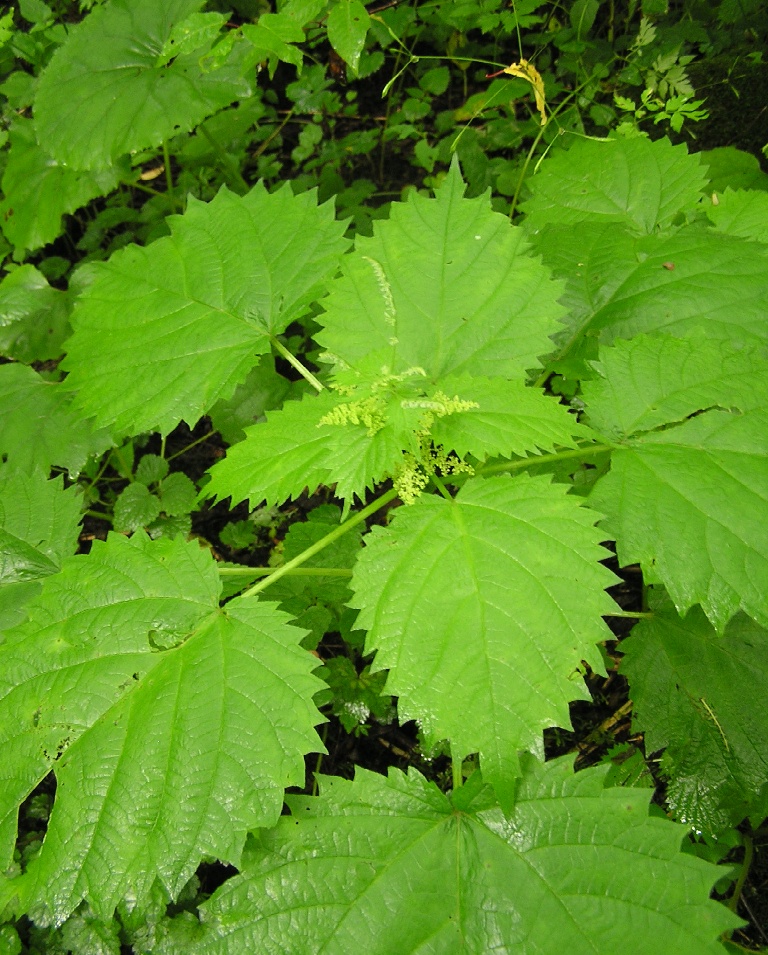
Laportea is a genus of herbaceous flowering plants in the family Urticaceae (the nettle family), placed in the order Rosales. The genus was described by the French botanist Charles Gaudichaud-Beaupré (Gaudich.) and comprises approximately 36 species, distributed across tropical and subtropical regions worldwide.
Plants in this genus are either annual or perennial herbs. A characteristic feature shared with many members of Urticaceae is the presence of stinging hairs (trichomes), which inject irritating compounds on contact. Distinctively, Laportea bears both stinging and non-stinging hairs on the same plant, a trait that helps distinguish it from closely related genera such as Urtica.
The genus has a broad pantropical distribution, with species occurring in Africa, Asia, the Pacific islands, and the Americas. Several species are found in moist forest understories or disturbed habitats, and some — such as Laportea interrupta — are widespread weedy species of tropical regions.
Etymology
The genus name Laportea honours the French naturalist and entomologist Francis de Laporte de Castelnau (1810–1880), who made significant contributions to natural history across multiple disciplines. The genus was formally described by the botanist Charles Gaudichaud-Beaupré.
Distribution
Laportea has a pantropical and subtropical distribution, with species native to Africa, Asia, Australia, Pacific islands, and the Americas. Individual species occupy a range of habitats from moist forest understories to disturbed and ruderal sites. Laportea interrupta is among the most widespread, occurring across much of the humid tropics.
Ecology
Like other members of Urticaceae, Laportea species are wind-pollinated and often grow in disturbed, nutrient-rich, or shaded habitats. The stinging hairs serve as a physical defence against herbivory, injecting formic acid and other irritants upon contact. Some species colonise secondary vegetation and forest margins.
Cultural Uses
Several Laportea species have traditional uses in the regions where they occur. The stinging hairs, though irritating, have been used medicinally in some cultures as a counter-irritant (urticulation therapy). Bast fibres from certain species have historically been used for cordage and weaving in parts of Africa and the Pacific.










