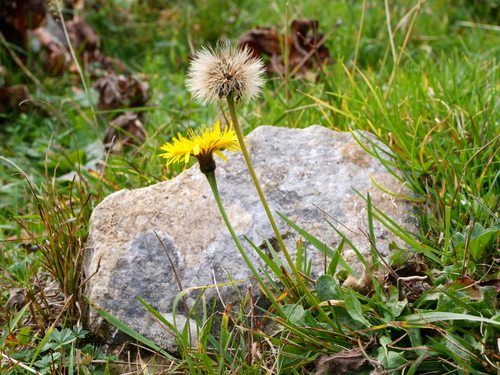
Leontodon is a genus of flowering plants in the tribe Cichorieae, within the daisy family Asteraceae (order Asterales). The genus is commonly known as hawkbits — a name rooted in the medieval belief that hawks consumed the plant to sharpen their eyesight. The genus name itself is derived from the Greek words for "lion" and "tooth," a reference to the characteristically toothed or deeply lobed leaves that are typical of the group.
Plants in the genus are herbaceous perennials or annuals, forming basal rosettes of toothed leaves from which leafless or sparsely-bracted scapes arise, bearing solitary yellow flower heads composed entirely of ray florets — the hallmark arrangement of tribe Cichorieae. The achene fruits are often furnished with a feathery pappus that aids wind dispersal.
Leontodon is native to Eurasia and North Africa, where it occupies grasslands, meadows, roadsides, and disturbed habitats. Several species have become naturalised beyond this native range, notably in the United States and New Zealand.
The circumscription of Leontodon has been substantially revised in recent decades. Research demonstrated that the genus as traditionally defined is polyphyletic. As a result, the former subgenus Oporinia was elevated to generic level; because the name Scorzoneroides holds nomenclatural priority, those members were transferred to the resurrected genus Scorzoneroides. The remaining Leontodon s.str. is thus a more narrowly defined group.
Chemically, Leontodon s.str. is notable as a source of hypocretenolides — unusual guaiane-type sesquiterpene lactones characterised by a 12,5-lactone ring rather than the more common 12,6 arrangement. The genus also yields luteolin-type flavonoids and several caffeoyl derivatives including chlorogenic acid and cichoric acid.
Etymology
The English common name "hawkbit" reflects a medieval belief that hawks ate these plants to maintain or improve their eyesight. The genus name Leontodon is formed from the Greek leōn (lion) and odous/odon (tooth), alluding to the deeply toothed or lobed margins of the basal leaves.
Distribution
Leontodon is naturally distributed across Eurasia and North Africa. Several species have since spread beyond this native range and are now established as naturalised plants in the United States and New Zealand.
Ecology
Seeds of Leontodon species are a recorded food source for certain bird species. The plants are characteristic of open grasslands, meadows, and disturbed ground throughout their native and introduced ranges.
Taxonomy Notes
The traditional circumscription of Leontodon was found to be polyphyletic by molecular research. The former subgenus Oporinia was consequently elevated to genus rank; because Scorzoneroides holds nomenclatural priority over the proposed name, the transferred species now belong to Scorzoneroides. The remaining Leontodon s.str. represents a more narrowly defined, monophyletic lineage in tribe Cichorieae of Asteraceae.
Cultural Uses
On the Greek island of Crete, Leontodon tuberosus is used as a food plant: the tuberous roots are consumed raw, while the leaves are prepared steamed.










