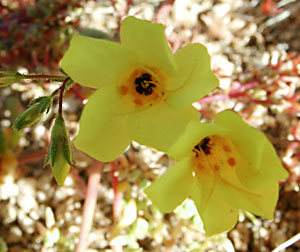
Leptosiphon Benth. is a genus of approximately 32–33 accepted species of flowering plants in the family Polemoniaceae (phlox family), order Ericales. The genus was described by George Bentham in 1833 and is known by a variety of common names including linanthus, flaxflower, babystars, whiskerbrush, and mustang clover, with "linanthus" being the preferred English name according to the Database of Vascular Plants of Canada.
Plants in the genus are annuals or perennials with stems that range from simple to much branched, erect to decumbent, and leafy. Leaves are typically opposite (rarely alternate above) and palmately lobed, with linear, flat to terete lobes. Flowers appear in terminal or axillary compact clusters and come in a range of colours — white, yellow, or lavender — borne on a characteristic narrow corolla tube from which the genus takes its name (Greek lepto-, narrow, + siphon, tube). The calyx bears membranes that are often ruptured or distended in fruit; mature capsules are ovoid to oblong and contain one to several seeds per chamber.
The centre of diversity for Leptosiphon is southwestern North America, particularly California, with additional species extending into Baja California and South America. Several species were formerly classified under the closely related genus Linanthus, from which Leptosiphon was broadly separated following the taxonomic revision by J.M. Porter and L.A. Johnson published in the journal CANOTIA in 2005. Some taxonomic frameworks still treat Linanthus as the accepted genus, while GBIF recognises Leptosiphon as accepted. The genus is also known under the synonyms Dactylophyllum Spach (1840), Linanthastrum Ewan (1942), and Siphonella A.Heller (1912).
Etymology
The genus name Leptosiphon is formed from two Greek elements: lepto- (λεπτός), meaning narrow or slender, and siphon (σίφων), meaning tube or pipe. The name refers to the characteristically narrow floral tube of these plants. The genus was formally described under this name by George Bentham in 1833.
Distribution
Leptosiphon is primarily a western North American genus, with the greatest diversity concentrated in California and adjacent regions of the southwestern United States and Baja California, Mexico. A smaller number of species extend into South America. Occurrence records confirm presence in desert and semi-arid habitats, as illustrated by populations at Joshua Tree National Park, California. The genus is not known to be invasive outside its native range.
Ecology
Leptosiphon species are annuals or perennials that grow in open, often dry habitats. Flowers are borne in terminal or axillary compact clusters, with equal stamen insertion on the corolla — a characteristic of the Polemoniaceae. The calyx membranes are typically ruptured or distended in fruit, aiding seed dispersal. Flower colour varies across the genus from white to yellow and lavender. Mature capsules are ovoid to oblong with one to several seeds per locule.
Cultivation
Some species of Leptosiphon are cultivated as ornamental plants, valued for their delicate, colourful flowers. The genus is represented in horticultural use through species such as L. androsaceus, L. grandiflorus, and L. bicolor, which are grown as annual garden plants or in wildflower seed mixes.
Taxonomy
Leptosiphon Benth. (1833) belongs to the family Polemoniaceae, order Ericales. The GBIF backbone taxonomy accepts the genus as valid with 33 recognised species, while some datasets within GBIF list Linanthus as the accepted name — reflecting an ongoing difference between taxonomic frameworks. The genus bears the synonyms Dactylophyllum Spach (1840), Linanthastrum Ewan (1942), and Siphonella A.Heller (1912).
The modern circumscription of Leptosiphon was substantially shaped by the 2005 treatment by Wilken and Porter published in CANOTIA, as well as the revision by J.M. Porter and L.A. Johnson, which transferred numerous species from Linanthus into Leptosiphon. Many species thus carry the authorship citation "(original author) J.M.Porter & L.A.Johnson".










